


Mcnichols Expanded Metal
In the realm of industrial materials, expanded metal stands as one of the most versatile and cost-effective solutions for structural support, filtration, and safety applications. For many engineers and procurement specialists, the term "McNichols expanded metal" has become synonymous with industry-standard specifications and immediate availability. However, selecting the right expanded metal for demanding industrial environments—particularly in specialized filtration—requires a deep understanding of manufacturing processes, material science, and mechanical performance.
This guide explores the technical nuances of expanded metal, the critical specifications used by industry leaders like McNichols, and how these components are integrated into high-performance industrial systems. Whether you are designing a new filtration unit or sourcing replacement components, understanding these variables is essential for ensuring system longevity and efficiency.
Understanding the Fundamentals of Expanded Metal
Expanded metal is a unique material produced by simultaneously slitting and stretching a solid sheet of metal. Unlike perforated metal, which involves punching holes and generating scrap material, the expansion process creates a diamond-shaped pattern without any waste. This makes it an inherently sustainable and cost-effective choice for industrial applications.
During manufacturing, the metal is fed through a machine equipped with a reciprocating knife. As the knife slits the metal, it also pushes it forward and outward, creating the characteristic diamond openings. The resulting product is a single piece of metal with no joins or welds, which contributes to its exceptional strength-to-weight ratio.
For engineers familiar with McNichols expanded metal, the primary appeal lies in the consistency of the diamond pattern and the breadth of available gauges. However, for those working in the chemical processing or pharmaceutical sectors, the focus shifts from general availability to the specific metallurgical properties and precision of the Perforated & Expanded Metal used in their systems.
Key Technical Specifications for Engineering Design
When specifying expanded metal, engineers must use precise terminology to ensure the final product meets the application's requirements. The industry typically uses four primary measurements to define the geometry of the diamond opening:
1. SWD (Short Way of Design): The distance from the center of one bond to the center of the next bond across the short axis of the diamond.
2. LWD (Long Way of Design): The distance from the center of one bond to the center of the next bond across the long axis of the diamond.
3. SWO (Short Way of Opening): The actual width of the opening, measured from the inside of the bonds across the short axis.
4. LWO (Long Way of Opening): The actual length of the opening, measured from the inside of the bonds across the long axis.
In addition to these dimensions, the Strand Width (the amount of metal between the openings) and Strand Thickness (the thickness of the original base metal) determine the overall strength and open area of the sheet. The open area is a critical calculation for filtration applications, as it directly impacts flow rates and pressure drop across the filter medium.
Material Selection: Optimizing for Durability and Resistance
The environment in which the expanded metal will operate dictates the material selection. While carbon steel is suitable for general-purpose applications like walkways or security fencing, industrial filtration often demands more robust alloys.
Stainless Steel (304 and 316L)
Stainless steel is the gold standard for expanded metal in filtration. Grade 304 offers excellent corrosion resistance for most water treatment and food-grade applications. However, in environments involving high chloride concentrations or aggressive chemicals, Grade 316L is preferred due to its molybdenum content, which provides superior resistance to pitting and crevice corrosion.
Aluminum
Aluminum expanded metal is prized for its lightweight properties and natural resistance to atmospheric corrosion. It is frequently used in HVAC filtration and aerospace applications where weight reduction is a primary engineering goal.
Specialty Alloys
For extreme environments, such as high-temperature chemical reactors or offshore oil platforms, expanded metal can be manufactured from Monel, Inconel, or Titanium. These materials ensure that the structural integrity of the filter cartridge or support screen remains intact despite thermal cycling or corrosive exposure.
Standard vs. Flattened Expanded Metal: Functional Differences
One of the most important decisions an engineer must make is whether to use "Standard" (raised) or "Flattened" expanded metal. This choice significantly affects the mechanical behavior of the material.
Standard Expanded Metal
In its standard form, the strands and bonds are set at a uniform angle to the plane of the sheet. This creates a three-dimensional surface that provides excellent grip (if used for flooring) and high structural rigidity. In filtration, the raised profile can help create turbulence, which may be desirable in certain mixing or heat-exchange applications. However, the raised edges can also capture debris more aggressively, which might complicate cleaning cycles.
Flattened Expanded Metal
Flattened expanded metal is produced by passing the standard expanded sheet through a cold-roll reducing mill. This process levels the strands and bonds, resulting in a smooth, flat surface. Flattened metal is slightly thinner than the original base sheet and the openings are slightly enlarged. In the context of Perforated & Expanded Metal for filtration, flattened surfaces are often preferred as they provide a smooth interface for delicate wire mesh layers, preventing mechanical abrasion and extending the life of the filter element.
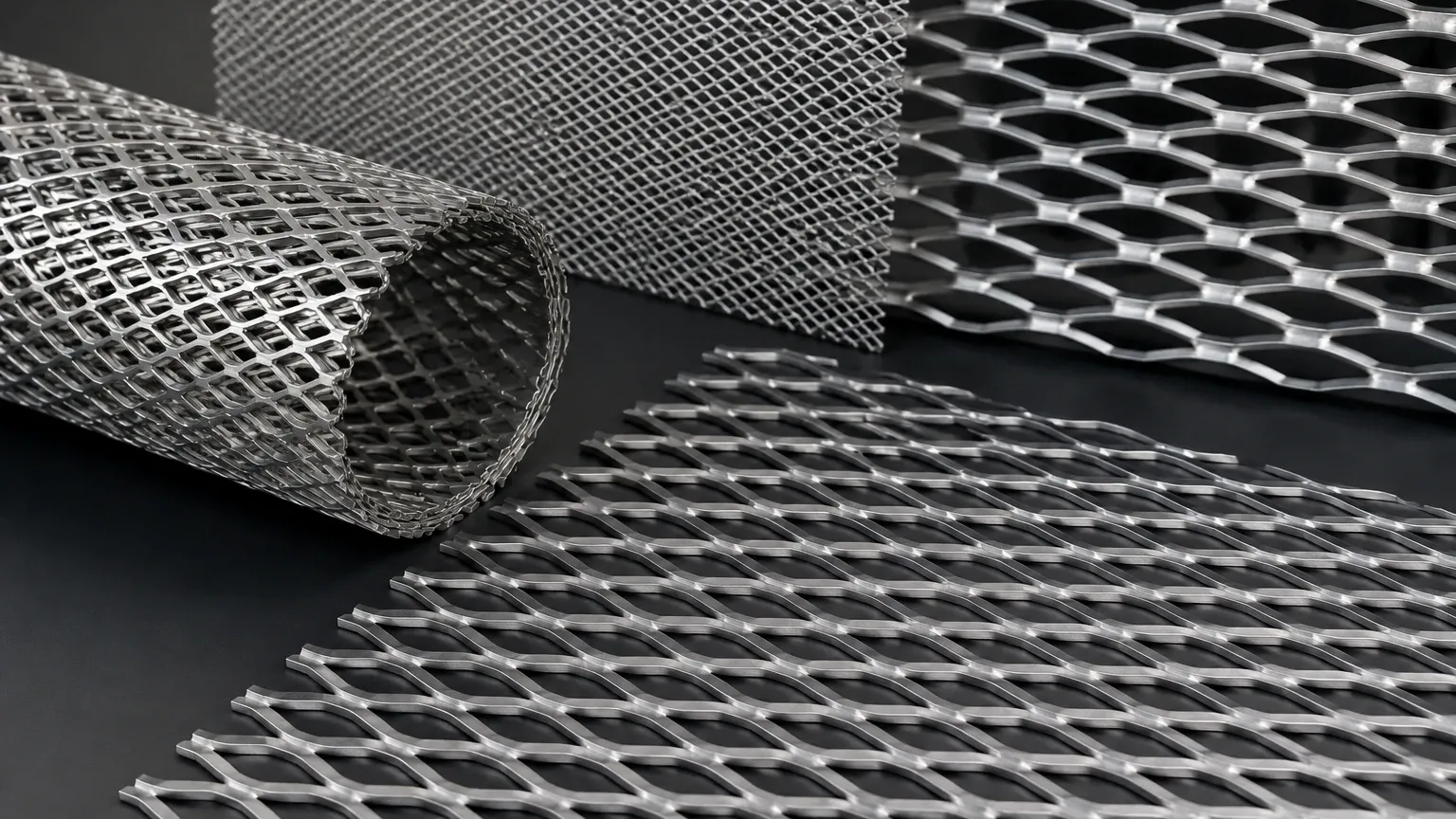
Applications of Expanded Metal in Industrial Filtration Systems
While expanded metal is used in everything from architectural facades to speaker grilles, its role in industrial filtration is foundational. It rarely acts as the primary filtration medium for fine particles; instead, it serves as the "backbone" of the filter assembly.
Support for Wire Mesh
In many liquid and gas filtration systems, the actual filtration is performed by a fine stainless steel wire mesh. Because this mesh is often thin and flexible, it cannot withstand high-pressure differentials on its own. Expanded metal is used as a support cylinder or cage, providing the necessary mechanical strength to prevent the mesh from collapsing or deforming under load.
Pre-Filtration and Coarse Screening
In water treatment and intake systems, expanded metal acts as a primary screen to remove large debris such as leaves, stones, or plastic waste. Its high open area allows for massive flow volumes while protecting downstream pumps and sensitive fine filters from damage.
Diffusers and Flow Stabilizers
Expanded metal can be used within a filter housing to break up laminar flow and distribute the fluid evenly across the entire surface of the filter media. This ensures that the filter is utilized uniformly, preventing "blind spots" and extending the interval between maintenance cycles.
Critical Evaluation Criteria for Procurement and OEM Integration
When purchasing expanded metal or components that incorporate it, such as filter cartridges, procurement teams should evaluate suppliers based on more than just price. The following criteria are essential for industrial-grade performance:
* Dimensional Tolerance: In high-precision machinery, even a slight deviation in the LWD or SWD can prevent a filter from fitting correctly into its housing. Suppliers must demonstrate the ability to maintain tight tolerances across large production runs.
* Edge Treatment: Expanded metal naturally has sharp edges where the diamonds are cut. For OEM applications, it is often necessary to have these edges deburred or to use a "random cut" vs. a "bond cut" to ensure safety and compatibility with other components.
* Cleanliness and Passivation: For pharmaceutical and food-processing applications, the metal must be free of manufacturing oils and residues. Stainless steel components should undergo passivation to restore the protective oxide layer, ensuring maximum corrosion resistance.
* Customization Capabilities: Standard stock sizes, like those found in a McNichols catalog, are excellent for prototyping. However, for full-scale production, engineers often require custom-sized sheets or pre-formed cylinders that reduce assembly time and material waste.
Transitioning from Standard Stock to Custom Filtration Solutions
While distributors like McNichols provide an invaluable service by stocking a wide range of standard expanded metal patterns, many industrial applications eventually require a more tailored approach. This is where the distinction between a general distributor and a specialized manufacturer like Kaifil becomes apparent.
Custom manufacturing allows for the optimization of every variable—from the specific alloy and strand thickness to the exact dimensions of the diamond opening. For engineers developing proprietary filtration systems, the ability to specify a custom Perforated & Expanded Metal component can lead to significant improvements in system efficiency and a reduction in the total cost of ownership.
When moving from a standard specification to a custom solution, it is vital to confirm the following with your manufacturing partner:
1. Pressure Requirements: What is the maximum differential pressure the component must withstand?
2. Chemical Compatibility: Will the material be exposed to caustic cleaning agents or acidic process fluids?
3. Integration Method: Will the expanded metal be welded, crimped, or mechanically fastened into the final assembly?
By addressing these technical considerations early in the design phase, engineering teams can ensure that their choice of expanded metal provides the reliability and performance required for demanding industrial environments. Whether you are utilizing the industry-standard patterns popularized by McNichols or seeking a fully customized filtration component, a deep understanding of these metal-forming principles is the key to successful application engineering.
