


Metal Perforated Pattern
In industrial filtration and structural engineering, the selection of a specific metal perforated pattern is far more than an aesthetic choice. It is a critical engineering decision that dictates the flow dynamics, structural integrity, and filtration efficiency of a component. For engineers and procurement specialists sourcing Perforated & Expanded Metal, understanding the technical nuances of hole geometry, pitch, and orientation is essential to ensuring the longevity and performance of the final product.
Perforated metal serves as the backbone for many industrial filtration systems, often acting as a support cage for fine wire mesh or as a primary strainer for coarse particles. Because these components must withstand high differential pressures, corrosive environments, and mechanical stress, the configuration of the perforations must be precision-engineered to meet the specific demands of the application.
The Fundamentals of Metal Perforated Pattern Geometry
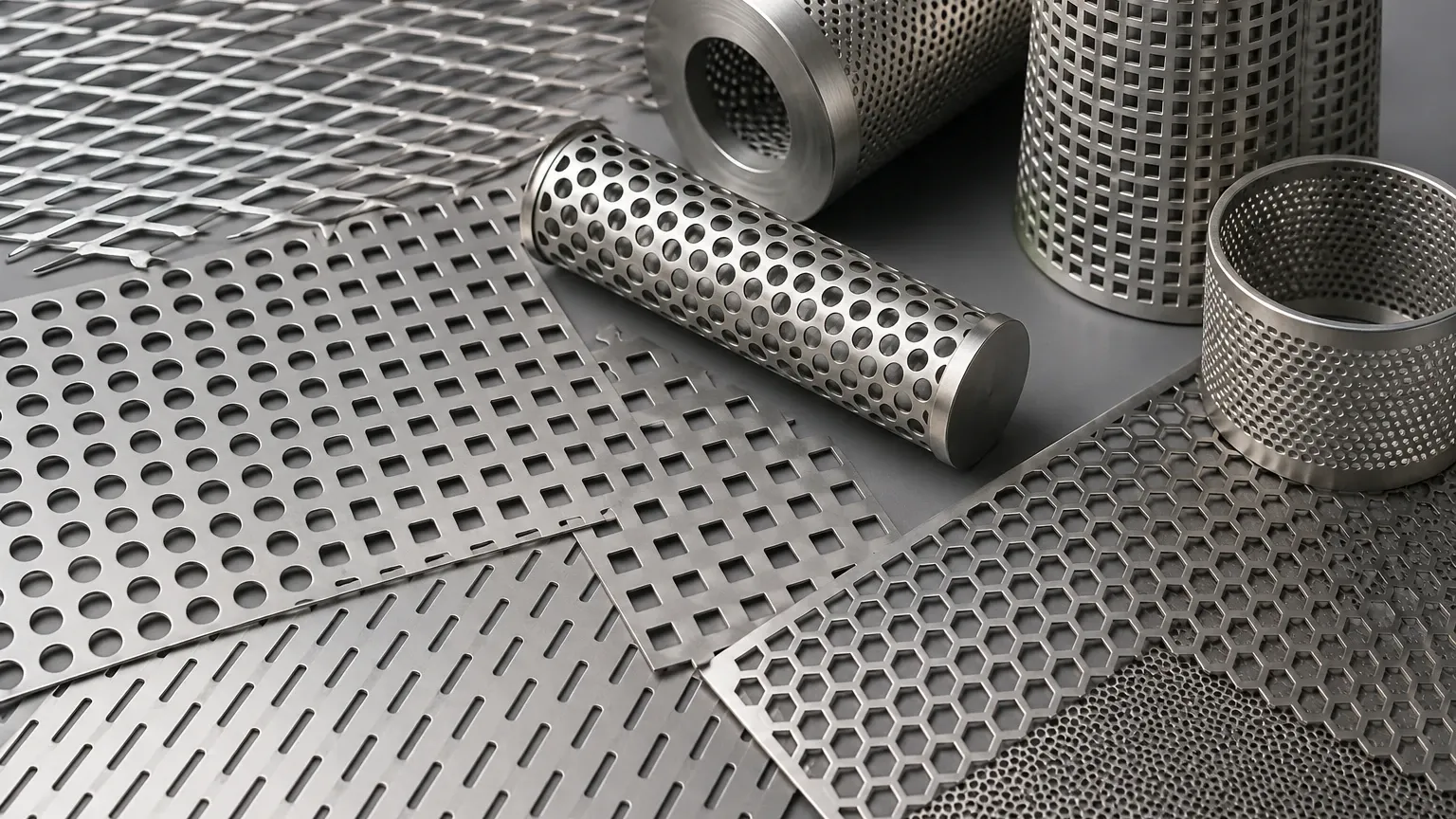
The geometry of a perforation determines how a fluid or gas interacts with the medium. While custom shapes are possible, four primary patterns dominate the industrial landscape due to their predictable performance and manufacturing efficiency.
Round Hole Patterns
Round holes are the industry standard for the majority of filtration applications. They offer a balanced combination of high structural strength and a wide range of open area percentages. From a manufacturing perspective, round holes are the most efficient to produce, leading to lower tooling costs and faster production cycles. In filtration, the circular shape provides a uniform distribution of stress across the plate, reducing the risk of fatigue cracking under pulsating loads.
Square Hole Patterns
Square holes are often selected when a higher open area is required without significantly increasing the hole size. They are commonly used in applications where high visibility or maximum airflow is prioritized. However, engineers must account for the stress concentrations that occur at the corners of the squares, which can make the plate more susceptible to mechanical failure compared to round hole designs.
Slotted and Rectangular Patterns
Slotted patterns are specifically engineered for the filtration of viscous fluids or for sorting elongated particles. In the context of industrial strainers, slotted holes help prevent "blinding" or clogging by allowing certain particle shapes to pass or be rejected more effectively than circular apertures. These are frequently used in the pulp and paper industry and in food processing applications.
Hexagonal Patterns
Hexagonal patterns, often referred to as "honeycomb," provide the highest possible open area—often exceeding 80%. This pattern is ideal for applications requiring maximum airflow and minimal weight, such as EMI/RFI shielding or high-volume air filtration. Despite the high open area, the hexagonal structure retains surprising rigidity due to the consistent width of the "bridges" between the holes.
Pattern Orientation: Staggered vs. Straight
The orientation of the metal perforated pattern significantly impacts both the mechanical strength and the flow characteristics of the material.
60-Degree Staggered Pattern
This is the most popular configuration for industrial use. In a 60-degree staggered pattern, the holes in subsequent rows are offset so that each hole is equidistant from its neighbors. This arrangement provides the highest degree of structural uniformity. For filtration, it ensures that the fluid flow is distributed evenly across the entire surface of the filter element, preventing localized high-velocity zones that could damage secondary filter media like wire mesh.
45-Degree Staggered Pattern
Similar to the 60-degree version, this pattern offers an offset arrangement but with a different aesthetic and slightly different mechanical properties. It is less common in heavy-duty industrial filtration but is used in specialized architectural and acoustic applications.
Straight Row Pattern
In a straight row pattern, holes are aligned both horizontally and vertically. While this is simpler for certain alignment tasks, it creates "break lines" or weak points along the rows. Under high pressure, a straight-row perforated plate is more likely to bend or fail along these lines compared to a staggered pattern. Consequently, straight patterns are generally avoided in high-pressure hydraulic or chemical processing applications.
Calculating Open Area and Flow Capacity
The "Open Area" is the total area of the holes expressed as a percentage of the total area of the sheet. This is the most critical metric for engineers, as it directly influences the pressure drop ($ΔP$) across the filter.
For a standard 60-degree staggered round hole pattern, the open area (OA) is calculated using the formula:
$$OA = \frac{D^2 \times 90.69}{P^2}$$
Where:
* D = Hole Diameter
* P = Pitch (the center-to-center distance between holes)
Selecting the correct open area requires a trade-off. A higher open area reduces the resistance to flow and lowers energy costs for pumps and compressors. However, as the open area increases, the amount of base metal (the "bridges") decreases, which reduces the structural integrity of the component. For high-pressure applications, such as those found in hydraulic systems, engineers typically specify a lower open area to ensure the filter cartridge does not collapse under load.
Structural Integrity and Material Thickness
The relationship between the hole diameter, the pitch, and the material thickness is vital for a successful design. A common rule of thumb in the perforation industry is that the hole diameter should not be smaller than the material thickness. For example, if you are using a 3mm thick stainless steel plate, the minimum recommended hole diameter is also 3mm.
Attempting to punch holes smaller than the material thickness significantly increases the risk of tool breakage and can result in irregular hole shapes or excessive burrs. If an application requires extremely fine filtration in a thick plate, alternative methods like laser cutting or chemical etching may be required, though these are typically more costly than traditional punching.
Furthermore, the "bridge" or "bar" width—the distance between the edges of adjacent holes—must be sufficient to maintain the plate's flatness during the manufacturing process. If the bridges are too narrow, the material may warp or stretch during perforation, necessitating secondary leveling processes.
Material Selection for Industrial Environments
The performance of a metal perforated pattern is heavily dependent on the alloy used. Since many industrial filters operate in aggressive chemical environments or at high temperatures, material selection is paramount.
* Stainless Steel 304: The most common grade for general industrial use, offering good corrosion resistance and excellent formability. It is suitable for water treatment and general industrial strainers.
* Stainless Steel 316L: Containing molybdenum, 316L provides superior resistance to chlorides and pitting. It is the standard for marine environments, chemical processing, and pharmaceutical applications where hygiene and corrosion resistance are critical.
* Duplex Stainless Steels: For high-stress environments involving highly corrosive media, Duplex alloys offer twice the strength of standard austenitic grades and exceptional resistance to stress corrosion cracking.
* Carbon Steel: Used primarily in applications where corrosion is not a primary concern or where the component will be coated or galvanized. It is a cost-effective choice for structural supports and coarse air intake screens.
Manufacturing Precision and Quality Control
When sourcing Perforated & Expanded Metal, technical professionals must define the required tolerances for their specific project. In high-precision filtration, even minor deviations in hole size or pitch can lead to bypass or inconsistent flow rates.
Burr Removal and Surface Finish
The punching process naturally creates a "die side" and a "punch side." The die side often has a small burr or sharp edge. For filtration applications involving delicate secondary media, such as fine wire mesh, these burrs must be removed through deburring or polishing to prevent abrasion and premature failure of the mesh.
Margins and Unperforated Areas
Engineers must specify the "margins"—the unperforated areas around the edges of the sheet. Margins are essential for welding the perforated plate into a cylinder for a filter cartridge or for bolting it into a frame. Providing clear specifications for margins ensures that the pattern is centered and that the structural integrity of the weld zones is maintained.
Flatness and Stress Relieving
The perforation process introduces significant internal stresses into the metal sheet. This can cause the material to curl or bow. High-quality manufacturers utilize precision leveling rollers to ensure the finished product meets flatness specifications, which is critical for subsequent assembly or automated welding processes.
Application-Specific Pattern Selection
Hydraulic and Lube Oil Filtration
In these applications, perforated metal usually serves as a support tube for pleated glass fiber or wire mesh media. The pattern must provide maximum support to prevent the media from collapsing under high differential pressure, while maintaining enough open area to keep the pressure drop within acceptable limits. A 60-degree staggered round hole pattern is almost universally used here.
Food and Beverage Processing
Hygiene is the priority in this sector. Patterns must be selected that are easy to clean and do not have "dead zones" where bacteria can accumulate. Stainless steel 316L with a polished finish and a round hole pattern is the standard, as it allows for efficient Clean-in-Place (CIP) cycles.
Chemical and Petrochemical
These environments often involve high temperatures and corrosive fluids. The thickness of the perforated plate is often increased to provide a corrosion allowance, ensuring the filter remains functional even after years of surface oxidation. The metal perforated pattern must be designed to withstand the thermal expansion and contraction cycles inherent in these processes.
Conclusion: Specifying Your Requirements
To ensure the success of an industrial filtration project, engineers should provide manufacturers like Kaifil with a comprehensive set of specifications. This includes the material grade, sheet thickness, hole diameter, pitch, pattern orientation (staggered or straight), and the required margins.
By carefully considering the relationship between the metal perforated pattern and the operational environment, technical teams can optimize their filtration systems for maximum efficiency, reduced maintenance, and a lower total cost of ownership. Whether you are designing a high-pressure hydraulic filter or a large-scale chemical strainer, the precision of the perforation is the foundation of reliable performance.
