


Perforated Metal Pattern
In industrial filtration and structural engineering, the selection of a perforated metal pattern is far more than an aesthetic choice. It is a critical engineering decision that dictates the flow dynamics, structural integrity, and filtration efficiency of a component. For engineers and procurement specialists sourcing components for chemical processing, food and beverage production, or hydraulic systems, understanding how the geometry of a perforation influences performance is essential for optimizing the lifespan and reliability of industrial equipment.
At Kaifil, we specialize in the precision manufacturing of Perforated & Expanded Metal solutions. These components often serve as the structural backbone or the primary media for industrial filters. By analyzing the technical variables of different patterns, engineering teams can ensure their filtration systems meet specific pressure drop requirements and mechanical stress tolerances.
Understanding the Fundamentals of Perforated Metal Patterns
A perforated metal pattern is defined by three primary variables: the hole shape, the hole size, and the arrangement (or pitch). While modern CNC and high-speed punching technology allow for nearly any geometric configuration, most industrial applications rely on standardized patterns that offer predictable mechanical properties.
The most common arrangements include staggered and straight-line configurations. A staggered pattern, typically set at a 60-degree angle, is the industry standard for filtration applications. This arrangement maximizes the number of holes per square inch, providing a higher open area percentage and more uniform structural strength across the sheet. In contrast, straight-line patterns align holes in parallel rows and columns, which may be preferred for specific aesthetic or mechanical tracking requirements but often result in lower overall open areas and reduced structural rigidity.
When selecting a perforated metal pattern, engineers must also consider the "bridge"—the distance of solid metal between the holes. The bridge width is a determining factor in the material's ability to withstand internal or external pressures without deforming. In high-pressure hydraulic or steam applications, a wider bridge may be necessary, even if it slightly reduces the flow rate.
Engineering the Open Area: Impact on Flow and Pressure Drop
The "open area" is the percentage of the total surface area of the sheet that is occupied by the perforations. This metric is the most critical factor in determining the flow capacity and pressure drop (delta P) of a filter element. A higher open area allows for greater throughput and lower resistance to flow, which reduces energy consumption in pumping systems.
However, increasing the open area via a specific perforated metal pattern involves a trade-off with mechanical strength. For instance, a pattern with a 60% open area will naturally be more susceptible to buckling under vacuum or high-pressure conditions than a pattern with a 30% open area.
To calculate the open area for a standard 60-degree staggered round hole pattern, engineers use the following logic:
`Open Area % = (D² × 90.69) / R²`
Where *D* is the hole diameter and *R* is the center-to-center pitch.
In filtration design, the goal is often to match the open area of the perforated support tube to the flow characteristics of the filter media (such as wire mesh or fiber felt). If the support tube's open area is too low, it becomes a bottleneck, causing localized high-velocity zones that can prematurely degrade the filter media. Conversely, if the pattern is too sparse, the media may lack the necessary support, leading to pleat collapse or media migration.
Comparative Analysis of Hole Shapes and Arrangements
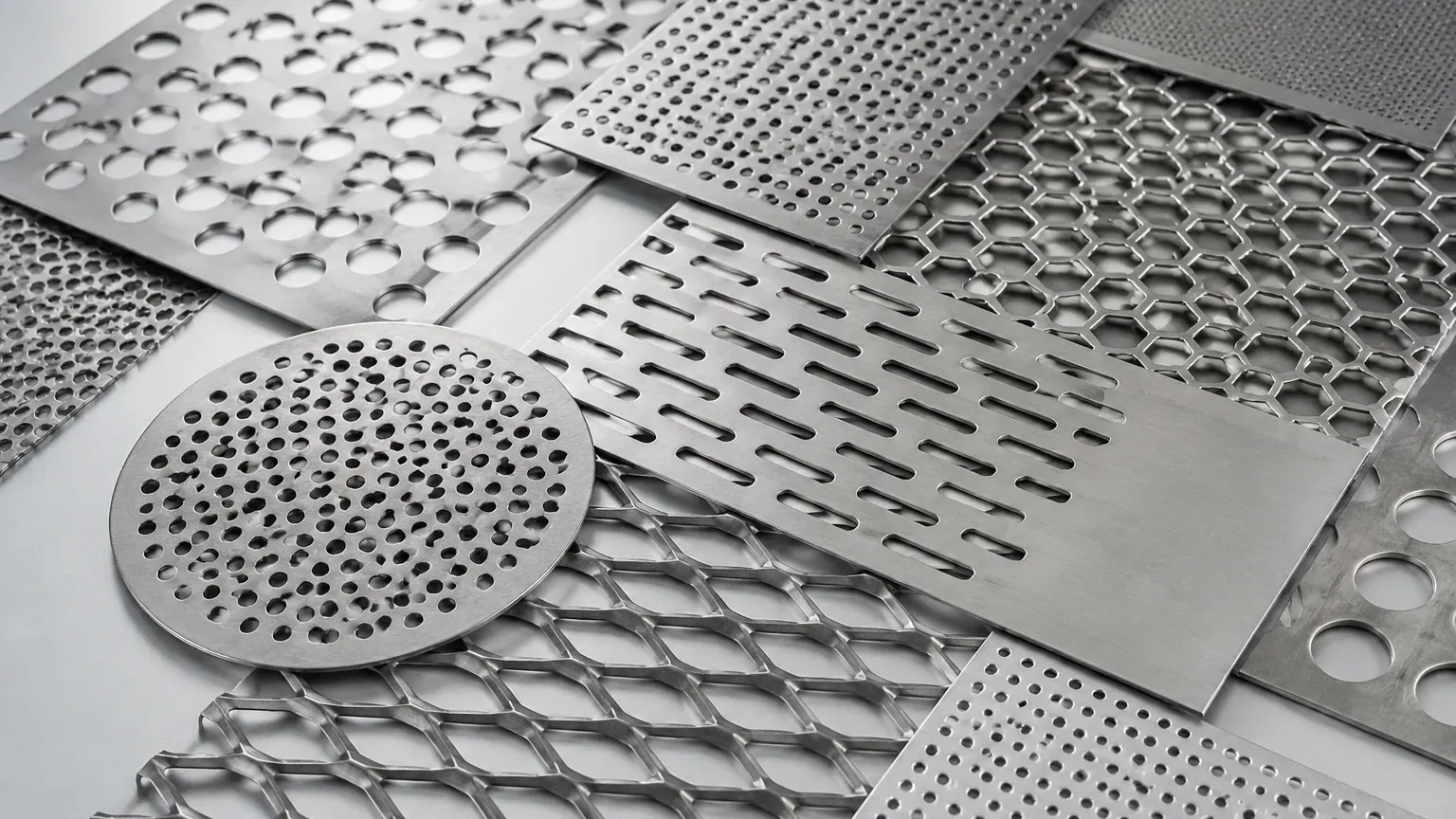
The geometry of the hole itself influences how fluids and particles interact with the surface. While round holes are the most prevalent due to ease of manufacturing and uniform stress distribution, other shapes offer unique advantages in specialized B2B applications.
Round Holes
Round holes are the most cost-effective and structurally sound option. They provide a balanced distribution of mechanical stress, making them ideal for cylindrical filter cartridges. In a 60-degree staggered perforated metal pattern, round holes offer the best combination of high open area and structural stiffness.
Square Holes
Square holes provide a significantly higher open area than round holes of the comparable width. This makes them suitable for high-flow applications where pressure drop must be kept to an absolute minimum. However, square holes create stress concentrations at the corners, which can lead to material fatigue or cracking in high-vibration environments.
Slotted and Oblong Holes
Slotted patterns are frequently used in solid-liquid separation where the particles are elongated or where the filter must act as a primary screen for fibrous materials. Slotted patterns can be oriented either parallel or perpendicular to the direction of flow, depending on the specific mechanical requirements of the vibrating screen or filter housing.
Hexagonal (Honeycomb) Patterns
Hexagonal patterns offer the highest possible open area (approaching 80% or more) while maintaining a reasonable degree of structural integrity. These are often used in specialized air filtration or electromagnetic interference (EMI) shielding, where maximum transparency to air or waves is required without sacrificing the metal's framing role.
Structural Integrity and Material Considerations
The performance of a perforated metal pattern is inextricably linked to the material thickness and the alloy used. In industrial filtration, stainless steel (Grade 304, 316, or 316L) is the preferred choice due to its corrosion resistance and mechanical durability.
When designing a filter cartridge, the "thickness-to-hole-diameter" ratio is a vital engineering constraint. Generally, the hole diameter should not be smaller than the material thickness. For example, if a project requires a 2mm thick stainless steel support tube, the perforated metal pattern should ideally feature holes of 2mm or larger. Attempting to punch holes smaller than the material thickness increases tool wear and risks structural micro-fractures around the hole edges, which can become sites for stress corrosion cracking in aggressive chemical environments.
Furthermore, the direction of the pattern relative to the grain of the metal affects the flexibility of the sheet. For components that need to be rolled into tight cylinders, such as small-diameter filter cartridges, the pattern must be oriented to allow for uniform bending without kinking or "orange-peeling" the metal surface.
Manufacturing Precision and Customization Requirements
For B2B procurement, the ability to customize a perforated metal pattern is essential for meeting specific OEM requirements. Standard off-the-shelf patterns may not always align with the precise flow calculations of a proprietary filtration system.
Kaifil provides extensive customization options for Perforated & Expanded Metal, including:
* Custom Pitch and Margin Configurations: We can design patterns with specific "solid zones" or margins to facilitate welding or mounting without interfering with the perforation. This is particularly important for filter end-caps and longitudinal seams.
* Precision Deburring: In filtration, any burr or sharp edge left by the punching process can trap contaminants or damage delicate wire mesh layers. Our manufacturing process ensures that the perforated pattern is clean and smooth, preserving the integrity of the secondary filter media.
* Material Selection: Beyond standard stainless steel, we work with specialized alloys for high-temperature or highly corrosive environments, ensuring the pattern maintains its geometry under extreme conditions.
When evaluating a supplier, engineers should confirm the tolerances for both hole diameter and pitch. In high-precision applications, even a 5% deviation in open area can lead to significant performance variances across a production batch.
Selection Criteria for Industrial Applications
Choosing the right perforated metal pattern requires a holistic view of the application environment. Here are the key criteria that technical teams should evaluate before finalizing a design:
1. Fluid Viscosity and Flow Rate: Higher viscosity fluids require larger hole sizes and higher open areas to prevent excessive backpressure.
2. Particulate Loading: If the perforated metal is acting as the primary filter, the hole size must be precisely calibrated to the minimum particle size to be retained. If it is a support structure, the pattern must be dense enough to prevent the primary media from extruding through the holes under pressure.
3. Chemical Compatibility: The pattern’s surface area exposure increases in high-open-area designs. If the fluid is corrosive, the material grade (e.g., 316L) becomes even more critical to prevent pitting within the perforations.
4. Mechanical Loading: Will the component be subject to hydraulic shock, vibration, or heavy cake loading? These factors dictate the minimum bridge width and material thickness required to prevent structural failure.
5. Cleaning and Maintenance: For reusable filters, the pattern should be easy to backwash or CIP (Clean-in-Place). Round holes are generally easier to clean than square or slotted patterns, which may have corners where debris can accumulate.
Conclusion
The engineering of a perforated metal pattern is a foundational element of industrial filtration design. By balancing open area, hole geometry, and structural margins, manufacturers can create components that offer high throughput, low pressure drop, and exceptional durability. Whether used as a protective outer guard, a central support core, or a primary screening surface, the precision of the perforation directly impacts the total cost of ownership and the efficiency of the industrial process.
For technical teams seeking to optimize their filtration systems, selecting a partner with deep manufacturing expertise in Perforated & Expanded Metal is vital. Kaifil remains committed to providing the technical guidance and high-quality stainless steel components necessary to meet the demanding requirements of modern industrial applications. By focusing on precision patterns and robust material selection, we help our clients achieve reliable, long-term filtration performance in even the most challenging environments.
