


Metal Perforations
In industrial filtration and structural engineering, metal perforations serve as a foundational technology for fluid dynamics, particle separation, and component reinforcement. These engineered openings, created through high-precision punching or laser-cutting processes, allow for the controlled passage of gases or liquids while maintaining the structural integrity of the base material. For engineers and procurement specialists, selecting the correct perforation specification is critical to ensuring the efficiency and longevity of filtration systems, particularly in demanding environments such as chemical processing, pharmaceutical manufacturing, and water treatment.
Understanding the technical nuances of metal perforations—including hole patterns, open area percentages, and material compatibility—is essential for optimizing system performance. As a specialized manufacturer, Kaifil provides customized Perforated & Expanded Metal solutions designed to meet the rigorous standards of industrial applications where durability and precise filtration accuracy are non-negotiable.
Engineering Fundamentals of Metal Perforations
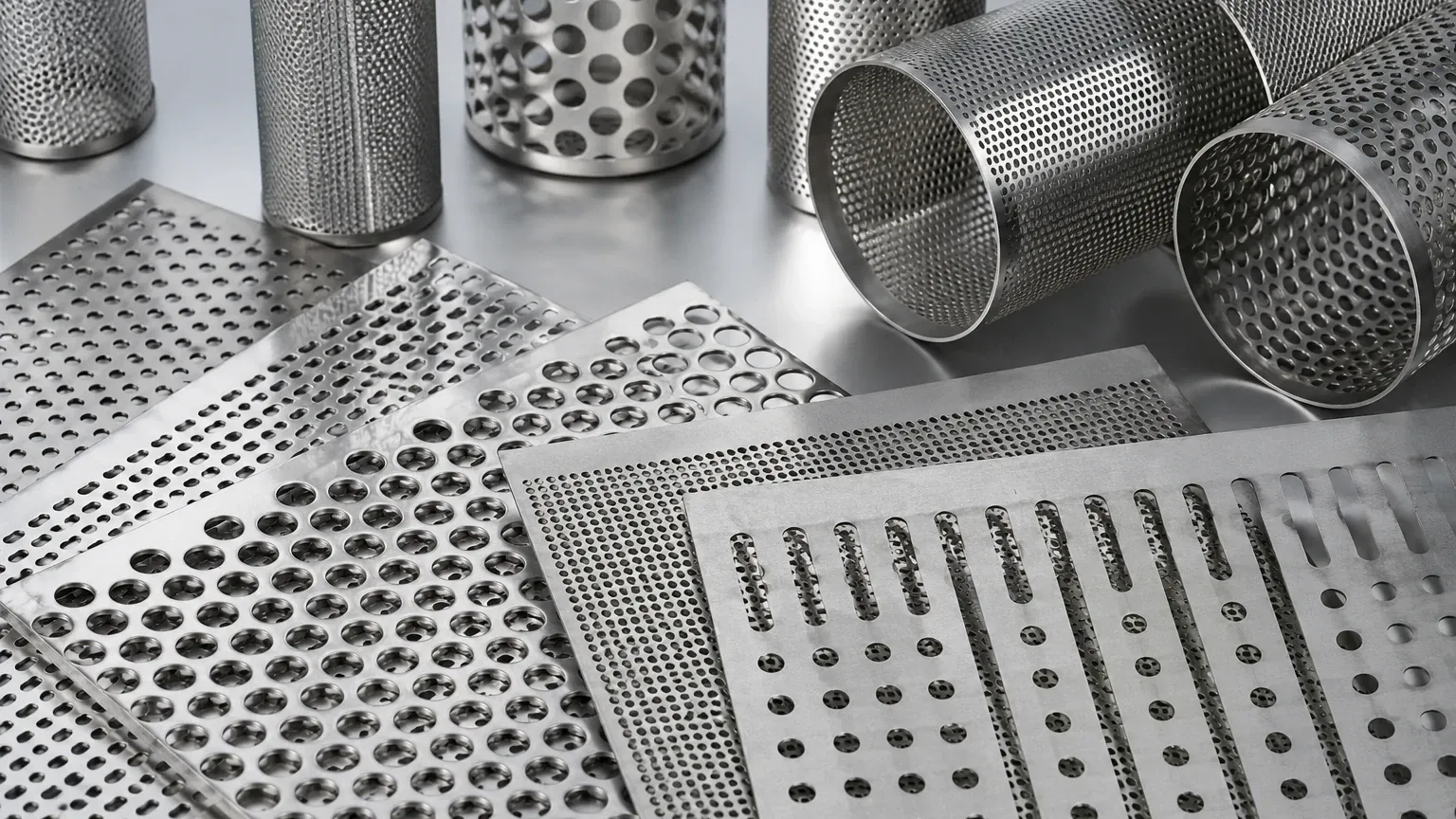
The performance of a perforated metal component is primarily dictated by its geometric configuration. Engineers must balance the need for high flow rates with the requirement for mechanical strength. The most common configuration is the round hole, typically arranged in a 60-degree staggered pattern. This specific alignment is favored because it provides the highest open area while maintaining the strongest structural bridge between holes.
Open Area Calculations
The "Open Area" is perhaps the most critical metric in filtration design. It represents the percentage of the sheet that is occupied by holes versus solid metal. A higher open area reduces pressure drop across the filter but may compromise the material's ability to withstand high differential pressures. The formula for a 60-degree staggered round hole pattern is:
Open Area % = (D² × 90.69) / P²
Where *D* is the hole diameter and *P* is the center-to-center pitch. Accurate calculation of these parameters ensures that the filter media can handle the required flow velocity without premature failure or excessive energy consumption in pumping systems.
Hole Geometry and Flow Characteristics
While round holes are the industry standard, other metal perforations are utilized for specific technical requirements:
* Square Holes: Offer a high open area but are more susceptible to stress fractures at the corners.
* Slotted Holes: Ideal for vibrating screens or applications where elongated particles must be oriented for separation.
* Hexagonal Patterns: Provide maximum open area (up to 80%) for high-flow gas applications where structural load is minimal.
Material Selection for Industrial Environments
The choice of substrate material is as important as the perforation pattern itself. In industrial filtration, the material must resist corrosion, withstand thermal cycling, and prevent contamination of the process stream.
Stainless Steel Grades
Most high-performance metal perforations are manufactured from stainless steel due to its inherent resistance to oxidation and chemical attack.
* Type 304: The standard grade for general industrial use, offering good corrosion resistance and excellent formability. It is widely used in food and beverage applications where hygiene is paramount.
* Type 316/316L: Contains molybdenum, which provides superior resistance to chlorides and pitting. This is the preferred choice for marine environments, chemical processing, and pharmaceutical filtration where aggressive cleaning agents or corrosive fluids are present.
* Specialty Alloys: For extreme conditions, materials like Monel, Inconel, or Hastelloy may be used to resist high temperatures or highly acidic environments.
Kaifil specializes in processing these high-grade materials, ensuring that the perforation process does not compromise the metallurgical properties of the alloy, such as its corrosion-resistant passive layer.
Comparing Perforated and Expanded Metal in Filtration
When designing a filtration system, engineers often choose between perforated metal and expanded metal. While they may appear similar, their manufacturing processes and mechanical properties differ significantly.
Perforated Metal
Perforated metal is produced by punching holes into a solid sheet. This process allows for precise control over hole size and placement. It is ideal for applications requiring exact filtration ratings or specific margins (solid borders) for welding and assembly. However, the punching process creates "slugs" or waste material, which can influence the total cost of high-value alloys.
Expanded Metal
Expanded metal is created by simultaneously slitting and stretching the metal sheet. This process produces diamond-shaped openings without any material waste, making it a cost-effective alternative for support structures. In filtration, Perforated & Expanded Metal components often serve different roles: perforated metal is frequently used as the primary filtration surface or a rigid core tube, while expanded metal is often utilized as a protective outer wrap or a support layer for finer wire mesh media.
Technical Specifications and Manufacturing Tolerances
For industrial-grade metal perforations, adherence to strict tolerances is necessary to ensure compatibility with other system components like end caps, housings, and gaskets. Key technical specifications that must be confirmed during the design phase include:
1. Gauge/Thickness: The thickness of the material affects both the weight and the pressure rating of the filter. Standard thicknesses range from thin foils for precision mesh support to heavy plates for high-pressure hydraulic cores.
2. Margins: These are the solid areas around the edges of the perforated sheet. Specifying "no margins" or "finished margins" is crucial for welding integrity. Unfinished margins (where holes are cut off at the edge) can create sharp points and structural weaknesses.
3. Flatness: The punching process can introduce internal stresses that cause the metal to curl. Precision leveling is often required post-perforation to ensure the sheet remains flat for subsequent rolling or welding operations.
4. Burr Control: In pharmaceutical and food-grade applications, the presence of burrs (small metal protrusions) is unacceptable as they can trap contaminants or break off into the process stream. High-quality manufacturing includes deburring processes to ensure a smooth, clean surface.
Applications in Industrial Filtration and Support
Metal perforations are integrated into various filtration architectures to provide both functional separation and mechanical stability.
Filter Core Tubes
In many cartridge filters, a perforated metal tube serves as the internal skeleton. This core must withstand the collapse pressure exerted by the fluid as it flows from the outside in. By selecting the appropriate hole pattern and wall thickness, engineers can design cores that support high-viscosity fluids or high-pressure surges without deformation.
Pre-Filtration and Strainers
For large-particle removal, perforated metal acts as the primary filter medium. These strainers are common in water treatment and chemical intake lines, protecting downstream pumps and sensitive instrumentation from debris. The durability of stainless steel perforations allows these components to be cleaned and reused, reducing the total cost of ownership compared to disposable plastic alternatives.
Media Support and Protection
Fine wire mesh filters often lack the structural rigidity to withstand high flow rates. In these designs, perforated metal is used as a support layer (backing) or a protective outer shroud. This prevents the delicate mesh from tearing or pleat-bunching under operational stress.
Selection Criteria for Procurement and Engineering
Before finalizing a purchase order for metal perforations, technical teams should evaluate several factors to ensure the component is fit for purpose.
* Filtration Accuracy: Does the hole size match the required particle retention? If the required rating is finer than what standard punching can achieve, a multi-layer composite involving wire mesh and perforated support may be necessary.
* Flow Dynamics: Has the pressure drop been calculated based on the open area? Minimizing pressure drop is essential for reducing energy costs in continuous-flow industrial processes.
* Environmental Compatibility: Is the selected alloy resistant to the specific chemicals and temperatures of the application? For instance, 316L is necessary for high-chloride environments to prevent stress corrosion cracking.
* Customization and OEM Requirements: Many industrial systems require non-standard dimensions or unique hole configurations. Working with a manufacturer like Kaifil allows for customized designs that integrate seamlessly into existing equipment housings.
* Total Cost of Ownership (TCO): While specialized alloys or precision deburring may increase the initial purchase price, they often result in longer service life and reduced maintenance downtime, providing better long-term value.
Conclusion
Metal perforations are more than just holes in a sheet; they are precision-engineered components that dictate the efficiency, safety, and reliability of industrial filtration systems. By understanding the relationship between hole patterns, material properties, and manufacturing tolerances, engineers can select the optimal Perforated & Expanded Metal solution for their specific application. Whether the goal is to provide a rigid support core for a hydraulic filter or a corrosion-resistant strainer for chemical processing, the technical details of the perforation process remain the key to successful industrial performance.
