


Perforated Metal 3d Warehouse
In the contemporary landscape of industrial design and mechanical engineering, the transition from conceptualization to physical production relies heavily on digital precision. The use of a perforated metal 3d warehouse—a digital repository of pre-modeled components—has become a standard starting point for architects and engineers. These assets allow for rapid prototyping and visualization within software environments like SketchUp, AutoCAD, or Revit. However, for industrial filtration and high-performance applications, a 3D model is only as valuable as its alignment with manufacturing realities.
When specifying Perforated & Expanded Metal for industrial use, engineers must look beyond the visual aesthetics provided by generic 3D assets. While a model in a 3D warehouse might represent a pattern of holes or diamonds, it often lacks the critical metadata required for filtration efficiency, structural load-bearing calculations, and material behavior under thermal stress. This guide explores how to bridge the gap between digital 3D models and the procurement of high-precision metal filtration components.
The Evolution of Digital Assets in Industrial Design
The concept of a 3D warehouse serves as a collaborative hub where designers share geometric representations of industrial materials. For perforated metal, these models typically define the hole shape, pitch, and sheet thickness. In the early stages of a project, such as designing a chemical processing vessel or a large-scale water treatment intake, these models help in spatial planning and aesthetic approval.
However, the primary limitation of a standard perforated metal 3d warehouse file is the lack of technical depth. In a B2B procurement context, the geometry is only one part of the equation. Engineers must consider the manufacturing process—whether the metal is punched (perforated) or slit and stretched (expanded). Each process imparts different physical characteristics to the final product. For instance, expanded metal provides a unique structural rigidity and a three-dimensional profile that a flat 2D-to-3D perforated model cannot accurately simulate without high-fidelity rendering and physics-based modeling.
Technical Specifications for Perforated & Expanded Metal
To move from a digital model to a functional component, several technical parameters must be defined with precision. At Kaifil, we emphasize that the performance of a filter cartridge or screen is dictated by these specific variables:
Hole Patterns and Geometry
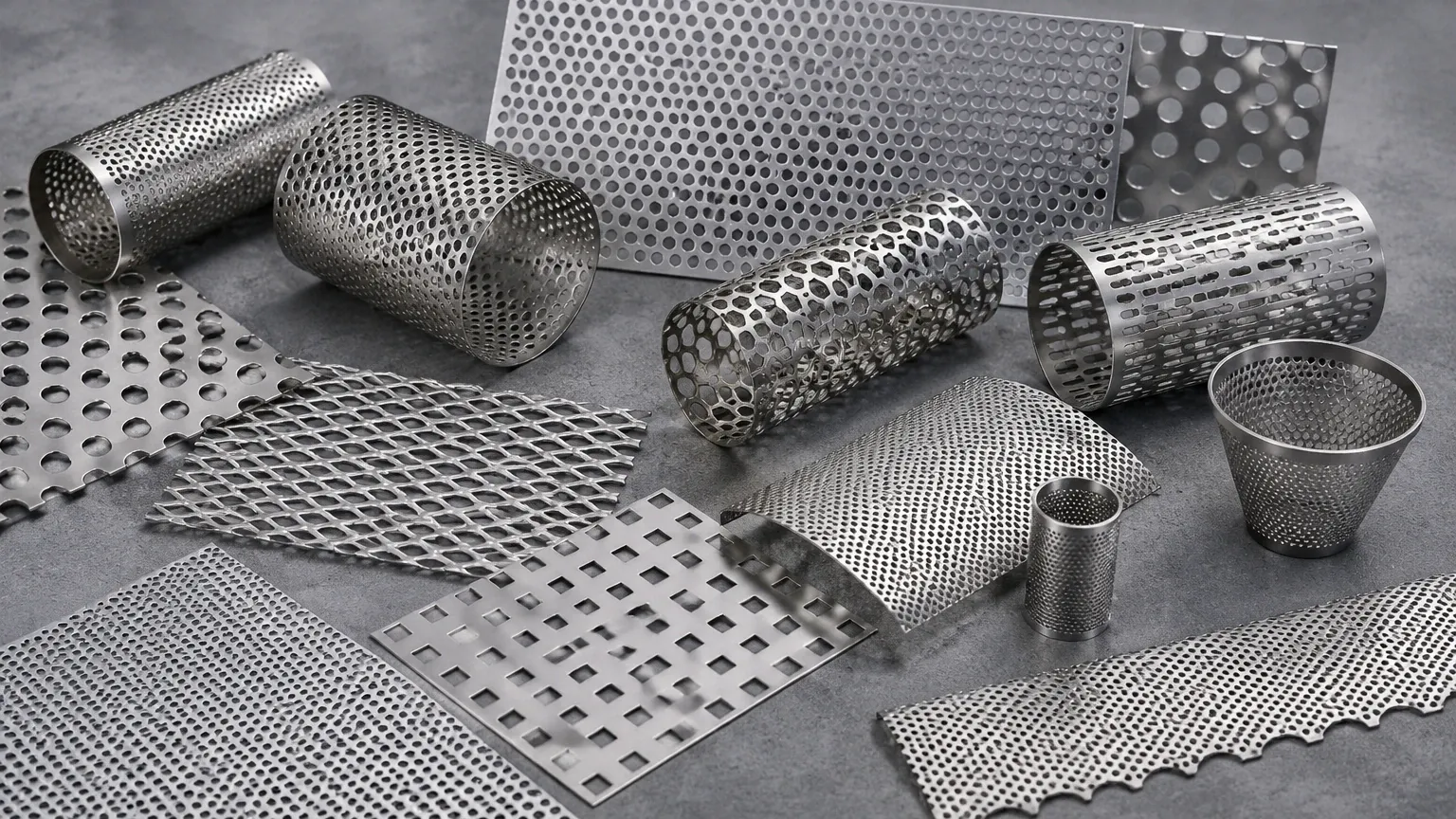
Perforated metal can be manufactured with various hole shapes, including round, square, slotted, and hexagonal. Round holes are the most common for industrial filtration due to their structural integrity and ease of cleaning. The arrangement—whether staggered (60-degree or 45-degree) or straight—significantly impacts the flow rate and the strength of the sheet.
Pitch and Bridge
The "pitch" is the distance from the center of one hole to the center of the adjacent hole. The "bridge" is the solid material remaining between the holes. In a digital model found in a perforated metal 3d warehouse, these might be approximated. In reality, the bridge must be thick enough to maintain the structural integrity of the filter under high pressure, yet thin enough to maximize the open area for flow efficiency.
Expanded Metal Characteristics
Unlike perforated metal, expanded metal is created by slitting and stretching the material simultaneously. This results in diamond-shaped openings. Key specifications include the Long Way of Diamond (LWD) and Short Way of Diamond (SWD), as well as the strand width and thickness. These dimensions determine the mesh's ability to catch debris while allowing fluid to pass through with minimal pressure drop.
Evaluating Open Area and Filtration Efficiency
One of the most critical calculations for any engineer is the "percentage of open area." This figure determines the flow capacity and the pressure drop across the filtration medium. A common pitfall when using generic assets from a perforated metal 3d warehouse is the failure to account for how the open area changes if the material is subsequently formed into a cylinder or pleated.
For a standard 60-degree staggered round hole pattern, the formula for open area is:
Open Area % = (D² × 90.69) / P²
*(Where D = Hole Diameter and P = Pitch)*
In industrial applications such as food and beverage processing or pharmaceutical manufacturing, achieving a specific open area is non-negotiable. If the open area is too low, the system will experience excessive backpressure, leading to pump strain and increased energy consumption. If it is too high, the structural integrity of the filter may be compromised, leading to premature failure under hydraulic shock.
Material Selection for Demanding Industrial Environments
A 3D model identifies the shape, but the material choice determines the lifespan of the component. When sourcing Perforated & Expanded Metal, the environment in which the filter will operate dictates the alloy selection:
* Stainless Steel 304/304L: The industry standard for general-purpose filtration. It offers excellent corrosion resistance and is suitable for most food-grade applications.
* Stainless Steel 316/316L: Contains molybdenum, which provides superior resistance to chlorides and acids. This is the preferred choice for marine environments, chemical processing, and pharmaceutical cleanrooms.
* Specialty Alloys: For high-temperature or highly corrosive environments, alloys like Monel, Inconel, or Hastelloy may be required.
When engineers download a model from a perforated metal 3d warehouse, they must manually overlay these material properties onto their simulations. Factors such as the thermal expansion coefficient and the yield strength of the specific alloy will determine how the perforated sheet behaves when welded into a filter cartridge or subjected to high-pressure backwashing cycles.
From Conceptual 3D Models to Precision Manufacturing
The transition from a CAD drawing to a finished product involves several manufacturing steps that are rarely captured in a digital asset. At Kaifil, our OEM and customization process addresses the nuances that a perforated metal 3d warehouse cannot:
1. Leveling: The punching process often causes the metal sheet to warp. Industrial-grade perforated metal must undergo precision leveling to ensure it is perfectly flat before it is rolled or welded.
2. Degreasing and Cleaning: Especially in the pharmaceutical and food industries, the removal of lubricants used during the perforation process is vital. We ensure that components meet stringent cleanliness standards.
3. Deburring: Punching holes creates sharp edges or "burrs" on the exit side of the tool. For filtration applications, these burrs can trap contaminants or damage sensitive filter membranes. Precision deburring is a standard part of our production workflow.
4. Custom Margins: A digital model often shows a continuous pattern. In reality, a filter sheet requires "margins"—solid areas around the edges—to facilitate clean welding and structural mounting. We customize these margins based on the final assembly requirements of the filter housing.
Common Risks in Using Generic 3D Assets for Engineering
Relying solely on a perforated metal 3d warehouse for engineering specifications carries significant risks. One major issue is the "moiré effect" or visual aliasing in digital models, which can hide the actual density of the holes. More importantly, generic models do not account for the "minimum hole size vs. material thickness" rule.
In manufacturing, it is generally difficult to punch a hole that is smaller in diameter than the thickness of the material. For example, if an engineer designs a 3D model with 1mm holes in a 2mm thick stainless steel plate, they may find that this is either impossible to manufacture or prohibitively expensive due to frequent tool breakage. By consulting with a professional manufacturer like Kaifil, engineers can optimize their designs for manufacturability (DfM), ensuring that the Perforated & Expanded Metal components are both functional and cost-effective.
Quality Control and Performance Validation
For B2B buyers, the total cost of ownership is a primary concern. This includes the initial purchase price, the ease of installation, and the replacement cycle. While a 3D warehouse model helps with the installation design, it does not provide data on the expected service life.
Kaifil implements rigorous quality control measures to ensure that every component matches the engineered specifications. This includes:
* Dimensional Inspection: Using precision calipers and optical measurement systems to verify hole diameters and pitch.
* Material Certification: Providing mill test reports (MTRs) to confirm the chemical composition of the stainless steel.
* Pressure Testing: For custom filter cartridges, we can simulate operating conditions to ensure the perforated support core can withstand the required differential pressure.
Conclusion: Selecting the Right Partner for Metal Filtration
While a perforated metal 3d warehouse is an excellent tool for the initial visualization of a project, the complexities of industrial filtration demand a deeper level of technical engagement. Whether you are designing a custom hydraulic filter, a chemical strainer, or an architectural screen with specific acoustic properties, the choice of perforated or expanded metal must be grounded in empirical data and manufacturing capability.
Kaifil specializes in transforming these digital concepts into high-performance, durable filtration solutions. By focusing on precision engineering, material integrity, and customized design, we support global industries in achieving efficient and reliable filtration. When your project moves beyond the 3D model and requires physical components that meet exact industrial standards, our team is ready to provide the technical expertise and manufacturing support necessary for success.
