


Perforated Metal Acoustic Wall Panels
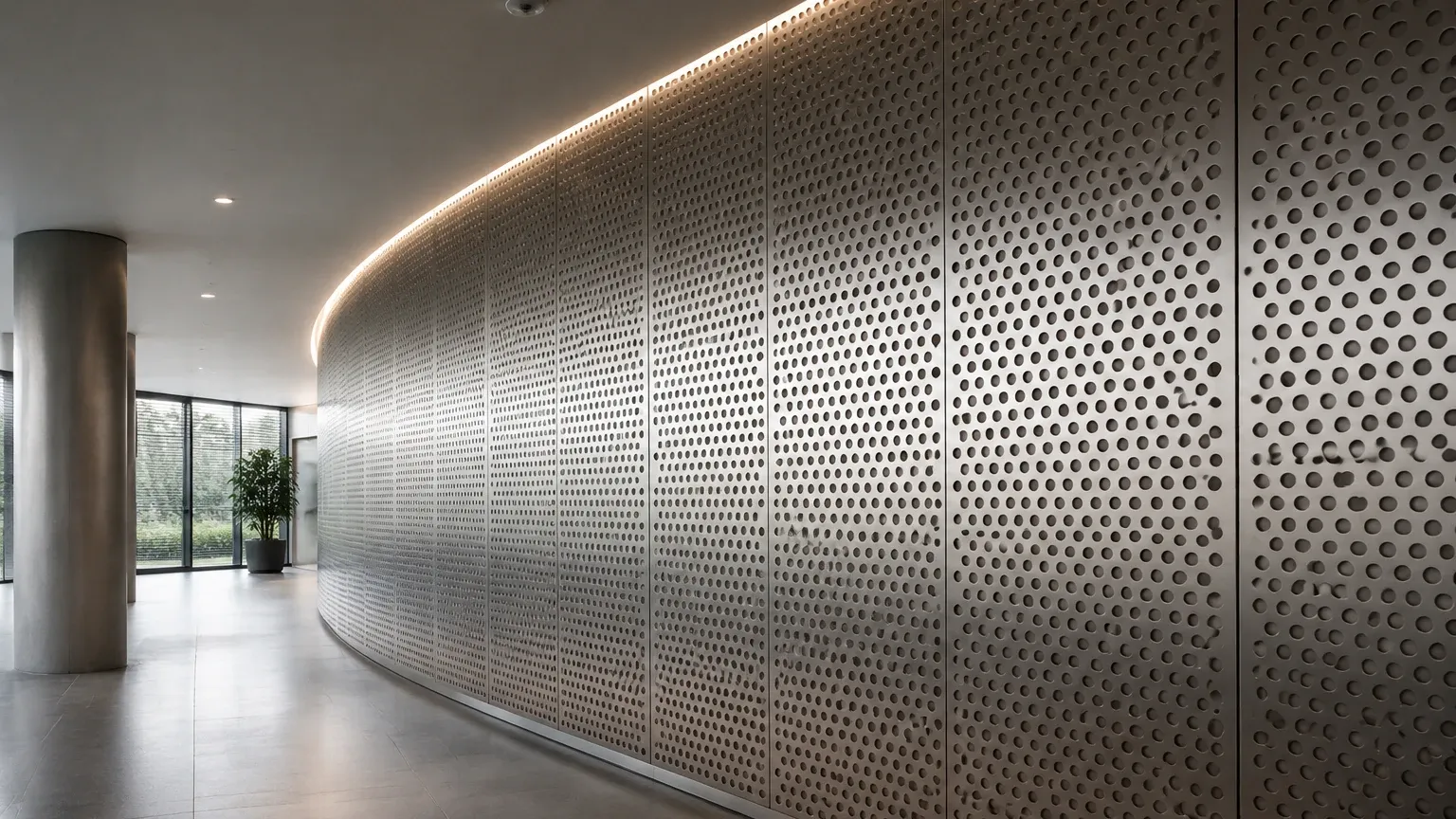
In industrial and commercial environments, noise control is a critical engineering requirement that impacts both personnel safety and operational efficiency. Perforated metal acoustic wall panels represent a specialized solution designed to manage sound reverberation while maintaining the structural integrity and durability required in demanding settings. Unlike soft acoustic treatments, metal panels offer a combination of impact resistance, fire safety, and longevity that is essential for power plants, manufacturing facilities, and chemical processing units.
Selecting the right Perforated & Expanded Metal configuration for acoustic applications requires an understanding of how hole patterns, material thickness, and open area percentages interact with sound waves. This guide provides a technical overview of the engineering principles, material considerations, and selection criteria for industrial acoustic panels.
Understanding the Mechanics of Sound Absorption in Metal Panels
It is a common misconception that the metal itself absorbs sound. In a perforated metal acoustic wall panel system, the metal sheet acts as a "transparent" face. Its primary function is to allow sound waves to pass through the perforations into an acoustic absorbent material—typically mineral wool or fiberglass—housed behind the panel.
The Role of Sound Transparency
When sound waves strike a solid surface, they reflect, creating echoes and increasing the overall decibel level. Perforated metal breaks this reflection. The sound waves pass through the holes and become trapped in the porous core material, where the sound energy is converted into low-grade heat through friction.
For the panel to be effective, it must have sufficient "open area." If the open area is too low, the panel acts more like a solid reflector. Conversely, if the open area is too high, the panel may lose the structural rigidity required to protect the insulation or withstand industrial impacts. Engineers typically aim for an open area between 20% and 50% for optimal acoustic transparency in industrial wall systems.
Key Engineering Parameters: Open Area and Hole Patterns
The performance of perforated metal acoustic wall panels is dictated by the geometry of the perforations. Precision manufacturing ensures that these parameters are consistent across the entire surface of the panel, preventing "dead zones" in sound absorption.
Calculating Open Area
The percentage of open area is the ratio of the total area of the holes to the total area of the sheet. For a standard 60-degree staggered round hole pattern—the most common for acoustic applications—the formula is:
Open Area % = (D² × 90.69) / P²
*Where D = Hole Diameter and P = Pitch (the distance between the centers of two adjacent holes).*
Impact of Hole Size and Pitch
While the total open area is the primary driver of sound transparency, the specific hole size and pitch also influence performance. Smaller, more frequent holes generally provide better sound transparency for high-frequency noise, whereas larger holes may be sufficient for lower-frequency industrial hums. In most B2B applications, round holes are preferred due to their structural stability and ease of manufacturing. However, square or slotted holes can be utilized for specific aesthetic or airflow requirements without significantly compromising acoustic performance, provided the open area remains consistent.
Material Selection for Industrial Durability
In industrial filtration and acoustic environments, material selection is dictated by the operating atmosphere. Kaifil specializes in high-performance metals that ensure the acoustic system remains functional over a long service life.
1. Stainless Steel (304 and 316): This is the gold standard for acoustic panels in chemical processing, food and beverage, and pharmaceutical facilities. Stainless steel offers superior corrosion resistance, especially in environments where panels are subject to washdowns or chemical vapors. 316 stainless steel is particularly recommended for marine or highly corrosive environments due to its molybdenum content.
2. Aluminum: Often selected for its high strength-to-weight ratio and natural resistance to atmospheric corrosion. Aluminum panels are easier to install in large-scale wall applications and are non-magnetic, making them suitable for specialized electronic or medical testing environments.
3. Galvanized Steel: A cost-effective solution for indoor industrial environments where moisture and chemical exposure are minimal. The zinc coating provides a baseline of protection against oxidation.
Integrating Acoustic Media and Scrims
The efficacy of perforated metal acoustic wall panels depends heavily on the "sandwich" construction. The perforated metal protects the internal components, but the internal components do the heavy lifting of sound attenuation.
Acoustic Fill Materials
* Mineral Wool: Preferred for its high fire resistance (non-combustible) and excellent absorption across a wide frequency range. It is often used in high-heat industrial environments.
* Fiberglass: A lightweight alternative that provides high Noise Reduction Coefficient (NRC) ratings.
The Importance of Acoustic Scrim
In many industrial applications, particularly in the food, beverage, and pharmaceutical sectors, it is vital to prevent the fibers of the acoustic fill from migrating through the perforations into the environment. A thin, non-woven black acoustic scrim or a specialized plastic film is often placed between the metal and the fill. This scrim must be acoustically transparent while acting as a physical barrier to particulates. For cleanroom or sterile environments, the fill may be completely encapsulated in a heat-sealed poly-bag.
Performance Evaluation: NRC and STC Ratings
When specifying perforated metal acoustic wall panels, engineers rely on two primary metrics to evaluate performance:
Noise Reduction Coefficient (NRC)
The NRC is a scalar representation of the amount of sound energy absorbed by a surface. It ranges from 0.0 (total reflection) to 1.0 (total absorption). A well-designed industrial perforated metal panel system with a 2-inch mineral wool core can achieve an NRC of 0.90 to 1.00. This means it absorbs 90% to 100% of the sound energy that hits it.
Sound Transmission Class (STC)
While NRC measures absorption *within* a room, STC measures how much sound is blocked from passing *through* a wall to the other side. Perforated panels are primarily used for absorption (NRC). If sound blocking is the goal, the perforated panel is usually combined with a solid metal backing or a heavy mass layer to increase the STC rating.
Customization and OEM Manufacturing Considerations
Industrial projects rarely utilize "off-the-shelf" solutions. Customization is necessary to accommodate specific wall dimensions, structural supports, and environmental challenges. When working with a manufacturer like Kaifil, several customization factors should be confirmed during the design phase:
* Margins and Borders: Panels often require unperforated borders (margins) to facilitate mounting or welding. Specifying the exact width of these margins is crucial for a clean installation.
* Panel Gauges: The thickness of the metal (gauge) affects the panel's ability to span distances without sagging. For wall panels, 18-gauge to 22-gauge is common, depending on the material and the level of impact resistance required.
* Finishing: Beyond the base material, panels can be powder-coated or PVDF-coated to match architectural requirements or provide an additional layer of chemical resistance.
* Forming: Panels can be flanged or bent into "pans" to provide additional stiffness and a recessed area for the acoustic insulation.
Installation and Maintenance in Industrial Settings
The longevity of an acoustic wall system depends on proper installation and a maintenance schedule that accounts for the specific industrial environment.
Mounting Systems
Most perforated metal acoustic wall panels are installed using Z-clips, hat channels, or direct-screw methods. In high-vibration environments, such as near heavy machinery or compressors, isolation gaskets should be used between the panel and the mounting structure to prevent mechanical rattling.
Maintenance and Replacement Cycles
In environments with high dust or particulate matter, the perforations can become clogged over time, which reduces the system's acoustic transparency.
* Cleaning: Stainless steel panels can often be cleaned with low-pressure air or vacuuming. In food-grade environments, panels designed for washdown must have encapsulated insulation to prevent water saturation.
* Inspection: Regular inspections should check for signs of corrosion (especially at mounting points) and ensure that the acoustic fill has not settled or degraded due to moisture.
Conclusion for Engineering and Purchasing Teams
Perforated metal acoustic wall panels are a sophisticated engineering solution that balances acoustic physics with industrial durability. For B2B procurement and engineering teams, the focus should remain on the technical specifications—material grade, open area percentage, and NRC requirements—to ensure the system meets the specific needs of the facility.
By selecting high-quality Perforated & Expanded Metal components and partnering with a manufacturer capable of precise customization, companies can achieve long-term noise control that withstands the rigors of industrial operations. Before finalizing a specification, confirm the environmental conditions, the target noise frequencies, and the required fire ratings to ensure the chosen panel configuration provides the optimal total cost of ownership.
