


Perforated Metal Designs
In industrial filtration and structural engineering, perforated metal serves as a foundational component that balances mechanical strength with precise permeability. Engineering effective perforated metal designs requires a deep understanding of material science, fluid dynamics, and manufacturing tolerances. For technical professionals and purchasing teams, selecting the right configuration is not merely about aesthetics; it is about optimizing flow rates, ensuring structural integrity under pressure, and extending the service life of filtration systems.
As a specialized manufacturer, Kaifil provides custom stainless steel filtration solutions where Perforated & Expanded Metal often acts as the primary support or the functional media itself. This guide explores the technical parameters of perforated metal designs, helping engineers navigate the complexities of selection, customization, and application.
The Engineering Principles of Perforated Metal Designs
The performance of a perforated metal sheet is determined by the interaction of several geometric variables. When designing a component for industrial use, engineers must define the hole shape, the pattern arrangement, and the spacing between perforations.
Hole Shapes and Their Functional Roles
While custom shapes are possible, most industrial applications rely on three primary geometries:
1. Round Holes: The most common and cost-effective design. Round holes offer the best structural stability and are the easiest to manufacture with high precision. They are ideal for liquid filtration and air diffusion.
2. Square Holes: These provide a higher open area percentage compared to round holes of the same diameter. They are often used in applications requiring maximum throughput, though they may have slightly lower structural rigidity under high-pressure loads.
3. Slotted Holes: Elongated perforations are particularly effective for filtering viscous fluids or materials with irregular particle shapes. They are frequently used in vibrating screens and centrifugal filters.
Pattern Arrangements
The arrangement of holes significantly impacts the strength of the material and the uniformity of the flow. The two standard configurations are:
* Staggered Patterns (60-Degree): This is the industry standard for most perforated metal designs. The 60-degree staggered layout provides the highest strength-to-weight ratio and ensures uniform wear on the punching tools during manufacturing.
* Straight Line Patterns: Holes are aligned in both horizontal and vertical rows. While simpler to visualize, this pattern is generally weaker than staggered arrangements and is typically reserved for specific aesthetic or alignment-heavy applications.
Material Selection: Balancing Corrosion Resistance and Strength
In demanding environments such as chemical processing or pharmaceutical manufacturing, the choice of material is as critical as the perforation design itself. Stainless steel is the preferred choice due to its durability and resistance to oxidation.
Common Stainless Steel Grades
* Grade 304: The standard "18/8" stainless steel. It offers excellent corrosion resistance in most atmospheric conditions and is widely used in food and beverage applications.
* Grade 316/316L: Containing molybdenum, these grades offer superior resistance to chlorides and pitting. They are essential for marine environments, chemical processing plants, and pharmaceutical filtration where aggressive cleaning agents are used.
* Specialty Alloys: For extreme temperatures or highly acidic environments, alloys like Duplex stainless steel or Hastelloy may be required to prevent premature failure of the perforated metal designs.
When selecting a material, engineers must also consider the thickness (gauge). Thicker materials provide greater pressure resistance but may limit the minimum hole size achievable through traditional punching methods. Generally, the hole diameter should not be smaller than the material thickness to ensure clean perforations and tool longevity.
Calculating Open Area and Its Impact on Filtration Efficiency
The "Open Area" is the percentage of the total sheet area that is occupied by the perforations. This metric is the primary driver of flow capacity and pressure drop across the filter media.
The Calculation Formula
For a standard 60-degree staggered round hole pattern, the formula is:
Open Area % = (D² × 90.69) / R²
* D: Hole diameter
* R: Center-to-center pitch (distance between the centers of two adjacent holes)
An increased open area reduces the pressure drop, allowing for higher flow rates. However, there is a technical trade-off: as the open area increases, the structural integrity of the sheet decreases. In high-pressure hydraulic or water treatment applications, perforated metal designs must maintain enough "bridge" (the metal between holes) to prevent buckling or tearing under the force of the fluid.
Structural Integrity and Mechanical Properties
Perforated metal is rarely used in isolation; it often serves as a support cage for fine wire mesh or as a protective shroud for delicate filter elements. Therefore, its mechanical properties under load are paramount.
Yield Strength and Stiffness
Perforating a metal sheet inherently reduces its stiffness. Engineers must account for the "Equivalent Solid Material" properties when performing stress analysis. Factors such as the direction of the stagger (parallel or perpendicular to the load) can influence how the material deforms under stress.
Margins and Blank Areas
Custom perforated metal designs allow for the inclusion of unperforated margins. Margins are essential for welding the perforated sheet into a cylinder or mounting it into a frame. Specifying "no margins" (perforated to the edge) can lead to sharp edges and potential structural weaknesses at the attachment points. At Kaifil, we work with engineers to define precise margin dimensions that facilitate seamless integration into final assemblies.
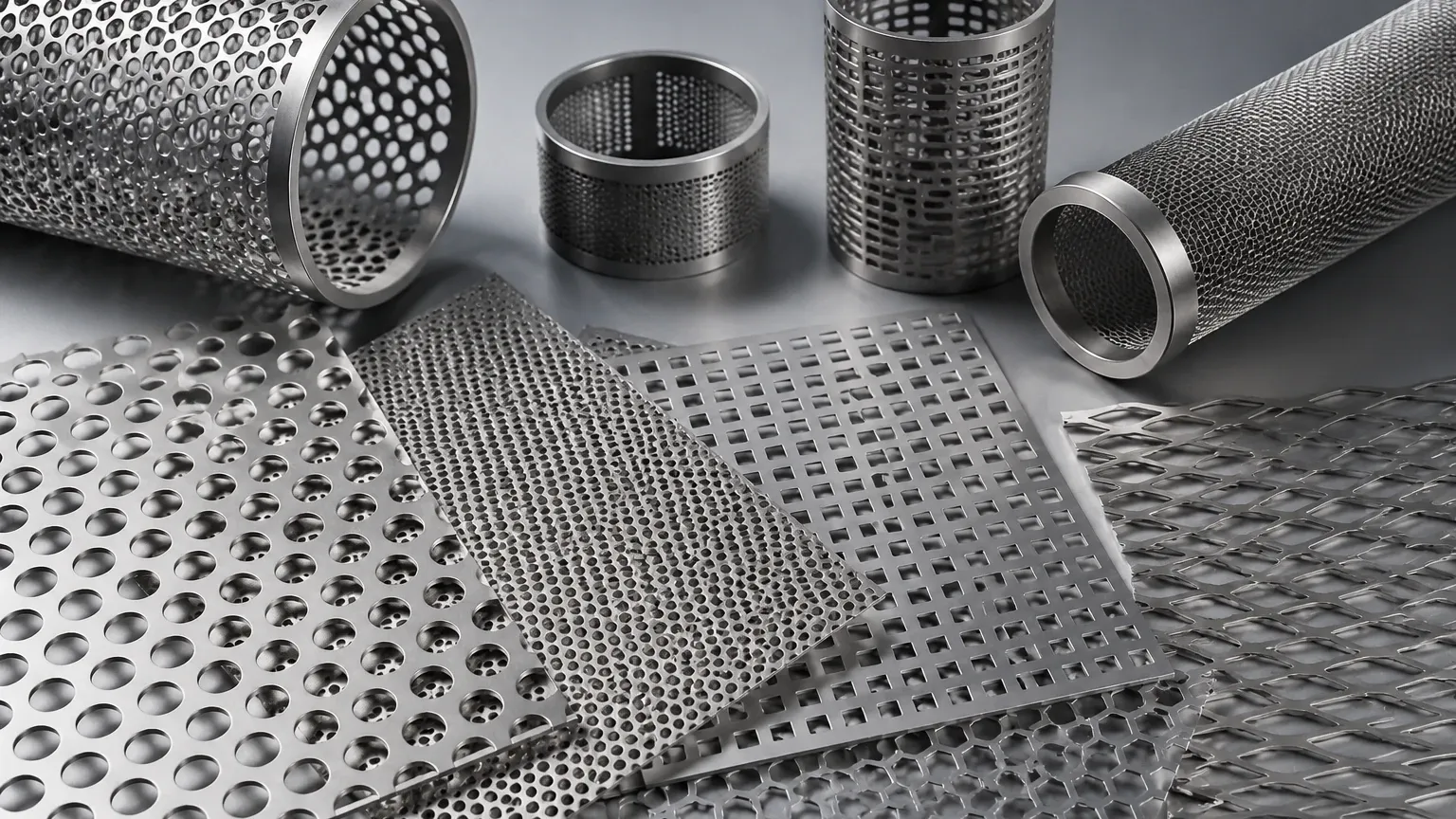
Customization and OEM Capabilities in Perforated & Expanded Metal
Standard off-the-shelf perforated sheets rarely meet the exacting requirements of specialized industrial equipment. OEM customization is often necessary to achieve the desired performance metrics. Customization options include:
* Variable Pitch: Adjusting the distance between holes to create zones of different flow rates within a single component.
* Complex Geometries: Producing conical, cylindrical, or pleated perforated components for specific housing designs.
* Surface Finishing: Post-perforation treatments such as electropolishing, pickling, or degreasing. These processes are vital for the food, beverage, and pharmaceutical industries to ensure surfaces are smooth, free of burrs, and easy to sanitize.
By leveraging advanced manufacturing capabilities, Kaifil ensures that Perforated & Expanded Metal components meet tight tolerances, which is critical for maintaining consistent filtration accuracy across large production batches.
Selecting the Right Design for Industrial Applications
The application environment dictates the necessary specifications for perforated metal designs. Below are common considerations for key sectors:
Chemical and Petrochemical Processing
In these sectors, filters are exposed to high temperatures and corrosive substances. The design must prioritize material grade (SS316L or higher) and structural thickness. Perforated metal here often acts as a strainer or a support for secondary mesh layers in catalyst recovery systems.
Food and Beverage Industry
Hygiene is the priority. Perforated designs must be free of "dead spots" where bacteria could accumulate. Smooth, round holes with electropolished finishes are standard. The design must also withstand frequent Clean-in-Place (CIP) cycles involving high-pressure water and chemical detergents.
Hydraulic and Lubrication Systems
Perforated metal in hydraulic systems usually serves as a suction strainer. The design must focus on a high open area to prevent pump cavitation while remaining rigid enough to withstand the high-viscosity pull of cold hydraulic oil.
Maintenance and Longevity of Stainless Steel Perforated Components
The total cost of ownership for industrial filters is heavily influenced by their maintenance requirements and replacement cycles. Well-engineered perforated metal designs can last for years if properly maintained.
Cleaning Protocols
Because stainless steel perforated metal is robust, it can often be cleaned using ultrasonic baths, backwashing, or mechanical scrubbing. However, the design must allow for this; for instance, staggered patterns are generally easier to backwash effectively than straight patterns because they create more turbulent, cleaning-efficient flow paths.
Monitoring Wear and Tear
In abrasive environments—such as those involving sand or slurry—the edges of the perforations can wear down over time, effectively increasing the hole size and reducing filtration accuracy. Regular inspection of the hole diameters and the thickness of the bridges is necessary to prevent bypass or structural failure.
Conclusion: Engineering Precision with Kaifil
Choosing the right perforated metal design involves a complex evaluation of hole geometry, open area, material properties, and manufacturing precision. For engineers and purchasing teams, partnering with a manufacturer that understands these technical nuances is essential for optimizing system performance and reducing long-term costs.
Kaifil specializes in providing customized, high-performance Perforated & Expanded Metal solutions tailored to the specific needs of industrial applications. Whether you require a high-strength support core for a hydraulic filter or a precision-punched screen for pharmaceutical processing, our engineering team provides the technical expertise and manufacturing reliability required for demanding environments. By focusing on quality materials and precise designs, we help our global customers achieve efficient and durable filtration results.
