


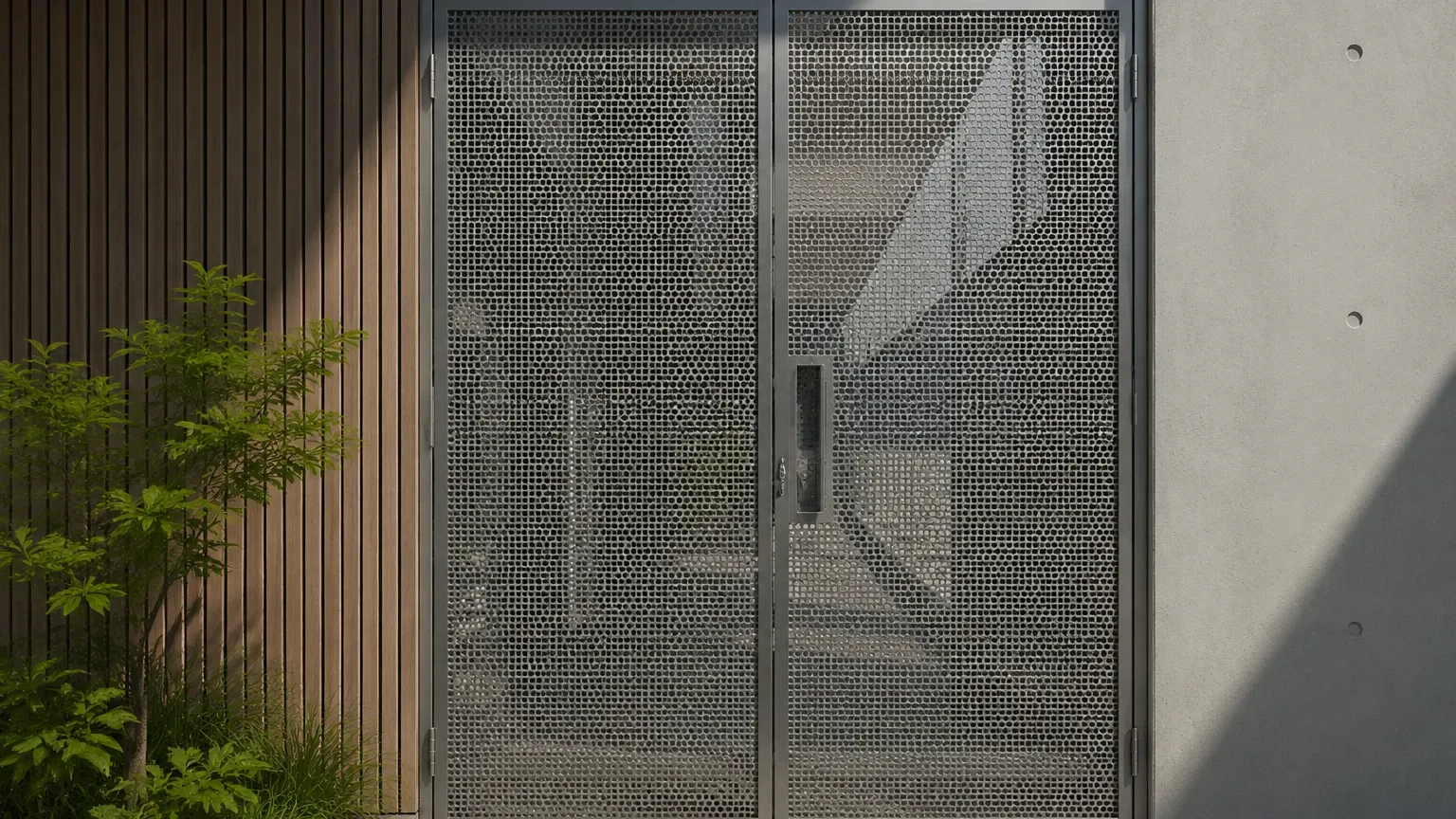
Perforated Metal Doors
In industrial and commercial engineering, the selection of access points and enclosures requires a balance between structural security, visibility, and environmental control. Perforated metal doors represent a specialized category of industrial components designed to meet these multifaceted demands. Unlike solid metal doors, which provide total isolation, or wire mesh gates, which may lack the necessary rigidity for heavy-duty applications, perforated metal solutions offer a customizable middle ground. By utilizing high-precision manufacturing techniques, engineers can specify the exact ratio of open area to solid material, ensuring that the door performs its primary function of security while facilitating essential airflow or light transmission.
For facilities managers and design engineers, understanding the technical nuances of Perforated & Expanded Metal is critical. These materials serve as the foundation for durable door systems used in environments ranging from chemical processing plants and server rooms to food production facilities and heavy machinery enclosures. This guide examines the engineering considerations, material science, and application-specific requirements that define the performance of perforated metal doors in industrial settings.
Engineering Principles: Balancing Open Area and Structural Integrity
The most critical technical decision when designing perforated metal doors is the determination of the "open area" percentage. This figure represents the ratio of the total area of the holes to the total area of the sheet. In industrial applications, this calculation directly impacts three key performance factors: airflow, visibility, and tensile strength.
The Calculation of Open Area
For a standard staggered round hole pattern—the most common configuration for industrial doors—the open area is calculated using the hole diameter (D) and the center-to-center spacing, or pitch (P). A higher open area percentage (typically 40% to 60%) is ideal for ventilation and heat dissipation, which is essential for doors used in electrical transformer rooms or computer server cabinets. However, as the open area increases, the structural rigidity of the door panel decreases. Engineers must compensate for high open area ratios by selecting a thicker material gauge or incorporating reinforced framing to prevent sagging or warping over time.
Hole Patterns and Geometry
While round holes are the industry standard due to their ease of manufacture and uniform stress distribution, other patterns serve specific functional needs:
* Square Holes: Provide a higher open area for maximum airflow but can be more prone to stress cracking at the corners under high-vibration conditions.
* Slotted Holes: Often used for doors that require directional screening or for applications where the door acts as a primary filter for elongated debris.
* Hexagonal Patterns: Offer the highest possible open area while maintaining significant structural integrity, often used in high-end architectural and technical enclosures.
Material Selection for Industrial Durability
The environment in which the door will operate dictates the material choice. Because perforated metal doors are often exposed to corrosive chemicals, high humidity, or extreme temperatures, selecting the correct alloy is paramount to ensuring a long service life and reducing the total cost of ownership.
Stainless Steel (304 and 316 Grades)
As a manufacturer specializing in stainless steel filtration and metal components, Kaifil emphasizes the use of stainless steel for demanding environments. Type 304 stainless steel provides excellent corrosion resistance for most indoor and mild outdoor applications. For more aggressive environments, such as chemical processing plants, coastal facilities, or food and beverage production lines where frequent washdowns with caustic agents are required, Type 316 stainless steel is the preferred choice due to its increased molybdenum content, which resists pitting and chloride-induced corrosion.
Carbon Steel and Aluminum
In less corrosive environments, carbon steel offers a cost-effective solution with high strength. However, it requires a protective finish, such as powder coating or hot-dip galvanizing, to prevent oxidation. Aluminum is selected for applications where weight reduction is a priority, such as in mobile machinery enclosures or overhead access doors, though it offers lower tensile strength and impact resistance compared to steel.
Perforated vs. Expanded Metal for Door Applications
When specifying metal doors, engineers often compare perforated metal with expanded metal. While both fall under the broader category of Perforated & Expanded Metal, they are manufactured through different processes and offer distinct mechanical properties.
Manufacturing Differences
Perforated metal is produced by punching holes into a solid sheet, which allows for precise control over hole size, shape, and placement. This process leaves a "margin" (a solid border) around the edges of the sheet, which simplifies welding and installation into a door frame. Expanded metal is created by slitting and stretching the material simultaneously. This process creates a diamond-shaped mesh without any material waste, making it a highly sustainable and cost-effective option.
Functional Comparison
Perforated metal doors are generally easier to clean and offer a smoother surface, which is critical in pharmaceutical and food-grade applications where hygiene is a priority. Expanded metal, with its raised ridges and multi-directional strength, provides superior grip and impact resistance, making it suitable for security gates and heavy-duty industrial partitions where aesthetic finish is secondary to raw durability.
Applications in Specialized Industrial Sectors
Perforated metal doors are rarely "one-size-fits-all." Their design must be tailored to the specific operational requirements of the facility.
HVAC and Ventilation Enclosures
In industrial HVAC systems, doors must protect sensitive internal components from unauthorized access while allowing massive volumes of air to pass through for cooling. Perforated metal allows for precise airflow modeling, ensuring that pressure drops across the door remain within the system's design tolerances.
Security and Visibility in Warehousing
In large-scale logistics centers, internal partitions and equipment cages often utilize perforated metal doors. These allow security personnel to maintain a clear line of sight into the restricted area without opening the door, enhancing safety and monitoring capabilities. The small hole diameters also prevent the passage of small tools or hands, providing a high level of anti-theft protection.
Acoustic Control and Noise Reduction
In noisy manufacturing environments, perforated metal can be used as the outer skin of an acoustic door. When combined with sound-absorbing insulation material, the perforations allow sound waves to pass through the metal surface and be trapped by the internal media, significantly reducing noise pollution in the surrounding workspace.
Customization and OEM Considerations
For many industrial projects, standard off-the-shelf doors are insufficient. Customization is often necessary to integrate the door into existing machinery or to meet specific filtration and safety standards. When working with a manufacturer like Kaifil, engineers can specify several custom parameters:
1. Margin Specifications: Custom solid borders can be left around the perforated area to facilitate easier mounting of hinges, locks, and handles without compromising the hole pattern.
2. Precision Leveling: The perforation process can cause internal stresses that lead to bowing. High-quality industrial doors undergo a leveling process to ensure the panel is perfectly flat before it is framed.
3. Bending and Forming: Perforated sheets can be formed into curved or multi-angled door panels for specialized equipment enclosures, maintaining the integrity of the hole pattern through the bends.
4. Surface Finishing: Beyond the base material, options such as electropolishing for stainless steel or specialized anti-corrosion coatings can be applied to meet industry-specific compliance standards (e.g., FDA or high-purity pharmaceutical requirements).
Maintenance and Performance Evaluation
The longevity of perforated metal doors depends on regular inspection and appropriate maintenance protocols. In industrial settings, the following factors should be monitored:
* Debris Accumulation: Because these doors often act as a secondary filter for the environment, dust and particulate matter can clog the perforations, reducing airflow and increasing the load on ventilation fans. Regular cleaning with compressed air or high-pressure water (depending on the material) is necessary.
* Structural Fatigue: In high-vibration environments, such as those near heavy stamping presses or turbines, the narrow "bridges" between holes can develop micro-cracks. Engineers should inspect high-stress areas near hinges and latches for signs of fatigue.
* Corrosion Monitoring: Even stainless steel can show signs of surface contamination or "tea staining" if exposed to harsh chemicals without regular rinsing. Early detection of surface oxidation can prevent structural failure.
Key Factors to Confirm Before Purchase
Before finalizing a specification for perforated metal doors, procurement teams and engineers should confirm the following technical details with their supplier:
* Material Certification: Ensure the supplier provides mill test reports (MTRs) to verify the alloy composition, especially for 316L stainless steel applications.
* Tolerance Requirements: Specify the allowable variance in hole diameter and pitch. For precision industrial applications, tight tolerances are required to ensure consistent performance.
* Load-Bearing Capacity: If the door is part of a larger structural assembly, confirm the weight-bearing limits of the perforated panel, taking into account the reduction in strength caused by the holes.
* Compatibility with Hardware: Ensure that the thickness of the metal and the hole pattern do not interfere with the installation of standard industrial hinges, panic bars, or electronic access control systems.
By focusing on these technical aspects, organizations can implement perforated metal doors that provide reliable service, enhance facility safety, and optimize environmental conditions. Whether the goal is to protect sensitive electronics in a server room or to provide a durable barrier in a chemical plant, the versatility of Perforated & Expanded Metal ensures a solution that meets the rigorous demands of modern industry.
