


Perforated Metal Enscape Material
In the realm of industrial engineering and architectural design, the transition from a digital concept to a physical installation requires a deep understanding of material properties. For professionals utilizing real-time rendering tools, specifying a perforated metal enscape material is more than an aesthetic choice; it is a digital representation of a functional component that must perform under specific industrial conditions. Whether the application involves high-pressure filtration, acoustic dampening, or structural support, the accuracy of the digital model must eventually align with the physical realities of Perforated & Expanded Metal.
This guide explores the technical parameters of perforated and expanded metals from a manufacturing perspective, helping engineers and procurement teams bridge the gap between digital visualization and industrial implementation.
The Role of Visualization in Industrial Filtration and Design
Modern industrial projects often begin in a 3D environment where software like Enscape allows engineers to visualize how light, air, and fluids interact with metal surfaces. When an engineer selects a perforated metal enscape material for a model, they are simulating the "open area" of a sheet. In a physical industrial setting, this open area determines the flow rate of a chemical processing line or the efficiency of a hydraulic filtration system.
Visualization helps in identifying potential interference issues in complex assemblies, such as filter housings or protective machinery guards. However, the digital texture must be backed by a manufacturable specification. Understanding the geometry of the perforations—whether they are round, square, or slotted—is critical because these shapes dictate the mechanical strength and the filtration accuracy of the final product.
Technical Specifications of Perforated Metal
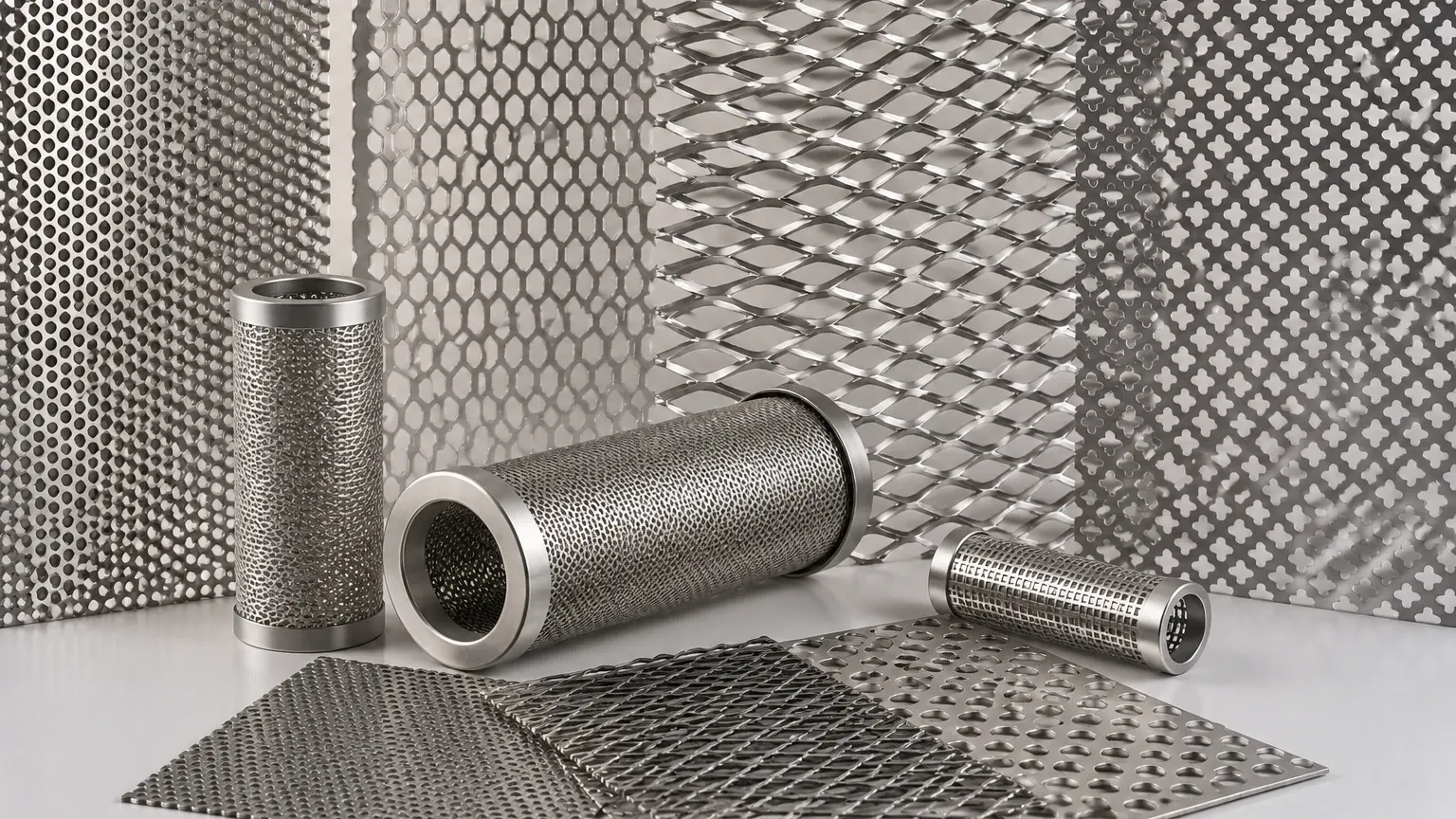
Perforated metal is produced by mechanically punching or laser-cutting holes into a solid metal sheet. For industrial applications, particularly in filtration, the precision of these holes is paramount. When moving from a digital rendering to a purchase order, several technical factors must be defined:
1. Hole Pattern and Orientation
Hole patterns are generally categorized into staggered or straight rows. A 60-degree staggered pattern is the most common for industrial use because it provides the highest open area and uniform strength across the sheet. In a digital environment, the perforated metal enscape material should reflect this orientation to accurately predict how the material will behave under stress.
2. Open Area Calculation
The open area is the percentage of the sheet that is occupied by holes. This is a critical metric for engineers calculating pressure drops in filtration systems. The formula for a 60-degree staggered round hole pattern is:
Open Area % = (D² × 90.69) / P²
*(Where D = Hole Diameter and P = Pitch/Center-to-Center distance)*
3. Gauge and Material Thickness
The thickness of the metal (gauge) affects both the weight and the durability of the component. In high-pressure hydraulic applications, a thicker gauge is required to prevent deformation, even if the digital model looks identical with a thinner material. Kaifil specializes in custom thicknesses to ensure that the physical product meets the structural demands of the application.
The Structural Mechanics of Expanded Metal
While perforated metal is created by removing material, expanded metal is produced by simultaneously slitting and stretching the sheet. This process creates a diamond-shaped mesh that is integral to the original piece of metal, meaning there are no welds or joins that can fail.
In an industrial context, expanded metal is often used for heavy-duty filtration supports, walkways, and protective grilles. When a designer specifies an expanded metal texture in a rendering, they must account for the "strand width" and the "long way of design" (LWD) vs. the "short way of design" (SWD). These dimensions determine the directional strength of the panel. Unlike perforated metal, expanded metal provides a three-dimensional profile that can deflect light or fluid, a feature that must be carefully considered during the simulation phase.
Material Selection: Stainless Steel in Corrosive Environments
For industries such as chemical processing, pharmaceuticals, and food and beverage, the choice of material is non-negotiable. Stainless steel is the industry standard due to its corrosion resistance and ability to withstand high temperatures.
* Grade 304: Suitable for general industrial use, providing excellent formability and resistance to oxidation.
* Grade 316L: The preferred choice for marine environments or pharmaceutical applications where high resistance to chlorides and acids is required. The "L" denotes low carbon content, which improves weldability and prevents sensitization in the heat-affected zone.
When configuring a perforated metal enscape material for a project in a corrosive environment, the visual representation remains the same, but the physical specification must prioritize the metallurgical properties of the alloy to ensure a long service life.
Filtration and Flow Dynamics
In B2B industrial procurement, the primary function of Perforated & Expanded Metal is often filtration or separation. The precision of the manufacturing process at Kaifil ensures that the filtration accuracy—the ability to stop particles of a certain size—is consistent across the entire surface.
Pressure Drop and Resistance
Every filter medium introduces a degree of resistance to the flow of liquid or gas. Engineers must calculate the expected pressure drop to size pumps and compressors correctly. A digital model using a perforated metal enscape material can provide a rough estimate of transparency, but physical testing or CFD (Computational Fluid Dynamics) modeling based on Kaifil’s manufacturing tolerances is necessary for mission-critical systems.
Support Structures
Perforated metals often serve as the "skeleton" for finer wire mesh filters. In these cases, the perforated sheet provides the structural integrity needed to withstand high differential pressures, while the mesh handles the actual filtration. The alignment between these two layers is vital to prevent "blind spots" where the flow is restricted.
Customization and OEM Integration
One of the primary challenges for purchasing teams is finding a manufacturer that can translate custom digital designs into physical components. Kaifil provides extensive OEM capabilities, allowing for customized hole patterns, unique sheet dimensions, and specialized edge treatments (such as solid margins for welding).
When a project requires a specific perforated metal enscape material that does not fit standard market sizes, customization becomes the solution. This includes:
* Custom Margins: Leaving specific areas of the sheet unperforated for mounting or structural reinforcement.
* Secondary Processing: Including leveling, shearing, and forming (rolling or bending) to fit into specific filter housings or machine frames.
* Surface Finishes: Electropolishing or pickling to meet the hygiene standards of the food and pharmaceutical industries.
Evaluation Criteria for Purchasing Managers
Before moving from a digital visualization to the procurement phase, engineers and purchasing managers should confirm several key factors with their supplier:
1. Dimensional Tolerances: Does the manufacturer adhere to international standards (such as ISO or ASTM) for hole diameter and pitch?
2. Flatness Requirements: Perforating metal can introduce internal stresses that cause the sheet to curl. Ensure the supplier uses leveling equipment to provide flat sheets.
3. Burr Removal: In filtration, burrs can trap contaminants or damage delicate filter membranes. Confirm that the material will be properly deburred.
4. Material Certification: Request Mill Test Reports (MTRs) to verify the chemical composition of the stainless steel.
Common Risks in Material Specification
Misalignment between the digital model and the physical product often leads to project delays or mechanical failure. A common risk is over-specifying the open area; while a high open area looks good in a rendering and provides low flow resistance, it may compromise the structural integrity of the sheet, leading to buckling under pressure.
Another risk is neglecting the "border" or margin. If a perforated metal enscape material is applied to a model without considering the solid metal edges required for welding into a frame, the final assembly may not fit or may require costly on-site modifications. Working with a professional manufacturer like Kaifil ensures these details are addressed during the technical review phase, long before production begins.
Conclusion: From Digital Vision to Industrial Reality
Whether you are using a perforated metal enscape material to simulate the aesthetics of an industrial facility or to model the flow of a new filtration system, the success of the project depends on the quality of the physical material. Perforated and expanded metals are versatile, durable, and essential components across various sectors, from hydraulic systems to food processing plants.
By focusing on technical accuracy—such as open area percentages, material grades, and manufacturing tolerances—engineers can ensure that their digital designs are not just visual successes, but functional ones. Kaifil remains a committed partner in this process, providing the engineering expertise and manufacturing precision required to turn complex specifications into high-performance filtration solutions.
For technical support or to discuss specific pattern requirements for your next project, Review product options and application support to ensure your material selection meets the highest industrial standards.
