


Perforated Metal Flat Bar
In the landscape of industrial components, the perforated metal flat bar represents a specialized intersection of structural rigidity and functional permeability. Unlike standard perforated sheets, which are typically broad and thin, the flat bar profile offers a specific geometry—narrower widths and often greater thicknesses—that serves as a critical element in filtration assemblies, machinery guards, and architectural supports. For engineers and procurement specialists, selecting the right perforated metal flat bar involves a detailed understanding of material properties, hole patterns, and the mechanical stresses the component will endure during its service life.
As a core component within the broader category of Perforated & Expanded Metal, these bars are engineered to provide precise open areas while maintaining the linear strength required for load-bearing or framing applications. This guide examines the technical specifications, manufacturing considerations, and engineering criteria essential for integrating these components into industrial systems.
Technical Overview: Defining the Perforated Metal Flat Bar
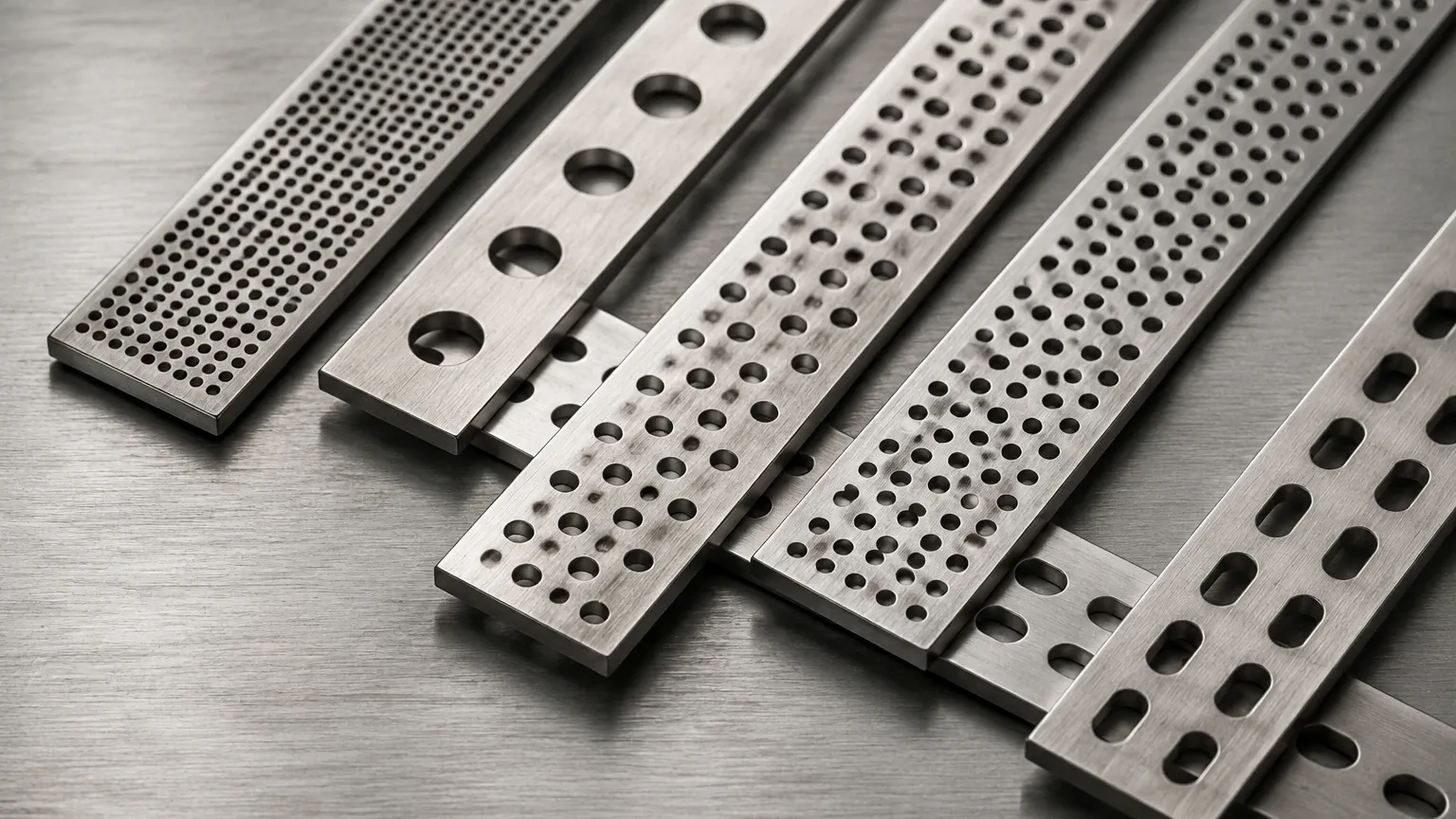
A perforated metal flat bar is essentially a metal strip that has been mechanically punched or laser-cut to create a pattern of holes. In industrial contexts, these are most commonly manufactured from stainless steel due to its superior corrosion resistance and mechanical strength. The "flat bar" designation refers to the rectangular cross-section of the raw material before or after perforation.
From a technical perspective, the primary challenge in designing a perforated metal flat bar is balancing the "open area" (the percentage of the bar that consists of holes) with the remaining "ligament" (the solid metal between the holes). The ligament must be sufficient to carry the intended mechanical load without deforming, while the open area must be optimized for flow rates, weight reduction, or aesthetic transparency.
At Kaifil, manufacturing these components involves precision tooling to ensure that the margins—the solid areas along the edges of the bar—are consistent. This is particularly important for flat bars that will be welded into frames or used as support ribs in large-scale stainless steel filter cartridges.
Material Selection for Industrial Environments
The performance of a perforated metal flat bar is largely dictated by its metallurgy. Given that these components are frequently used in chemical processing, food and beverage production, and water treatment, material selection is a primary engineering decision.
Stainless Steel 304 and 304L
Grade 304 is the standard "18/8" stainless steel. It offers excellent formability and weldability. For most industrial applications where moderate corrosion resistance is required, 304 is the cost-effective choice. The "L" variant (304L) is preferred for components that require extensive welding, as it minimizes carbide precipitation that can lead to intergranular corrosion.
Stainless Steel 316 and 316L
For more demanding environments, such as marine applications or chemical plants involving chlorides and acids, Grade 316 is the industry standard. The addition of molybdenum enhances its resistance to pitting and crevice corrosion. In high-precision filtration systems, using a 316L perforated metal flat bar ensures the longevity of the assembly even under aggressive cleaning cycles or exposure to corrosive filtrates.
Specialty Alloys
In specific high-temperature or highly acidic environments, alloys like Monel, Inconel, or Hastelloy may be utilized. While more expensive, these materials provide the necessary durability for specialized aerospace or petrochemical applications where standard stainless steels would fail.
Critical Design Parameters and Calculations
When specifying a perforated metal flat bar, engineers must define several geometric variables. These parameters directly impact the component's performance in filtration and structural roles.
1. Hole Shape: Round holes are the most common due to their structural stability and ease of manufacturing. However, square holes offer a higher open area, and slotted holes are often used for specific screening or sorting processes.
2. Hole Pattern:
* Staggered (60-degree): This is the most popular pattern, providing the highest open area and uniform strength across the bar.
* Straight Line: Holes are aligned in both directions. This is often chosen for aesthetic reasons or specific mechanical alignment but generally offers lower structural integrity than staggered patterns.
3. Open Area Calculation: For a 60-degree staggered round hole pattern, the open area (OA%) is calculated using the formula:
*OA% = (d² × 90.69) / p²*
Where *d* is the hole diameter and *p* is the pitch (center-to-center distance). Understanding this value is critical for engineers calculating pressure drops in filtration systems or airflow in ventilation guards.
4. Margins: In a flat bar, the side margins are critical. Unlike large sheets where margins might be negligible, a 50mm wide bar with 5mm margins on each side loses a significant portion of its potential perforated area. Specifying "end margins" and "side margins" ensures the bar can be easily integrated into larger assemblies without interfering with hole patterns.
Manufacturing Precision: From Punching to Leveling
The manufacturing process for a perforated metal flat bar involves more than just punching holes. Because the punching process introduces internal stresses into the metal, the bar often tends to curl or warp.
Precision Punching
High-speed CNC punching presses are used to ensure hole diameter tolerances are met. For thicker flat bars (e.g., 5mm or thicker), the clearance between the punch and die must be meticulously managed to prevent excessive burring or deformation of the hole edges.
Leveling and Degreasing
After perforation, the bars must undergo a leveling process to restore flatness. This is essential for B2B customers who require the bars to fit into tight-tolerance machinery. Following leveling, the bars are typically degreased to remove lubricants used during the punching process, ensuring they are ready for welding or further finishing.
Finishing Options
Depending on the application, the perforated metal flat bar may require additional surface treatments:
* Pickling and Passivation: Essential for stainless steel to restore the protective oxide layer after fabrication.
* Electropolishing: Provides a mirror-like finish and removes microscopic burrs, which is critical for food-grade and pharmaceutical applications to prevent bacterial growth.
* Powder Coating: Used primarily for architectural or identification purposes where color-coding or additional environmental protection is needed.
Strategic Applications in Industrial Filtration
Within the scope of Perforated & Expanded Metal products, the flat bar profile serves several distinct roles in industrial filtration and mechanical engineering.
Internal Support for Filter Elements
In large industrial filter cartridges, the perforated metal flat bar is often used as a longitudinal support or a circumferential reinforcement. Because it is thicker than the mesh it supports, it provides the structural skeleton that prevents the filter media from collapsing under high differential pressure.
Drainage Channels and Grates
In water treatment and food processing facilities, perforated flat bars are used to create custom drainage grates. The flat bar profile allows for a high load-bearing capacity (e.g., for foot traffic or light equipment) while the perforations allow for efficient liquid runoff and debris capture.
Machinery Guards and Safety Screens
Engineers specify perforated flat bars for guards where both visibility and airflow are required. The flat bar format allows for easy bolting or welding to machine frames, providing a robust barrier that meets safety standards without completely enclosing the equipment.
Procurement Checklist: What Engineers Must Confirm
To ensure a successful procurement process and avoid costly redesigns, purchasing teams and engineers should confirm the following details before placing an order for a perforated metal flat bar:
* Dimensional Accuracy: Confirm the exact width, thickness, and length. Note that tolerances for perforated materials may differ from standard cold-rolled bars.
* Hole Specification: Define the hole diameter and the pitch. If the application is sensitive to flow, specify the minimum required open area.
* Margin Requirements: Clearly state if "no margins" (perforation to the edge) or "finished margins" (solid metal edges) are required. Finished margins are generally preferred for safety and ease of welding.
* Flatness Tolerance: Specify the maximum allowable bow or twist per linear meter, especially for long bars used in precision assemblies.
* Material Certification: Request Mill Test Reports (MTRs) to verify the chemical composition and mechanical properties of the stainless steel, particularly for regulated industries like pharmaceuticals.
Maintenance and Long-Term Performance
The total cost of ownership for a perforated metal flat bar is influenced by its durability and ease of maintenance. Stainless steel variants are favored because they require minimal upkeep. However, in filtration applications, the holes can become blinded by particulates over time.
Cleaning Protocols
For bars used in screening, regular cleaning via high-pressure water jets or ultrasonic baths can extend the service life. Because Kaifil focuses on high-quality manufacturing, our perforated products are designed to withstand these rigorous cleaning methods without losing structural integrity.
Replacement Cycles
While a well-specified 316L stainless steel bar can last for decades in a stable environment, components subject to abrasive slurries or high-frequency vibration should be inspected annually for signs of ligament cracking or erosion. Replacing these components before a total structural failure is critical for maintaining the safety and efficiency of industrial systems.
By selecting a partner with deep expertise in custom stainless steel filtration and Perforated & Expanded Metal fabrication, companies can ensure that their perforated metal flat bar components are engineered for precision, durability, and optimal performance in the most demanding industrial environments.
