


Perforated Metal for Cabinet Doors
In industrial and commercial environments, cabinet doors serve a dual purpose: they must provide a secure physical barrier while often facilitating critical functions such as thermal management, acoustic dampening, or visual monitoring. Selecting perforated metal for cabinet doors is an engineering decision that impacts the longevity of the equipment housed within and the overall safety of the facility. Unlike solid panels, perforated and expanded metal components offer a controlled "open area" that allows for the passage of air, light, and sound without compromising structural integrity.
For engineers and procurement professionals, the selection process involves more than aesthetics. It requires a deep understanding of material properties, perforation patterns, and fabrication techniques to ensure the final component meets the specific demands of the application, whether it is a high-density server rack, a chemical storage unit, or a food processing enclosure.
Engineering Requirements for Industrial Cabinet Ventilation
The primary technical driver for choosing perforated metal for cabinet doors is ventilation. In sectors such as telecommunications and power electronics, heat dissipation is critical. A solid door would lead to thermal buildup, potentially causing equipment failure. Perforated panels allow for passive or forced-air cooling, maintaining optimal operating temperatures.
When specifying these panels, engineers must calculate the required airflow, which is directly influenced by the "open area" percentage of the metal. The open area is the ratio of the total area of the holes to the total area of the sheet. For instance, a pattern with a 40% open area provides significantly different cooling characteristics than one with 60%.
Beyond airflow, the hole size and spacing (pitch) must be considered to prevent the ingress of foreign objects. In many industrial settings, cabinet doors must meet specific IP (Ingress Protection) ratings. If the holes are too large, they may allow debris or tools to enter the cabinet, posing a safety risk or damaging sensitive components. Conversely, if the holes are too small or the pitch is too tight, the panel may become a structural liability or suffer from "blinding" (clogging) in dusty environments.
Material Selection: Why Stainless Steel Dominates Industrial Cabinetry
While perforated metal can be manufactured from various alloys, stainless steel remains the standard for industrial cabinet doors due to its superior mechanical properties and resistance to environmental stressors. Kaifil specializes in custom stainless steel solutions, emphasizing the use of 304 and 316-grade alloys for demanding applications.
Grade 304 Stainless Steel
This is the most common grade used for industrial cabinetry. It offers excellent corrosion resistance and durability for indoor environments and most outdoor applications that are not exposed to high-salinity or heavy chemical concentrations. It is highly weldable and maintainable, making it ideal for custom-fabricated cabinet frames.
Grade 316 Stainless Steel
For environments involving chemical processing, pharmaceuticals, or marine exposure, Grade 316 is preferred. The addition of molybdenum enhances its resistance to pitting and crevice corrosion, particularly in chloride-rich environments. When perforated metal for cabinet doors is used in a laboratory or a wash-down food grade facility, 316 stainless steel ensures that the door remains structurally sound and hygienic over decades of service.
Other materials like aluminum or galvanized steel may be considered for weight reduction or cost savings, but they often lack the impact resistance and chemical stability required in heavy-duty B2B sectors. Stainless steel’s high strength-to-weight ratio allows for thinner gauges to be used without sacrificing the rigidity of the door panel.
Technical Parameters: Calculating Open Area and Hole Patterns
The performance of Perforated & Expanded Metal in cabinetry is defined by its geometry. The choice of pattern affects not only the airflow but also the visibility of the contents and the strength of the door.
1. Round Holes: The most common and cost-effective pattern. Staggered round holes (usually at a 60-degree angle) provide the best balance of open area and structural strength. They are easier to punch and result in less tool wear during manufacturing.
2. Square Holes: These offer a higher open area percentage, which is beneficial for maximum ventilation. However, square holes create stress concentrations at the corners, which can lead to cracking if the door is subjected to frequent mechanical vibration or impact.
3. Slotted Holes: Often used for specific aesthetic or functional requirements, such as allowing visibility in one direction while obscuring it in another. Slotted perforations are also useful for drainage in wet environments.
To calculate the open area for a staggered round hole pattern, the formula is:
`Open Area % = (D² x 90.69) / C²`
*Where D is the hole diameter and C is the center-to-center distance (pitch).*
Ensuring these calculations are accurate is vital for engineers who must guarantee that the cooling fans within a cabinet can move a specific volume of air (CFM) through the door without excessive static pressure loss.
Structural Considerations: Gauge, Rigidity, and Fabrication
A common challenge when using perforated metal for cabinet doors is maintaining flatness and rigidity. The process of punching thousands of holes into a metal sheet introduces internal stresses that can cause the material to warp or "oil-can."
Material Gauge
For most industrial cabinet doors, gauges ranging from 16 to 20 (approximately 1.5mm to 0.9mm) are standard. Thicker gauges provide more security and impact resistance but increase the weight of the door, requiring heavy-duty hinges and frames. Thinner gauges are lighter and easier to perforate but may require stiffeners or a robust outer frame to prevent flexing.
Margins and Borders
When ordering custom perforated panels, specifying "margins" is essential. Margins are the unperforated areas along the edges of the sheet. A solid border around the perforated area significantly increases the structural integrity of the door and provides a clean surface for welding or bolting the panel into a frame. Without proper margins, the edges of the perforated area can be sharp and prone to deformation during the assembly process.
Edge Treatments and Framing
Perforated panels are rarely used as standalone doors. They are typically inset into a U-channel frame or welded to an L-angle frame. This fabrication step ensures that the door remains square and can support its own weight over time. For high-security applications, the intersection between the perforated metal and the frame must be continuous to prevent prying or tampering.
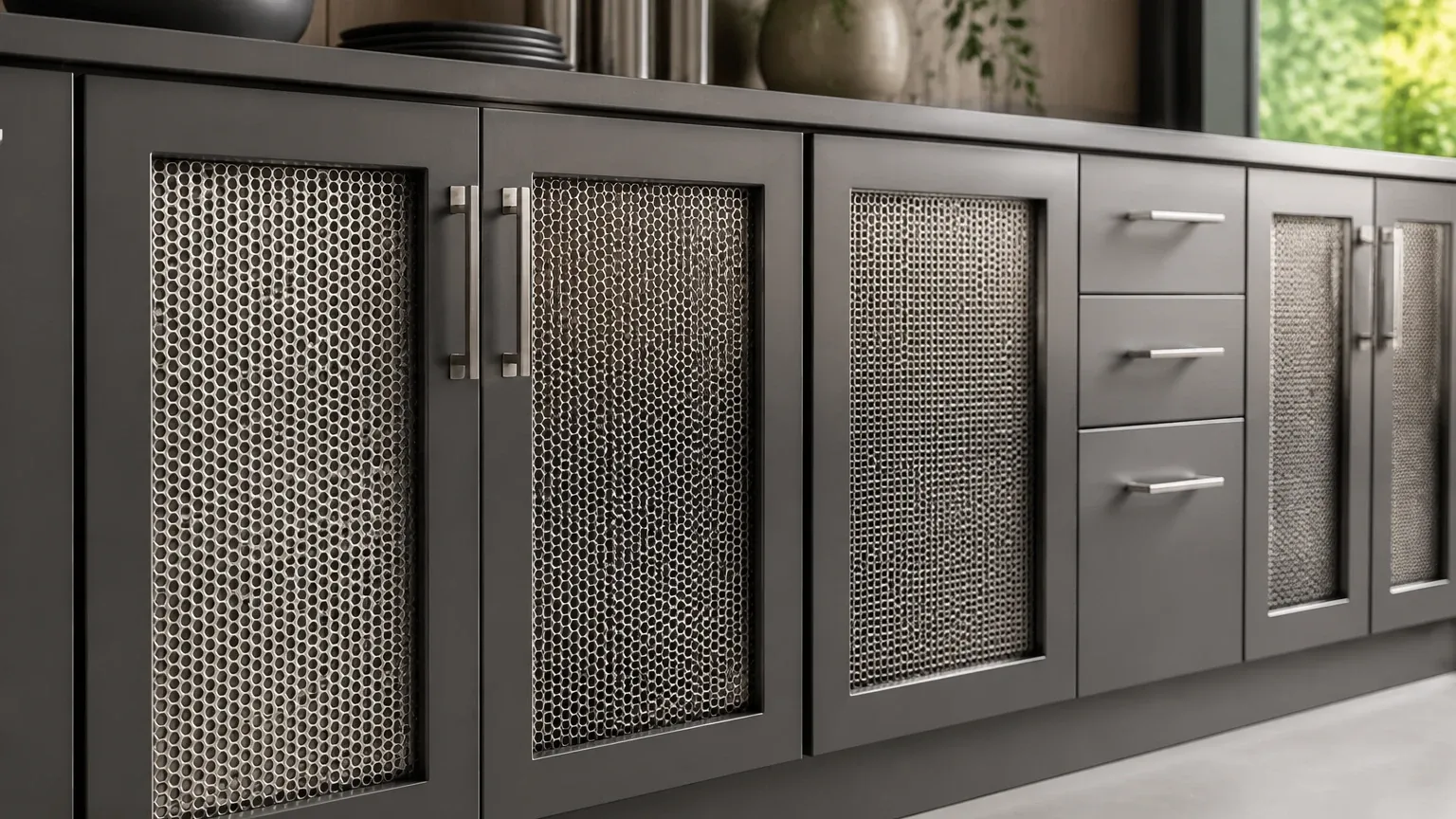
Comparing Perforated & Expanded Metal for Cabinetry Applications
While perforated metal is the most frequent choice, expanded metal is a viable alternative for specific cabinet types. Understanding the difference is key to optimal selection.
* Perforated Metal: Created by punching holes out of a solid sheet. This results in a flat, smooth surface with precise hole dimensions. It is the preferred choice when specific airflow calculations are required or when the door needs a high-quality finish (such as powder coating or polishing).
* Expanded Metal: Created by slitting and stretching the metal simultaneously. This process produces a diamond-shaped mesh. Expanded metal is often more cost-effective because there is no material waste (no "slugs" are punched out). It offers a unique 3D texture that can provide additional stiffness. However, the edges of standard expanded metal can be sharp, and the open area is more difficult to calculate precisely compared to perforated sheets.
In heavy industrial lockers or security cages where airflow is needed but a "see-through" aesthetic is less critical, expanded metal provides a rugged, high-strength solution. For precision electronics and laboratory cabinets, perforated metal remains the superior option due to its flatness and predictable performance.
Industrial Use Cases: From Data Centers to Chemical Storage
The application of perforated metal for cabinet doors spans across several critical industries, each with unique requirements:
1. Data Centers and IT Infrastructure
Server rack doors must provide maximum airflow to prevent CPU throttling. High-percentage open area perforated panels (often 60% to 80%) are used. These doors are often finished with conductive coatings to assist with EMI/RFI shielding, protecting sensitive data from electromagnetic interference.
2. Pharmaceutical and Laboratory Cabinets
In these environments, cleanliness is paramount. Perforated stainless steel doors allow for the ventilation of volatile organic compounds (VOCs) while being easy to sterilize. The smooth surface of perforated metal prevents the accumulation of contaminants, which is a risk with woven wire meshes.
3. Food and Beverage Processing
Ventilated cabinets in food plants are used to house motor starters and control systems that require cooling but must also withstand daily high-pressure wash-downs. Using 304 or 316 stainless steel perforated panels ensures the enclosures remain rust-free despite exposure to water and cleaning agents.
4. Industrial Tool and Safety Storage
Perforated doors allow supervisors to perform visual inventory checks without opening the cabinet. This is crucial for safety equipment storage, where the presence of items must be verified quickly in an emergency.
Procurement Checklist: Specifying Custom Metal Panels
Before moving forward with a purchase or production run, engineers and purchasing teams should confirm several technical details with their manufacturer. At Kaifil, we recommend reviewing the following checklist to ensure the final product meets the application’s performance expectations:
* Material Grade: Is 304 sufficient, or does the environment require 316 stainless steel?
* Hole Pattern and Size: Have the hole diameter and pitch been optimized for the required airflow and object ingress protection?
* Open Area Percentage: Does the calculated open area meet the thermal management requirements of the housed equipment?
* Sheet Thickness (Gauge): Is the gauge heavy enough to prevent warping but light enough for the intended hinge system?
* Margins and Borders: Have the unperforated margins been clearly defined for framing and welding?
* Flatness Requirements: Does the application require the panels to be leveled or flattened after the perforation process?
* Surface Finish: Is a mill finish acceptable, or is a secondary process like electropolishing, powder coating, or degreasing required?
By addressing these factors during the design phase, B2B buyers can avoid common pitfalls such as structural sagging, insufficient cooling, or premature corrosion. Customization is the hallmark of effective industrial filtration and enclosure solutions. Whether you are designing a single prototype or a large-scale industrial installation, the choice of Perforated & Expanded Metal will dictate the long-term reliability of your cabinetry system.
