


Perforated Metal for Speaker Grill
In the realm of industrial audio engineering and commercial equipment design, the speaker grill is often viewed through two lenses: aesthetic appeal and physical protection. However, for engineers and procurement specialists, the selection of the right material involves a complex balance of acoustic transparency, structural integrity, and environmental resistance. Among the various options available, perforated metal for speaker grill applications stands out as the industry standard due to its versatility and precision.
Selecting the appropriate Perforated & Expanded Metal requires an understanding of how hole patterns, material thickness, and open area percentages influence sound propagation. This guide explores the technical specifications and engineering considerations necessary to optimize filtration of unwanted debris while ensuring high-fidelity sound transmission.
Understanding the Technical Role of Speaker Grills
A speaker grill serves as the primary barrier between the sensitive internal components of a transducer—such as the cone, surround, and voice coil—and the external environment. In industrial settings, this environment may include dust, moisture, or physical impact risks. The challenge lies in providing this protection without introducing acoustic impedance or distortion.
When sound waves travel from the driver, they must pass through the grill. If the grill is not engineered correctly, it can cause several issues:
1. High-Frequency Attenuation: Smaller wavelengths (high frequencies) are more easily blocked or reflected by solid sections of metal.
2. Diffraction: Sound waves can bend around the edges of the perforations, leading to phase interference.
3. Resonance and Vibration: If the metal sheet is too thin or poorly secured, it may vibrate at specific frequencies, adding unwanted noise to the audio output.
Using high-quality perforated metal for speaker grill designs allows engineers to mitigate these risks by customizing the hole geometry and material properties to match the specific frequency response of the audio system.
The Critical Metric: Open Area Percentage
The most important specification in choosing perforated metal for acoustic applications is the "Open Area." This is the ratio of the total area of the holes to the total area of the sheet, expressed as a percentage.
For most professional and industrial audio applications, an open area between 40% and 60% is considered the "sweet spot."
* Low Open Area (<40%): Provides superior physical protection and a more solid aesthetic. However, it significantly increases the risk of sound reflection and high-frequency loss. This is generally reserved for subwoofers where the longer wavelengths of low frequencies can pass through smaller openings more easily.
* High Open Area (>60%): Offers excellent acoustic transparency, making the grill nearly "invisible" to sound waves. The trade-off is reduced structural rigidity and less protection against fine particles or impact.
Engineers must calculate the open area based on the hole diameter ($D$) and the center-to-center spacing, also known as the pitch ($P$). For a standard 60-degree staggered pattern, the formula is:
$$\text{Open Area \%} = \frac{D^2 \times 90.69}{P^2}$$
By adjusting these variables, manufacturers like Kaifil can produce Perforated & Expanded Metal that meets the exact transparency requirements of a specific project.
Hole Patterns and Acoustic Transparency
The geometry of the perforations plays a significant role in how sound interacts with the grill. While there are many decorative patterns available, three main configurations dominate the industrial audio market:
1. Round Holes (Staggered)
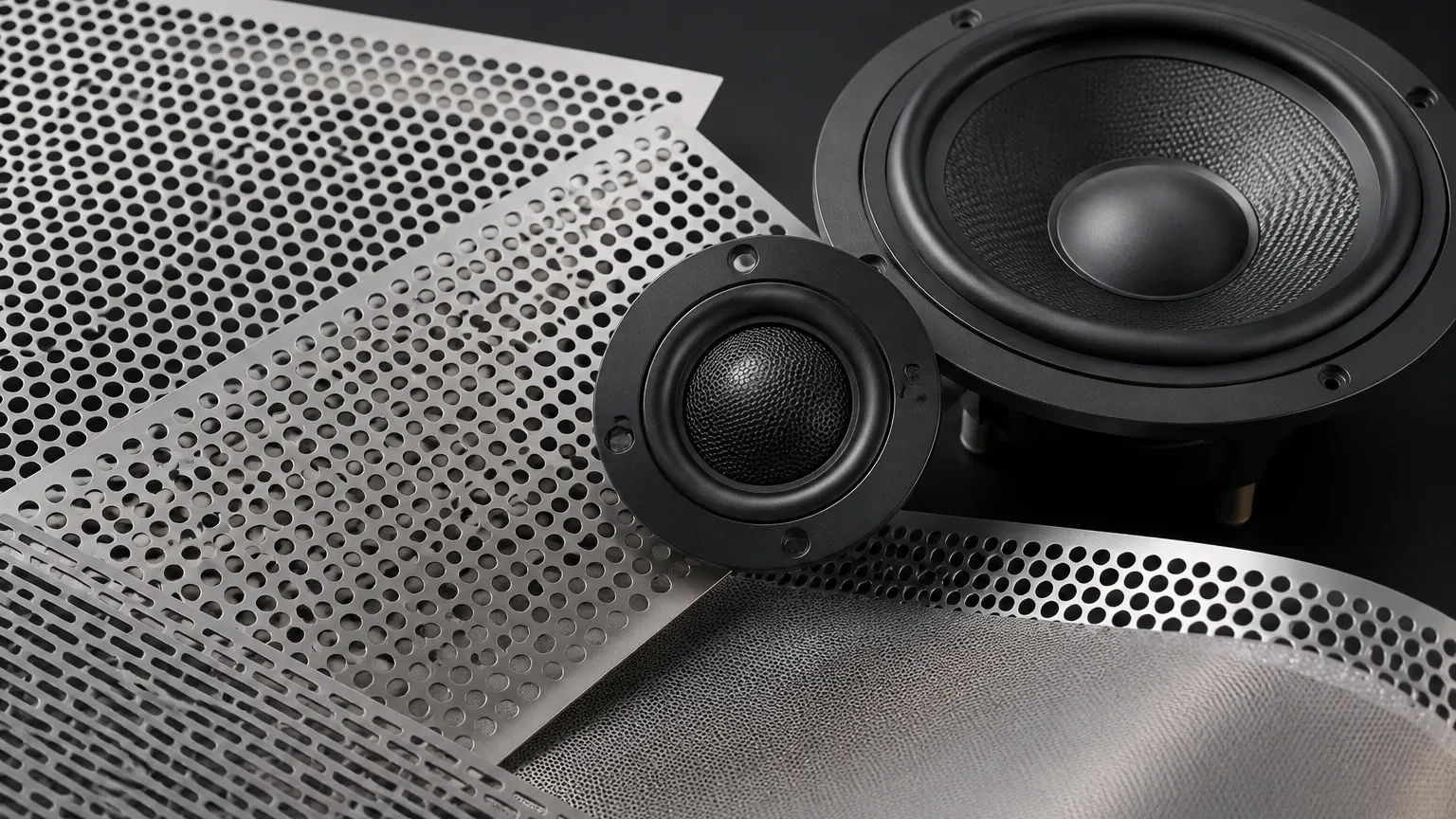
This is the most common pattern for perforated metal for speaker grill production. A 60-degree staggered orientation provides the highest structural strength and the most uniform open area. From an acoustic perspective, round holes minimize the sharp edges that can cause turbulence or air whistling at high volumes.
2. Square Holes
Square holes offer a higher open area than round holes for the same pitch. This makes them excellent for high-transparency needs. However, they are more prone to structural deformation under impact and may require thicker gauges to maintain flatness across large spans.
3. Hexagonal (Honeycomb) Patterns
Hexagonal patterns are often preferred in high-end audio and high-performance industrial equipment. They provide a very high open area (often exceeding 70%) while maintaining a high strength-to-weight ratio. This pattern is particularly effective at reducing the "shadowing" effect on sound waves.
Material Selection for Durability and Performance
The choice of alloy is dictated by the operating environment of the speaker. As a specialist in stainless steel filtration and metal components, Kaifil emphasizes the importance of matching the material to the lifecycle expectations of the product.
Stainless Steel (304 and 316)
Stainless steel is the premium choice for industrial, marine, and outdoor audio systems.
* Grade 304: Offers excellent corrosion resistance and strength. It is the standard for most commercial environments.
* Grade 316: Contains molybdenum, providing superior resistance to chlorides and salt spray, making it essential for marine-grade speaker grills or chemical processing plants.
Aluminum
Aluminum is favored for its lightweight properties and natural resistance to atmospheric corrosion. It is easier to form and shape into curved grill designs. However, it has lower tensile strength than steel, meaning it may need to be thicker to achieve the same impact resistance.
Carbon Steel (Cold Rolled Steel)
Carbon steel is the most cost-effective option for indoor, controlled environments. To prevent rust, it must be finished with a protective coating, such as powder coating or electro-galvanization.
Engineering Considerations: Thickness and Margins
Beyond the holes themselves, the physical dimensions of the metal sheet are vital for a successful integration.
Sheet Thickness (Gauge)
Selecting the correct gauge is a balancing act. A sheet that is too thin will be prone to "oil-canning" (popping in and out) and resonant vibrations. A sheet that is too thick may be difficult to form and adds unnecessary weight to the enclosure. For most medium-sized industrial speakers, a thickness between 0.8mm and 1.5mm is standard.
Margins and Unperforated Borders
When ordering perforated metal for speaker grill components, engineers must specify the "margins." These are the solid areas around the edges of the sheet. Margins are necessary for:
* Mounting: Providing a solid surface for screws, clips, or welding.
* Structural Integrity: Preventing the edges from fraying or becoming sharp.
* Aesthetics: Ensuring a clean, finished look when the grill is seated in the cabinet recess.
Surface Finishing and its Impact on Acoustics
Most industrial speaker grills undergo a secondary finishing process. While these finishes provide color and corrosion protection, they also affect the technical performance of the grill.
* Powder Coating: This is the most common finish. It provides a thick, durable layer of protection. However, engineers must account for the "build-up" of the powder. A heavy coat can reduce the effective hole diameter by 0.1mm to 0.2mm, which in turn reduces the open area. It is critical to calculate the open area based on the *finished* dimensions, not the raw perforated dimensions.
* Anodizing (for Aluminum): This process creates an oxide layer that is integrated with the metal. It does not significantly change the hole size, making it ideal for precision acoustic applications.
* E-Coating: Often used as a primer for automotive or outdoor speakers, e-coating provides a thin, uniform layer that reaches into the interior of the perforations, ensuring no raw metal is exposed to the elements.
Procurement Checklist: What to Confirm Before Ordering
When sourcing Perforated & Expanded Metal for an OEM project, technical professionals should confirm the following details with their manufacturer to ensure the final product meets performance expectations:
1. Hole Size and Pitch: Specify the exact diameter and the distance between centers.
2. Open Area Calculation: Confirm that the calculated open area meets the acoustic transparency requirements of the driver.
3. Flatness Requirements: Perforating metal can introduce internal stresses that cause the sheet to bow. Specify "leveled" or "extra flat" if the grill must sit perfectly flush.
4. Burr Direction: During the punching process, one side of the metal will have a slightly sharper edge (the burr side). Engineers should specify if the burr side should face inward toward the speaker or if the sheet requires deburring.
5. Forming Requirements: If the grill needs to be curved or flanged, ensure the material grade and thickness are compatible with the required radius without cracking.
Conclusion
The selection of perforated metal for speaker grill applications is a specialized engineering task that bridges the gap between mechanical protection and acoustic performance. By carefully considering the open area, hole pattern, and material properties, engineers can ensure that their audio systems are both durable and high-performing.
Kaifil provides precision-manufactured Perforated & Expanded Metal solutions tailored to the rigorous demands of industrial and commercial audio. Whether the application requires the extreme corrosion resistance of 316 stainless steel or a high-transparency hexagonal pattern for high-fidelity sound, understanding these technical boundaries is the first step toward a successful design.
