


Perforated Metal Hexagon
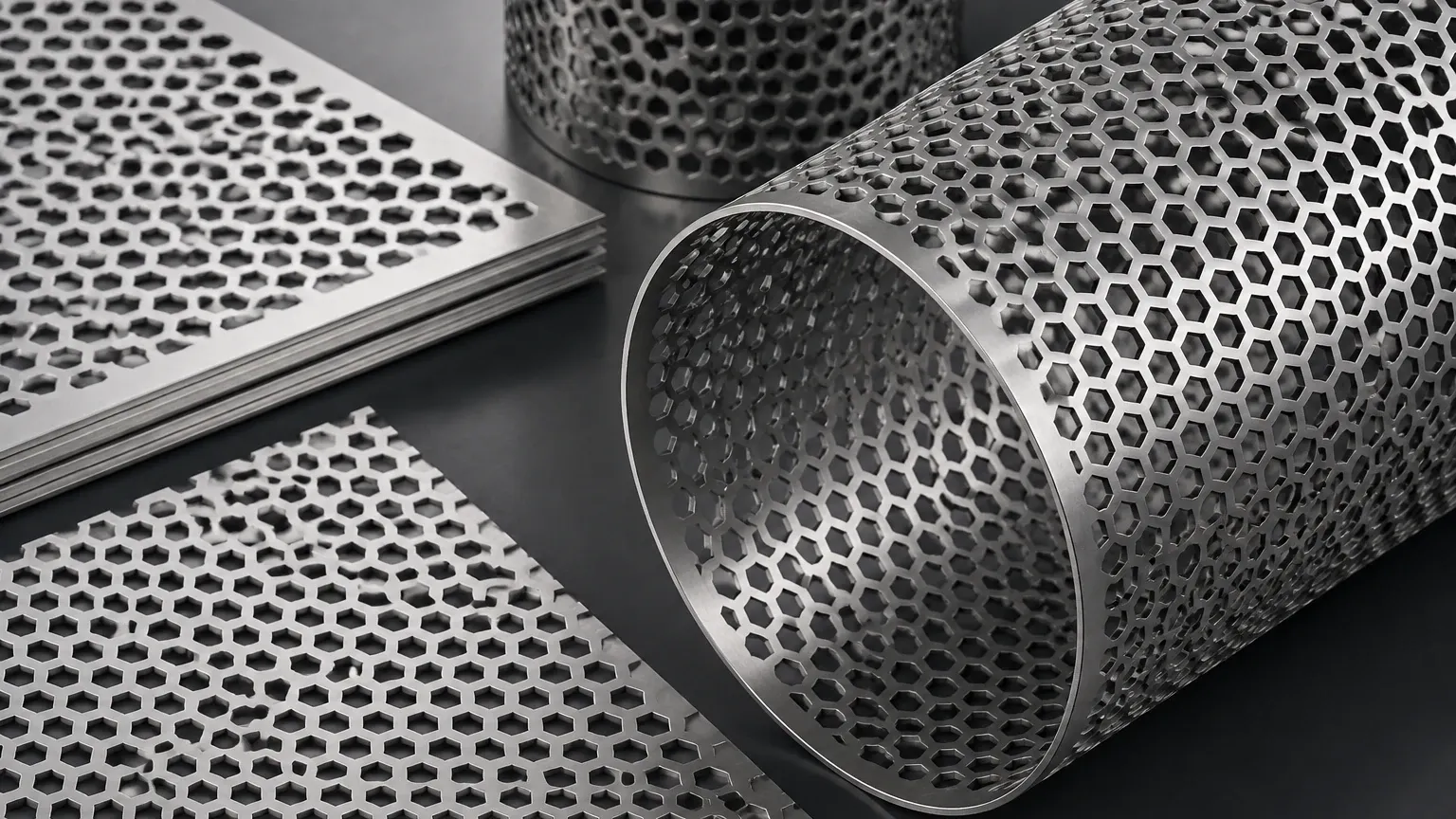
In the field of industrial filtration and structural engineering, the selection of perforation patterns is a critical decision that impacts flow dynamics, structural integrity, and material efficiency. Among the various geometries available in Perforated & Expanded Metal solutions, the hexagonal pattern stands out for its high open-area ratio and unique aesthetic-functional balance. Often referred to as "honeycomb" perforation, the perforated metal hexagon is engineered to provide maximum ventilation and fluid throughput without significantly compromising the strength of the base material.
For engineers and procurement professionals, understanding the technical nuances of hexagonal perforations is essential for optimizing system performance in chemical processing, food production, and architectural applications. This guide examines the engineering considerations, material specifications, and application-specific benefits of hexagonal perforated metal.
Technical Characteristics of Hexagonal Perforations
The perforated metal hexagon is characterized by a series of six-sided holes arranged in a staggered pattern. This specific geometry is favored in industrial design because it allows for a higher open area—often reaching up to 79% to 80%—compared to standard round or square holes.
Geometric Efficiency
From a geometric standpoint, hexagons are the most efficient shape for tiling a plane without gaps. In perforation, this efficiency translates to more "hole" and less "bridge" (the metal remaining between holes). This high open area is particularly beneficial in applications where airflow or liquid flow is the primary performance metric. For example, in heat dissipation for high-performance electronics or industrial machinery, the hexagonal pattern minimizes resistance to air movement, preventing hotspots more effectively than round-hole alternatives.
Strength-to-Weight Ratio
Despite the high percentage of removed material, the hexagonal structure retains a surprising amount of rigidity. The staggered arrangement ensures that stress loads are distributed across the remaining metal bridges. While a round hole is traditionally the strongest for resisting multi-directional stress, the hexagonal pattern offers the best compromise for applications requiring both extreme transparency (high open area) and sufficient structural support to resist sagging or deformation under load.
Material Selection and Durability
The performance of a perforated metal hexagon component is largely dictated by the substrate material. As a specialist in stainless steel filtration solutions, Kaifil emphasizes the selection of alloys that match the operating environment's chemical and thermal demands.
1. Stainless Steel 304: The standard choice for general industrial use. It offers excellent corrosion resistance and is suitable for most indoor and mild outdoor environments. It is commonly used in architectural grilles and basic filtration units.
2. Stainless Steel 316/316L: Specified for high-corrosion environments, such as marine applications, chemical processing plants, and pharmaceutical manufacturing. The addition of molybdenum enhances resistance to pitting and crevice corrosion in chloride-rich environments.
3. Aluminum: Preferred for applications where weight reduction is critical, such as in aerospace or portable filtration equipment. Aluminum also provides natural corrosion resistance through its oxide layer, though it lacks the high-temperature stability of stainless steel.
4. Carbon Steel: Often used in heavy-duty industrial settings where cost-effectiveness is a priority and the environment is controlled (or the material is post-treated with galvanization or powder coating).
Engineering Calculations: Open Area and Flow Rates
When specifying a perforated metal hexagon for a filtration or ventilation system, engineers must calculate the open area to predict pressure drop and flow velocity. The open area for a hexagonal pattern is determined by the hole size (measured flat-to-flat) and the pitch (the distance from the center of one hole to the center of the adjacent hole).
The Open Area Formula
For a staggered hexagonal pattern, the percentage of open area can be calculated using the following engineering formula:
Open Area % = (D² / P²) × 90.69
*Where:*
* D = The diameter of the hexagon (measured across the flats).
* P = The pitch (center-to-center distance between holes).
This formula demonstrates why the hexagonal pattern is so efficient; the constant (90.69) is significantly higher than the constant used for staggered round holes (approx. 90.68) or square holes in a straight line (which varies based on bridge width but rarely achieves the same density).
Impact on Filtration
In filtration applications, a higher open area reduces the "face velocity" of the fluid passing through the medium. Lower face velocity results in a lower pressure drop across the filter, which reduces the energy requirements for pumps and fans. Furthermore, it can extend the life of the filter by allowing for more surface area for particle impingement before the mesh becomes blinded or clogged.
Comparison: Hexagonal vs. Round and Square Patterns
Choosing between different perforation geometries involves trade-offs between cost, strength, and throughput.
* Hexagonal vs. Round: Round holes are the most common and easiest to manufacture, leading to lower tooling costs. However, to achieve an open area equivalent to a hexagon, the bridges between round holes must be made very thin, which can lead to material fatigue or tearing during the punching process. Hexagons provide a more uniform distribution of the remaining metal at high open-area percentages.
* Hexagonal vs. Square: Square holes offer high open areas but are prone to stress concentrations at the corners. This makes square-hole perforated metal more likely to crack under vibration or mechanical stress. The hexagonal pattern avoids sharp 90-degree corners, providing better durability in dynamic industrial environments.
* Aesthetic Considerations: In architectural and high-end industrial equipment design, the "honeycomb" look of the perforated metal hexagon is often preferred for its modern, technical appearance. It is frequently used in speaker grilles, radiator covers, and interior partitions where visual appeal is as important as functionality.
Manufacturing Precision and Customization
Producing high-quality perforated metal requires advanced CNC punching or laser cutting technology to ensure consistency across large sheets. For B2B procurement, several manufacturing factors must be confirmed to ensure the final product meets the intended engineering specifications.
Tooling and Tolerances
Standard hexagonal dies are available in various sizes, typically ranging from 3mm to 20mm or larger. However, custom sizes can be engineered for specific filtration requirements. Tolerance levels are critical; even a minor deviation in the bridge width can significantly alter the total open area of the sheet, potentially causing a system to fail its performance benchmarks.
Margins and Blank Areas
Engineers must specify whether the perforation should be "full-bleed" (running to the very edge of the sheet) or if there should be solid margins. Margins are often necessary for welding the perforated sheet into a frame or a filter cartridge housing. Without specified margins, the ragged edges of a cut hexagonal pattern can be difficult to weld and may present safety hazards during handling.
Leveling and Degreasing
The punching process often introduces internal stresses into the metal, causing the sheet to curl or bow. High-quality manufacturers use precision leveling rollers to ensure the finished perforated metal hexagon sheet is perfectly flat. Additionally, for food-grade or pharmaceutical applications, the sheets must undergo a thorough degreasing process to remove lubricants used during the punching stage.
Industrial Applications of Hexagonal Perforated Metal
Due to its unique properties, the hexagonal pattern is utilized across several specialized sectors:
1. High-End Filtration Systems
In liquid filtration, hexagonal patterns are used as the support core for fine wire mesh or as standalone strainers for large-particle removal. Their high throughput makes them ideal for high-viscosity fluids in the chemical and oil industries.
2. Electronic Shielding and Ventilation
As electronic components become more powerful, they generate more heat. Hexagonal perforated panels are used in server racks and computer chassis to maximize airflow while providing EMI/RFI shielding. The geometry of the hexagon is particularly effective at blocking certain electromagnetic frequencies while remaining almost transparent to air.
3. Food and Beverage Processing
In industrial drying and sorting, hexagonal perforations allow for efficient drainage and air circulation. Stainless steel 316L hexagonal sheets are used in grain drying, malt kilning, and fruit processing where hygiene and corrosion resistance are paramount.
4. Architectural and Acoustic Panels
Hexagonal patterns are frequently used in acoustic ceiling panels and wall claddings. When backed with sound-absorbent material, the perforated metal hexagon acts as a resonator that helps dissipate sound energy, improving the acoustic quality of large industrial or commercial spaces.
Procurement Checklist: What to Confirm Before Ordering
To ensure a successful procurement process for Perforated & Expanded Metal components, engineering and purchasing teams should define the following parameters:
* Material Grade: (e.g., SS304, SS316, Aluminum).
* Sheet Thickness: Specified in gauge or millimeters (must be compatible with the hole size to prevent tool breakage).
* Hole Size (D): The distance between the flat sides of the hexagon.
* Pitch (P): The center-to-center distance between adjacent holes.
* Hole Orientation: Whether the hexagons are oriented with the flat side or the point toward the sheet edge.
* Margins: Width of the solid metal borders on all four sides.
* Flatness Requirements: Whether precision leveling is required after punching.
* Post-Processing: Requirements for deburring, painting, or specialized cleaning.
By focusing on these technical details, engineers can leverage the unique benefits of the perforated metal hexagon to create systems that are more efficient, durable, and cost-effective. Whether for a custom filter cartridge or a large-scale industrial ventilation project, the hexagonal pattern remains a pinnacle of functional geometry in the metalworking industry.
