


Perforated Metal Hole Size
In industrial filtration and structural engineering, the specification of perforated metal is rarely a matter of aesthetics. For engineers and procurement specialists, selecting the correct perforated metal hole size is a critical decision that influences flow dynamics, structural integrity, and the efficiency of the entire filtration system. As a specialized manufacturer of stainless steel filtration solutions, Kaifil understands that the performance of Perforated & Expanded Metal components depends on the precise calibration of hole geometry relative to the material’s thickness and the application's specific demands.
This guide examines the technical considerations surrounding perforated metal hole size, providing the engineering data necessary to optimize filtration performance and ensure long-term durability in demanding environments like chemical processing, food production, and hydraulic systems.
Understanding the Fundamentals of Perforated Metal Hole Size
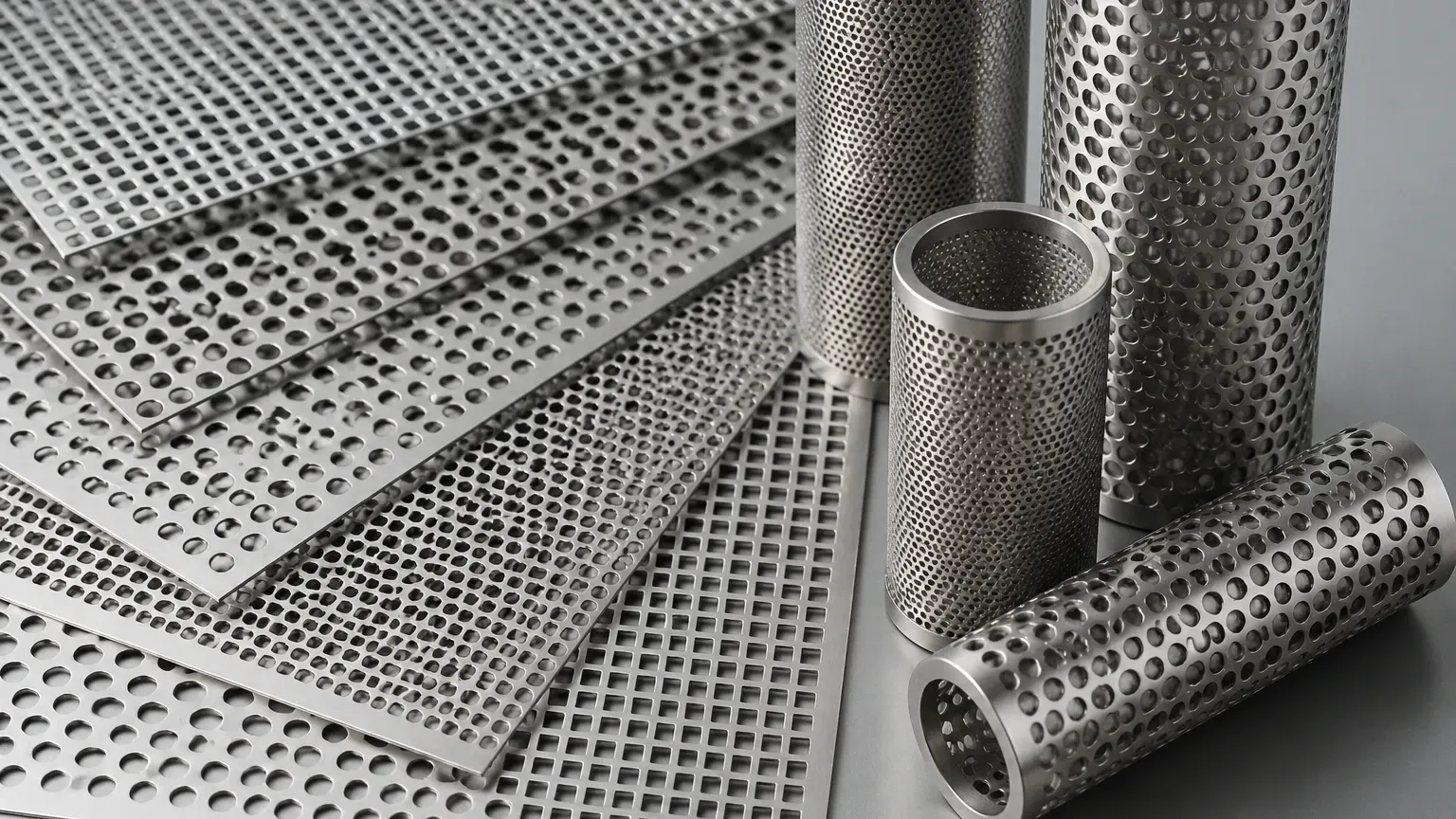
The term "hole size" refers to the dimensions of the openings created during the perforation process, typically via CNC punching or laser cutting. While the diameter of a round hole is the most common metric, hole size also encompasses the width and length of slots or the side dimensions of square and hexagonal patterns.
When specifying perforated metal hole size, it is essential to distinguish between the nominal size and the actual effective opening. In filtration, the hole size determines the "micron rating" or the particle retention capability of the media. For instance, if a process requires the removal of particles larger than 2mm, the hole size must be calculated not just by the diameter of the punch, but by the final tolerances after any secondary processes like electropolishing or coating, which can slightly alter the aperture.
Geometric Patterns and Their Impact
The arrangement of these holes—whether in a 60-degree staggered, 45-degree staggered, or straight-line pattern—interacts with the hole size to define the material’s performance. A 60-degree staggered pattern is the industry standard because it provides the highest open area and uniform strength across the sheet. When the perforated metal hole size is kept constant but the pattern is changed, the flow resistance and structural rigidity of the filter cartridge or screen will shift significantly.
The Relationship Between Hole Size and Open Area
One of the most vital calculations for any engineer is the percentage of open area. This value represents the total area of the holes divided by the total area of the sheet, expressed as a percentage. The perforated metal hole size is the primary variable in this equation, alongside the "pitch" (the distance from the center of one hole to the center of the adjacent hole).
Calculating Open Area for Round Holes
For a standard 60-degree staggered pattern, the formula for open area is:
Open Area % = (D² × 90.69) / P²
*(Where D = Hole Diameter and P = Center-to-Center Pitch)*
If the perforated metal hole size is increased while the pitch remains the same, the open area increases, leading to a lower pressure drop across the filter. However, this also reduces the "bridge" (the metal remaining between the holes), which can compromise the mechanical strength of the component. In high-pressure hydraulic or water treatment applications, finding the balance between a large enough hole size for flow and a small enough size to maintain structural stability is the core engineering challenge.
Material Thickness and the "1:1 Rule"
A common technical constraint in the manufacturing of perforated metal is the relationship between the hole diameter and the sheet thickness. In the industry, this is often referred to as the "1:1 Rule."
The Engineering Constraint
Generally, the perforated metal hole size should not be smaller than the thickness of the material. For example, if you are using a 2mm thick 316L stainless steel sheet, the minimum recommended hole diameter is also 2mm.
Why does this rule exist?
1. Tooling Durability: Punching a hole smaller than the material thickness subjects the punch pin to extreme compressive stress, leading to frequent breakage and increased manufacturing costs.
2. Hole Quality: When the hole size is smaller than the thickness, the risk of "slug pulling" or incomplete perforation increases, resulting in burrs that can trap contaminants or impede flow.
3. Work Hardening: Stainless steel work-hardens during the punching process. Small holes in thick material can lead to micro-fractures around the hole circumference, reducing the fatigue life of the filter cartridge.
While advanced laser cutting can sometimes bypass the 1:1 rule for specialized applications, CNC punching remains the most cost-effective method for high-volume industrial filtration components, making this ratio a primary design boundary.
Selecting Hole Size for Specific Filtration Applications
The choice of perforated metal hole size is dictated by what needs to pass through the screen and what needs to be retained. Kaifil provides customized solutions across several sectors, each with unique sizing requirements.
Chemical and Pharmaceutical Processing
In these industries, precision is paramount. Perforated metal often serves as a support structure for finer wire mesh or as a primary coarse filter. The hole size must be large enough to allow high-viscosity fluids to pass without excessive shear, yet small enough to provide a rigid backing for delicate mesh layers. Smooth, burr-free hole edges are required to prevent bacterial growth and ensure effective Clean-in-Place (CIP) cycles.
Food and Beverage Industry
For applications like fruit juice straining or grain separation, the perforated metal hole size is selected based on the specific dimensions of the organic solids. For instance, in brewery lauter tuns, milled grain must be retained to form a natural filter bed; the slots or holes must be narrow enough to hold the grain but wide enough to allow the wort to flow freely. Stainless steel 304 or 316 is standard here to ensure corrosion resistance and food safety.
Hydraulic and Water Treatment
In hydraulic systems, perforated metal is frequently used as a suction strainer. The hole size is designed to protect pumps from large debris (nuts, bolts, or scale). If the hole size is too small, the resulting pressure drop can cause pump cavitation. If it is too large, the pump's internal components may be damaged by debris. Engineers must calculate the "Total Open Area" (TOA) to ensure it is at least 3 to 4 times the area of the intake pipe.
Customization and Manufacturing Tolerances
When sourcing Perforated & Expanded Metal, understanding tolerances is essential for a proper fit in industrial housings. Standard commercial tolerances for perforated metal hole size are typically +/- 0.1mm to 0.5mm, depending on the material thickness and the punching method.
Precision Customization
Kaifil offers customized filtration components where the hole size can be tailored to non-standard increments. This is particularly useful when a standard "off-the-shelf" size (like 1/8" or 3mm) does not meet the specific micron retention requirements of a proprietary process.
Beyond the hole size itself, engineers should confirm the following customization options:
* Margins: The unperforated areas along the edges of the sheet. Proper margins are necessary for welding the perforated metal into a cylinder for a filter cartridge.
* Blank Areas: Specific zones within the sheet that remain unpunched for structural mounting or bolt holes.
* Surface Finishes: Electropolishing or pickling can slightly increase the effective hole size while removing burrs and improving corrosion resistance.
Common Risks and Evaluation Criteria
Selecting the wrong perforated metal hole size or failing to account for secondary factors can lead to system failure. Engineers should evaluate the following risks during the design phase:
1. Blinding and Clogging: If the hole size is too close to the size of the particles being filtered, "near-size" particles can become wedged in the openings. This is known as blinding. Using a staggered pattern or a specific hole shape (like tapered holes) can help mitigate this.
2. Pressure Drop: A hole size that is too small for the required flow rate will cause a significant pressure differential. This increases energy consumption and puts stress on seals and joints.
3. Media Migration: In multi-stage filtration, if the support layer's hole size is too large, the finer primary filter media (like wire mesh) may deform into the holes under pressure, eventually leading to a breach.
4. Structural Fatigue: High open area (achieved through large hole sizes and small pitches) reduces the amount of metal available to resist mechanical loads. In vibrating screens or high-pressure housings, this can lead to cracking.
Conclusion: Confirming Technical Requirements
To ensure the success of a filtration project, the purchasing and engineering teams should confirm several key details before proceeding with a custom order. At Kaifil, we recommend a thorough review of the following:
* Target Particle Size: What is the minimum and maximum particle size that must be retained?
* Operating Pressure and Temperature: Will the material thickness support the chosen hole size under these conditions?
* Flow Rate Requirements: What is the minimum required open area percentage to maintain system efficiency?
* Chemical Compatibility: Is the chosen metal (e.g., 304, 316L, or specialty alloys) resistant to the process fluid at the specified hole size?
By focusing on the technical interplay between perforated metal hole size, material thickness, and open area, engineers can specify components that deliver reliable, long-term performance. Whether you are designing a new hydraulic system or optimizing a pharmaceutical filtration process, the precision of the perforation is the foundation of system integrity.
For detailed technical specifications and to explore customization options for your specific industrial application, Review product options and application support to find the ideal balance of filtration accuracy and structural durability.
