


Perforated Metal in Architecture
In modern industrial and commercial construction, the selection of materials is driven by a balance of structural integrity, functional performance, and environmental resilience. Perforated metal has transitioned from a purely industrial component used in filtration and sorting to a primary element in architectural design. When specifying Perforated & Expanded Metal for large-scale projects, engineers and architects must move beyond aesthetic considerations to evaluate technical parameters such as open area ratios, load-bearing capacities, and material compatibility.
This guide examines the technical nuances of using perforated metal in architecture, providing the data necessary for informed procurement and engineering specification.
Understanding Perforated & Expanded Metal in Structural Design
While often grouped together, perforated metal and expanded metal are manufactured through distinct processes that result in different physical properties. Understanding these differences is critical for selecting the correct material for architectural facades, sunscreens, or interior partitions.
Perforated Metal Manufacturing
Perforated metal is produced by mechanically punching or laser-cutting a series of holes into a solid metal sheet. This process allows for extreme precision in hole placement and geometry. Engineers can specify exact hole diameters, staggered or straight patterns, and custom margins (the solid areas around the edges of the sheet). This precision makes it the preferred choice for applications requiring specific airflow calculations or acoustic performance.
Expanded Metal Manufacturing
Expanded metal is created by simultaneously slitting and stretching a sheet of metal. This process creates diamond-shaped openings without any material waste, making it a highly cost-effective and sustainable option. Because the metal is stretched rather than punched, the resulting mesh is often stronger per pound than the original sheet, as the strands are oriented at an angle to the plane of the sheet, providing inherent structural rigidity.
For most applications involving perforated metal in architecture, the choice between these two depends on the required transparency, the weight-to-strength ratio, and the specific environmental stressors the material will face.
Key Engineering Considerations for Architectural Specification
Specifying metal components for architectural use requires a deep dive into the physics of the material. The following parameters are the most critical for ensuring the longevity and safety of the installation.
Open Area Calculations
The "open area" is the percentage of the sheet that is occupied by holes. This is perhaps the most important metric for engineers, as it dictates:
* Light Transmission: How much natural light enters a building.
* Airflow/Ventilation: The pressure drop across the panel, which affects HVAC efficiency.
* Visibility: The level of privacy or transparency provided by the screen.
For example, a round hole pattern with a 60-degree staggered pitch provides a high open area while maintaining structural uniformity. Engineers must calculate the open area to ensure that architectural facades do not create excessive wind resistance (wind loading) or fail to provide adequate ventilation for mechanical systems housed behind the panels.
Hole Geometry and Pitch
The shape of the perforation—whether round, square, slotted, or hexagonal—affects both the strength of the panel and its visual impact. Round holes are the most common due to their ease of manufacture and uniform stress distribution. The "pitch" refers to the distance between the centers of adjacent holes. A tighter pitch increases the open area but reduces the overall strength of the metal bridge (the material between the holes).
Material Selection: Why Stainless Steel Dominates Industrial Architecture
In the context of perforated metal in architecture, material selection is the primary determinant of the project's lifespan. While aluminum and carbon steel are used in certain environments, stainless steel remains the industry standard for high-performance architectural applications.
Corrosion Resistance
Architectural elements are frequently exposed to harsh environments, including coastal salt air, industrial pollutants, and extreme humidity. Kaifil specializes in stainless steel solutions because of the material's inherent chromium content, which forms a self-healing passive layer. For most architectural applications, Grade 304 provides excellent resistance, while Grade 316 is specified for marine environments or areas with high chemical exposure to prevent pitting and crevice corrosion.
Durability and Maintenance
Unlike coated carbon steel, which can rust if the surface is scratched, stainless steel maintains its integrity throughout its thickness. This is particularly important for perforated panels where the edges of every hole are exposed to the atmosphere. Stainless steel requires minimal maintenance, typically only needing periodic cleaning to remove surface contaminants that could lead to staining.
Functional Applications: Beyond Aesthetics
While the visual appeal of perforated metal is undeniable, its primary value in architecture lies in its multi-functional capabilities. Engineers utilize these materials to solve complex environmental and structural challenges.
Solar Shading and Thermal Control
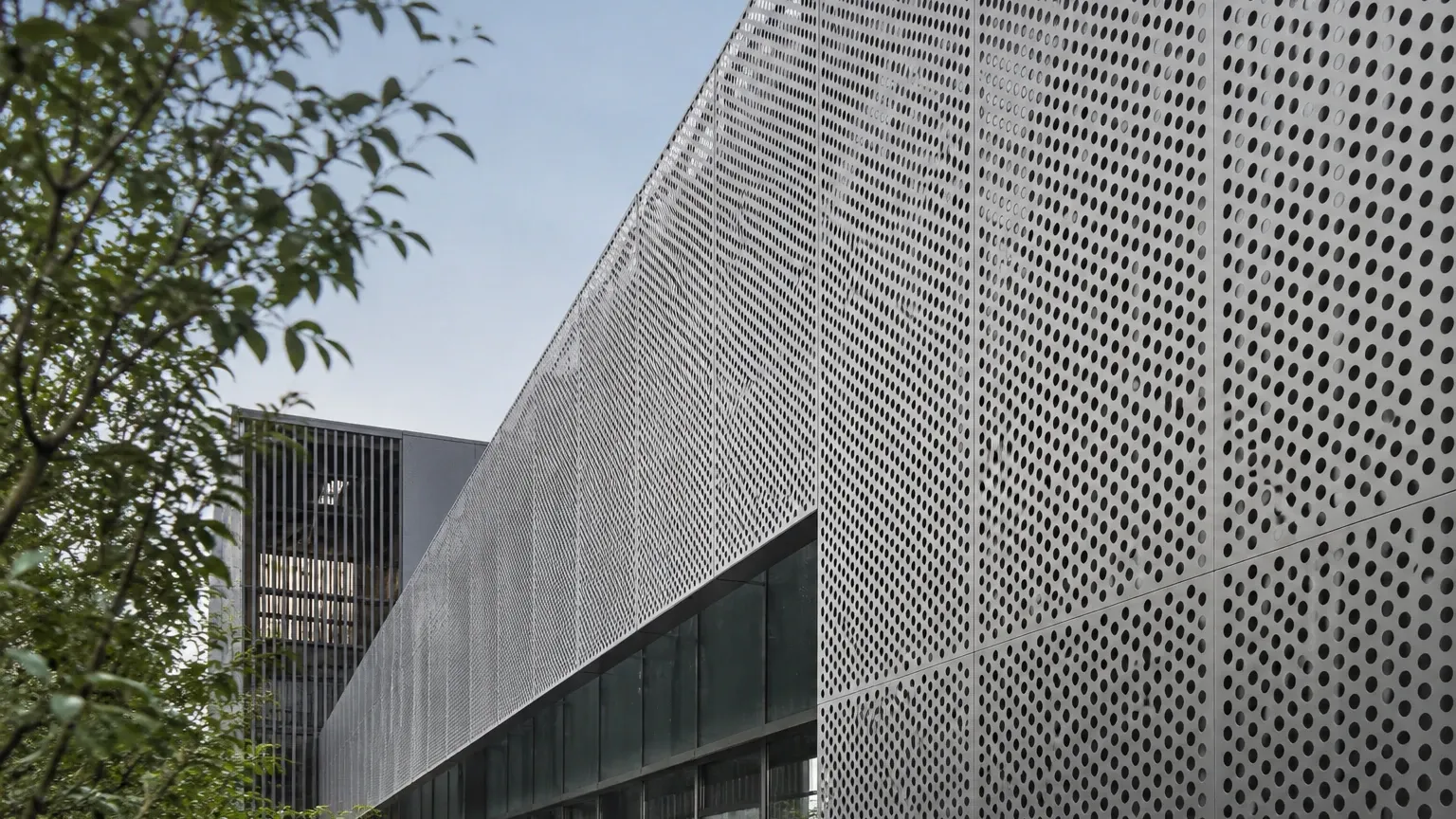
One of the most common uses of perforated metal in architecture is the creation of "second skins" or sunscreens. By calculating the angle of the sun and the required open area, engineers can design panels that block direct solar heat gain while still allowing diffused natural light to enter the workspace. This significantly reduces the cooling load on the building's HVAC system, contributing to LEED certification and overall energy efficiency.
Acoustic Performance
Perforated metal is an essential component in acoustic engineering. When used in conjunction with sound-absorbing materials, perforated panels act as a transparent face that allows sound waves to pass through to the insulation, where the energy is dissipated. This is widely used in transit hubs, auditoriums, and industrial facilities to manage noise levels without sacrificing the durability of the wall or ceiling surfaces.
Safety and Security
Expanded metal, in particular, is highly effective for security screening. Its three-dimensional structure makes it difficult to cut or climb, yet it maintains visibility for security personnel. In architectural contexts, this is often used for parking garage enclosures, pedestrian bridges, and machinery guards where both airflow and protection are required.
Evaluating Performance and Durability in Demanding Environments
When integrating perforated metal into a building’s envelope, engineers must perform a series of performance evaluations to ensure the material can withstand site-specific conditions.
Wind Loading and Structural Integrity
Large architectural panels act as sails. Engineers must determine the maximum wind speeds the panels will encounter and ensure the thickness (gauge) of the metal and the support structure can handle the resulting pressure. The open area plays a significant role here; a higher open area reduces wind resistance but may also reduce the panel's ability to resist physical impact.
Thermal Expansion
Metal expands and contracts with temperature fluctuations. In long runs of architectural cladding, specify appropriate fastening systems that allow for thermal movement. Failure to account for this can lead to oil-canning (buckling) of the panels or failure of the attachment points.
Edge Conditions and Margins
In a B2B procurement context, specifying the "margins" is vital. Margins are the unperforated areas along the edges of the sheet. Providing solid margins increases the structural rigidity of the panel and provides a clean area for welding or mechanical fastening to the sub-frame. Engineers should confirm whether they require "finished ends" (where the pattern is centered and complete) or "unfinished ends" (where the pattern is sheared through).
Procurement and Customization: What Engineers Need to Confirm
To ensure a successful project, purchasing teams and engineers should confirm several technical details before finalizing an order for Perforated & Expanded Metal.
1. Material Grade and Finish: Confirm the specific alloy (e.g., SS304 vs. SS316) and the desired finish (e.g., 2B mill finish, brushed, or electropolished). Electropolishing is often recommended for architectural stainless steel to enhance corrosion resistance and provide a uniform luster.
2. Flatness Requirements: The punching process can introduce internal stresses into the metal, causing it to curl. Specify "leveling" if the panels must be perfectly flat for a facade application.
3. Tolerances: Standard industrial tolerances may not be sufficient for high-end architectural finishes. Clearly define acceptable variances in hole diameter, pitch, and panel dimensions.
4. Custom Hole Patterns: Advanced manufacturing allows for "image perforation," where hole sizes are varied across a panel to create a visual image or gradient. If this is required, provide detailed CAD files early in the consultation process.
Total Cost of Ownership in Architectural Filtration and Screening
When evaluating the cost of perforated metal, it is essential to look beyond the initial purchase price. The total cost of ownership (TCO) includes installation labor, maintenance, and the projected lifespan of the material.
Choosing a high-quality stainless steel solution from a dedicated manufacturer like Kaifil ensures that the components will not require replacement due to corrosion or structural failure for decades. Furthermore, the energy savings realized through effective solar shading often offset the premium cost of stainless steel over a few years of building operation.
Conclusion
Perforated metal in architecture is a sophisticated engineering tool that offers a unique combination of transparency, strength, and environmental control. By focusing on technical specifications—such as open area, material grade, and structural margins—engineers can specify solutions that enhance both the performance and the longevity of modern structures. Whether the goal is to manage thermal gain, improve acoustic quality, or provide a durable security barrier, the precision of perforated and expanded metal remains an indispensable asset in the architectural toolkit.
