


Perforated Metal in Rhino
In the realm of industrial design and precision engineering, Rhinoceros 3D (Rhino) has become a primary tool for developing complex filtration systems and structural components. For engineers and designers, the challenge lies in accurately representing perforated metal in rhino while ensuring the digital model remains compatible with physical manufacturing constraints. Bridging the gap between a high-fidelity 3D model and the actual production of Perforated & Expanded Metal requires a deep understanding of both software capabilities and industrial fabrication limits.
At Kaifil, we specialize in translating these technical designs into high-performance stainless steel filtration solutions. Whether you are designing a custom filter cartridge for chemical processing or a precision screen for food and beverage applications, understanding how to handle perforated geometries in a CAD environment is the first step toward a successful industrial product.
Modeling Techniques for Perforated Metal in Rhino
When working with perforated patterns in Rhino, engineers often face a trade-off between visual accuracy and computational performance. Creating thousands of individual holes as physical geometry (NURBS surfaces) can significantly slow down a workstation and complicate downstream processes like FEA (Finite Element Analysis) or CFD (Computational Fluid Dynamics).
1. Parametric Modeling with Grasshopper
For complex or non-standard patterns, Grasshopper—the visual programming environment within Rhino—is the most effective tool. It allows designers to define the logic of a perforation pattern (such as hole diameter, pitch, and staggered vs. straight alignment) and apply it to any surface. This is particularly useful for cylindrical filter cartridges where the hole density might need to vary across the length of the component to manage flow distribution.
2. Texture Mapping and Alpha Channels
For large-scale industrial assemblies where the structural detail of every hole is not required for the immediate design phase, using textures with alpha channels is preferred. This method simulates the appearance of perforated metal without the computational overhead of millions of polygons. However, this approach is insufficient for manufacturing; eventually, the design must be converted into vector data (DXF or DWG) for CNC punching or laser cutting.
3. Geometry Displacement
Intermediate between textures and full NURBS geometry is displacement mapping. This technique uses a grayscale heightmap to generate 3D geometry at render time. While useful for visualization, engineers must ensure that the final output provided to manufacturers like Kaifil is based on precise geometric coordinates rather than visual approximations.
Engineering Specifications for Perforated & Expanded Metal
Transitioning from a digital model to a physical component requires strict adherence to engineering standards. When specifying Perforated & Expanded Metal for industrial filtration, several variables must be defined in the Rhino model to ensure the final product meets performance expectations.
Open Area Calculations
The "Open Area" is the most critical metric for filtration efficiency and pressure drop calculations. In Rhino, you can calculate this by measuring the area of a single pattern unit and dividing the hole area by the total unit area. For a standard 60-degree staggered pattern, the formula is:
$$OA = \frac{D^2 \times 90.69}{P^2}$$
Where:
* D = Hole Diameter
* P = Pitch (distance between centers of holes)
Ensuring that your Rhino model reflects a realistic open area is vital. If the open area is too low, the pressure drop across the filter will be excessive; if it is too high, the structural integrity of the stainless steel sheet may be compromised.
Hole Patterns and Pitch
Standard patterns include round, square, and hexagonal holes. Round holes with a 60-degree staggered pitch are the most common in industrial filtration due to their inherent structural strength and uniform flow characteristics. When modeling perforated metal in rhino, designers should align their digital pitch with standard industrial tooling to avoid the high costs associated with custom punch dies.
Material Selection and Industrial Durability
Kaifil produces filtration components primarily from stainless steel, chosen for its corrosion resistance and mechanical properties. When designing in Rhino, the material thickness (gauge) must be factored into the 3D model, especially when the perforated sheet is to be rolled into a cylinder or welded into a multi-layered filter cartridge.
Stainless Steel 304 vs. 316L
* Grade 304: Suitable for general industrial use, providing excellent formability and welding characteristics. It is commonly used in food processing and architectural applications.
* Grade 316L: The "L" stands for low carbon, which improves weldability and prevents sensitization. This grade is essential for pharmaceutical and marine environments where resistance to chloride-induced pitting is required.
Expanded Metal Considerations
Unlike perforated metal, which is punched, expanded metal is slit and stretched. This creates a diamond-shaped mesh that is integral to the sheet, meaning there is no waste material. In Rhino, modeling expanded metal is more complex due to the three-dimensional nature of the strands. Designers must account for the "strand width" and "thickness" to ensure the mesh fits within the housing of the filtration unit.
Manufacturing Feasibility: From Rhino to Production
A common pitfall in digital design is creating geometries that are impossible or cost-prohibitive to manufacture. When preparing your Rhino files for Kaifil’s production line, consider the following "Rule of Thumb" for perforated metal:
1. Hole Size vs. Thickness: Generally, the hole diameter should not be smaller than the material thickness. For example, if you are using a 2mm thick stainless steel sheet, the minimum hole diameter should be 2mm. Attempting to punch holes smaller than the thickness increases the risk of tool breakage and burr formation.
2. The Bar Width: The distance between holes (the "bar") should be at least equal to the material thickness to maintain the structural integrity of the sheet during the punching process.
3. Margins and Dead Zones: In Rhino, it is easy to model perforations that go right to the edge of a part. In reality, a "safe margin" of unperforated material is usually required for welding or mounting. Clearly define these unperforated borders in your CAD data.
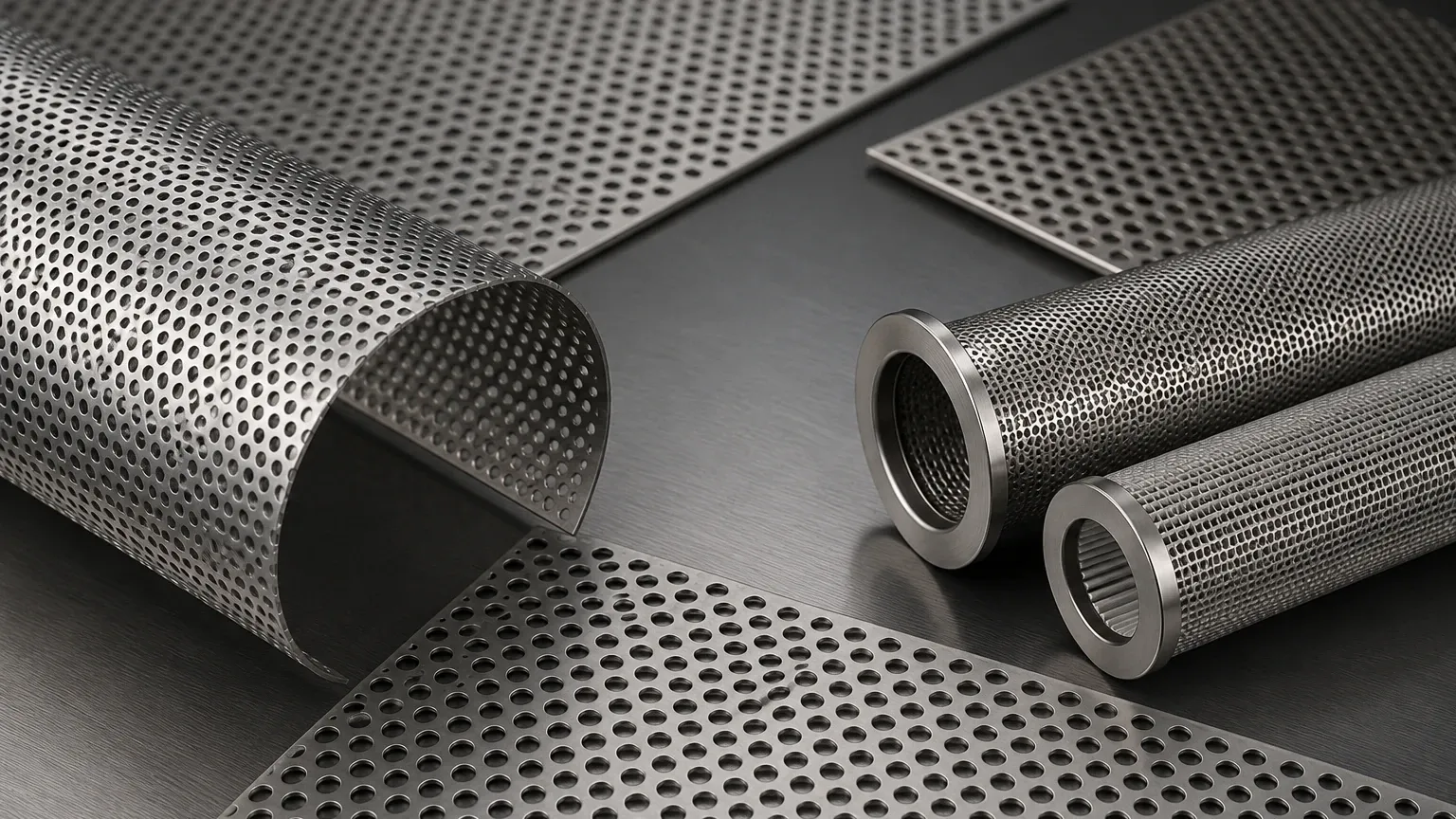
Performance Evaluation in Filtration Systems
Engineers using Rhino for filtration design often integrate their models into simulation suites. The performance of Perforated & Expanded Metal is evaluated based on its ability to withstand operational stresses while maintaining a specific filtration accuracy.
Pressure Drop and Flow Velocity
Using the geometric data from the Rhino model, engineers can simulate how fluid moves through the perforated media. High flow velocities through small openings can lead to erosion or cavitation. By adjusting the hole density in the digital model, designers can optimize the flow profile before any physical prototypes are built.
Structural Integrity under Differential Pressure
In hydraulic and high-pressure water treatment applications, the perforated metal often acts as a support for finer wire mesh layers. The Rhino model must account for the structural load-bearing capacity of the perforated plate. If the differential pressure exceeds the yield strength of the material, the filter may collapse. Kaifil provides engineering support to ensure that the selected gauge and pattern can handle the specific demands of your application.
Customization and Procurement Checklist
Before finalizing a design and moving to the procurement phase, purchasing teams and engineers should confirm several technical details. Providing a detailed Rhino-generated drawing or a clean DXF file to the manufacturer ensures an accurate quote and a faster production cycle.
Key Information to Confirm:
* Material Grade: (e.g., SS304, SS316L, or specialized alloys).
* Sheet Dimensions: Length, width, and thickness.
* Hole Specifications: Shape, diameter, and pitch.
* Pattern Orientation: Staggered (60° or 45°) or straight.
* Margins: Dimensions of unperforated edges on all four sides.
* Post-Processing: Requirements for deburring, degreasing, or pickling and passivation.
* Quantity: Industrial filtration projects often benefit from economies of scale in the punching process.
For those seeking technical guidance on material compatibility or custom pattern development, you can Review product options and application support to see how our manufacturing capabilities align with your Rhino-based designs.
Conclusion
Modeling perforated metal in rhino is a powerful way to visualize and engineer advanced filtration components. However, the digital model is only as good as its manufacturability. By considering the physical properties of stainless steel, the limitations of CNC punching, and the specific requirements of the industrial environment, engineers can create designs that are both innovative and practical.
Kaifil remains committed to supporting global engineering teams with high-quality, customized Perforated & Expanded Metal solutions. From the initial CAD design to the final filtration component, our focus on precision and durability ensures that your systems perform reliably in the most demanding chemical, pharmaceutical, and industrial applications.
