


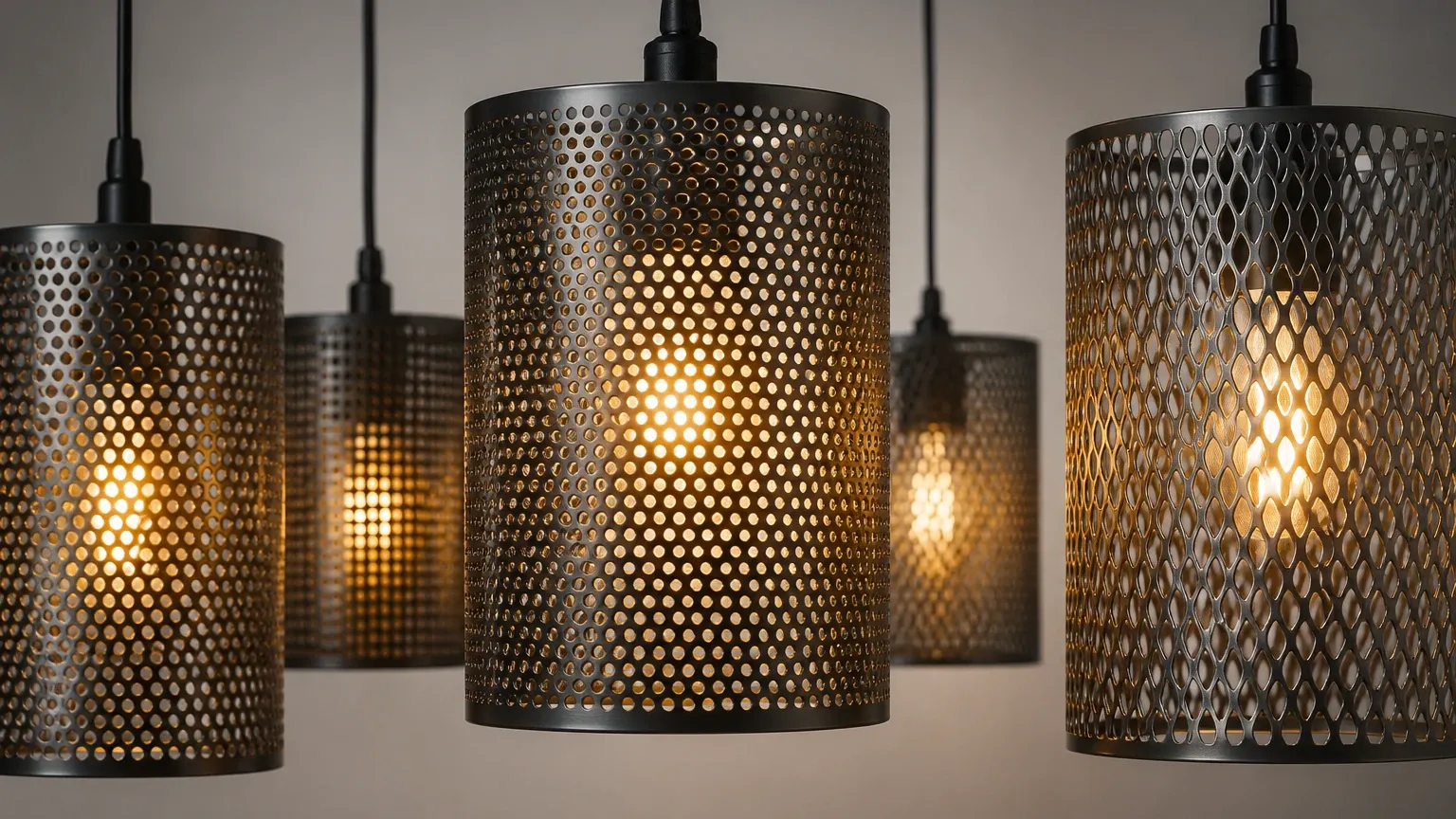
Perforated Metal Light Shade
In industrial, commercial, and high-end architectural applications, a perforated metal light shade is more than a decorative element; it is a precision-engineered component designed to manage light distribution, facilitate heat dissipation, and ensure structural longevity. For engineers and procurement specialists, selecting the right materials and patterns for these components requires a deep understanding of metallurgy, open area calculations, and manufacturing tolerances.
As a specialist in custom stainless steel and precision metal components, Kaifil provides the technical expertise necessary to transition from a conceptual design to a high-performance filtration or lighting component. Utilizing Perforated & Expanded Metal allows for a level of customization that standard off-the-shelf solutions cannot match, particularly in demanding environments where corrosion resistance and thermal stability are paramount.
Technical Fundamentals of Perforated Metal in Lighting
The primary function of a perforated metal light shade is to control the transmission of light while maintaining the physical integrity of the fixture. This is achieved through the precise arrangement of holes punched into a metal sheet. The performance of the shade is dictated by several technical factors:
Open Area Percentage
The "open area" is the ratio of the area of the holes to the total area of the sheet, expressed as a percentage. This metric is critical because it determines exactly how much light will pass through the shade. For example, a 60-degree staggered round hole pattern provides a uniform distribution of light and a high strength-to-weight ratio.
Calculating the open area involves specific formulas. For a 60-degree staggered round hole pattern, the formula is:
OA = (D² × 90.69) / P²
*Where D is the hole diameter and P is the center-to-center pitch.*
Engineers must balance the desired luminous intensity with the structural rigidity of the shade. A higher open area allows for more light but may reduce the shade's resistance to mechanical stress or impact.
Light Diffusion and Moire Effects
Perforated metal acts as a mechanical diffuser. By breaking up the light source into thousands of smaller points, it reduces glare and creates a softer ambient environment. However, designers must be cautious of the Moire effect—an interference pattern that can occur when two layers of perforated metal are overlaid or when the hole size interacts poorly with certain LED frequencies. Precision in hole alignment during the manufacturing process is essential to mitigate these visual artifacts.
Material Selection for Industrial and Commercial Environments
The choice of material for a perforated metal light shade significantly impacts its lifespan and performance, especially in industrial settings where exposure to chemicals, moisture, or extreme temperatures is common.
Stainless Steel (Grades 304 and 316)
Stainless steel is the preferred choice for applications requiring maximum durability and corrosion resistance. Grade 304 is suitable for most indoor and light outdoor applications. However, for coastal environments or chemical processing facilities where the light shade may be exposed to chlorides or acidic vapors, Grade 316 is recommended due to its molybdenum content, which provides superior pitting resistance.
Aluminum
Aluminum is favored for its lightweight properties and excellent thermal conductivity. In high-output LED lighting, the metal shade often doubles as a secondary heat sink. Aluminum’s ability to dissipate heat rapidly helps extend the life of the electronic components within the fixture. Furthermore, aluminum is naturally corrosion-resistant and can be anodized to provide a variety of technical finishes.
Specialty Alloys and Carbon Steel
In some industrial contexts, carbon steel may be used if it is subsequently treated with a high-performance powder coating or galvanization. While more cost-effective, it lacks the inherent longevity of stainless steel in high-moisture environments. For specific architectural aesthetics or electrical grounding requirements, brass or copper may also be utilized.
Engineering Considerations for Heat Dissipation
Modern lighting systems, particularly high-intensity LEDs, generate significant thermal energy. If this heat is not managed, it can lead to premature failure of the LED chips and drivers. A perforated metal light shade provides a distinct advantage over solid materials or plastics due to its high thermal conductivity and the presence of perforations that allow for convective cooling.
Convective Airflow
The holes in a perforated shade allow air to circulate freely around the light source. As the air inside the shade warms up, it rises (the chimney effect), drawing cooler air in through the lower perforations. This passive cooling mechanism is vital for maintaining the junction temperature of the LEDs within safe operating limits. When specifying Perforated & Expanded Metal for lighting, engineers should consider the hole size in relation to airflow resistance to optimize this cooling effect.
Thermal Radiation
Metal surfaces are efficient at radiating heat away from the source. By selecting finishes with specific emissivity values—such as certain matte powder coatings or specialized anodized layers—the thermal performance of the light shade can be further enhanced.
Manufacturing Processes and Customization
Producing a high-quality perforated metal light shade involves several sophisticated manufacturing steps. At Kaifil, the process is tailored to meet the exact specifications of the OEM client.
1. Perforating: Utilizing CNC turret presses or high-speed perforating lines, holes are punched into the metal sheet with extreme precision. This ensures that the pitch and diameter remain consistent across the entire surface, which is critical for both aesthetics and light uniformity.
2. Leveling: The punching process can introduce internal stresses into the metal, causing it to curl or warp. Precision leveling is required to ensure the sheet is perfectly flat before it is formed into the final shade shape.
3. Forming and Bending: The perforated sheets are then bent, rolled, or deep-drawn into the required geometry—whether it be a simple cylinder, a complex cone, or a custom geometric box. Care must be taken during this stage to ensure the hole patterns do not deform at the bend radii.
4. Welding and Assembly: For many industrial shades, the seams must be joined. TIG (Tungsten Inert Gas) welding is often preferred for stainless steel to provide clean, strong joints that do not detract from the visual quality of the piece. Spot welding may be used for internal bracing or mounting brackets.
5. Surface Finishing: Depending on the application, the shade may undergo electropolishing (for stainless steel), anodizing (for aluminum), or powder coating. These finishes provide not only the desired color and texture but also an additional layer of protection against environmental degradation.
Selection Criteria for B2B Procurement
When sourcing perforated metal light shades for large-scale projects or OEM equipment, procurement teams should evaluate suppliers based on several technical benchmarks:
* Tolerance Standards: Industrial applications often require tight tolerances on both the dimensions of the shade and the placement of the holes. Suppliers should be able to demonstrate compliance with standard industry tolerances (e.g., IPA – Industrial Perforators Association standards).
* Edge Configurations: A "safe margin" (a solid area around the perimeter of the perforated pattern) is often necessary for welding or mounting. Specifying the width of these margins is essential during the design phase to avoid cutting through holes, which can leave sharp, jagged edges.
* Material Certification: For industries such as food and beverage or pharmaceuticals, material traceability is a requirement. Ensure the supplier can provide Mill Test Reports (MTRs) to verify the chemical composition and mechanical properties of the metal.
* Customization Capabilities: Can the manufacturer handle non-standard hole shapes (slotted, hexagonal, or custom decorative patterns) or variable pitch layouts? Customization is often the key to solving specific light-throw or shielding challenges.
Maintenance and Long-Term Durability
One of the primary reasons engineers specify Perforated & Expanded Metal for light shades is the low maintenance requirement compared to glass or plastic. In industrial environments, dust and grease accumulation can significantly reduce light output.
Perforated metal is inherently robust; it does not shatter like glass and is more resistant to UV degradation and yellowing than most polymers. Cleaning typically involves high-pressure air or mild aqueous detergents. In heavy industrial settings, the ability to remove the shade and steam-clean it without risk of damage is a major operational advantage. Furthermore, the metal is fully recyclable at the end of its service life, supporting corporate sustainability goals.
Conclusion: Selecting the Right Filtration and Metal Partner
Designing and specifying a perforated metal light shade requires a balance of optical performance, thermal management, and mechanical durability. By focusing on material grade, open area calculations, and precision manufacturing, engineers can ensure that their lighting solutions meet the rigorous demands of industrial and commercial applications.
Kaifil’s expertise in metal fabrication and filtration solutions ensures that every component is manufactured to the highest standards of accuracy. Whether the requirement is for a standard cylindrical shade or a complex, custom-engineered metal component, understanding the technical boundaries of Perforated & Expanded Metal is the first step toward achieving optimized performance and long-term reliability in any lighting or industrial system.
