


Perforated Metal Liner
In industrial filtration and fluid processing, the structural integrity of a filter element is as critical as the filtration media itself. A perforated metal liner serves as the essential "skeleton" for various filtration components, providing the necessary mechanical strength to withstand high differential pressures while maintaining the desired flow characteristics. For engineers and procurement specialists, selecting the correct liner involves a complex balance of material science, geometric configurations, and manufacturing precision.
As a specialized component within the broader category of Perforated & Expanded Metal, these liners are most commonly utilized as internal support cores or external protective cages for filter cartridges. This guide examines the technical specifications, engineering considerations, and selection criteria required to optimize the performance and longevity of industrial filtration systems.
The Role of Perforated Metal Liners in Industrial Filtration
The primary function of a perforated metal liner is to provide rigid support to flexible or fragile filter media, such as wire mesh, filter paper, or synthetic membranes. Without a robust liner, the pressure exerted by the fluid flow would cause the media to collapse or deform, leading to bypass, reduced filtration efficiency, or total system failure.
Internal Support Cores
In most cylindrical filter designs, the fluid flows from the outside in (out-to-in). In this configuration, the perforated metal liner acts as an internal core. It must resist the compressive forces generated by the pressure drop across the filter media. If the core is under-designed, it may buckle, compromising the entire assembly.
External Protective Cages
Conversely, when fluid flows from the inside out, or when the filter media requires protection from mechanical damage during installation and handling, an external perforated liner is used. This cage protects the pleats of a filter or the delicate layers of a multi-layer sintered mesh from abrasion and impact.
Flow Distribution and Turbulence Control
Beyond structural support, the hole pattern of a perforated metal liner influences the fluid dynamics within the filter housing. A well-engineered liner ensures even flow distribution across the entire surface area of the filter media, preventing "hot spots" where high-velocity fluid could cause premature wear or localized clogging.
Engineering Specifications: Material Selection and Compatibility
Material selection is the first and most critical step in specifying a perforated metal liner. Because these components are often exposed to aggressive chemicals, high temperatures, and high-pressure environments, the choice of alloy dictates the service life of the filter.
Stainless Steel Grades
Stainless steel is the industry standard for most B2B filtration applications due to its corrosion resistance and mechanical strength.
* Grade 304/304L: The most common choice for general industrial applications, food and beverage processing, and water treatment. It offers excellent formability and weldability.
* Grade 316/316L: Preferred for chemical processing, pharmaceutical manufacturing, and marine environments. The addition of molybdenum provides superior resistance to pitting and crevice corrosion, particularly in chloride-rich environments.
* Specialty Alloys: In extreme cases involving highly acidic or high-temperature conditions, liners may be manufactured from Duplex stainless steel, Monel, or Inconel, though these are typically reserved for specialized OEM requirements.
Mechanical Properties and Thickness
The gauge of the metal used for the liner must be matched to the expected differential pressure. While thicker material provides greater burst and collapse strength, it also increases the weight and cost of the component. Engineers must calculate the required wall thickness based on the diameter of the liner and the maximum operating pressure of the system.
Geometric Configurations and Open Area Calculations
The performance of a perforated metal liner is largely defined by its hole pattern and the resulting "open area percentage." This percentage represents the ratio of the total area of the holes to the total area of the sheet.
Hole Patterns
* 60-Degree Staggered: This is the most popular pattern for industrial liners. It provides the highest open area while maintaining excellent structural rigidity. The staggered arrangement ensures that there is no straight line of weakness, which enhances the tube's resistance to bending and collapsing.
* Straight Row: Holes are aligned in both vertical and horizontal rows. While simpler to manufacture, this pattern is generally weaker than staggered patterns and is typically used for aesthetic or low-pressure applications.
* Custom Patterns: For specific flow requirements, manufacturers can adjust hole diameters and center-to-center distances (pitch).
Calculating Open Area
For a standard 60-degree staggered pattern, the open area percentage (OA%) is calculated using the following formula:
$$OA\% = \frac{D^2 \times 90.69}{C^2}$$
Where:
* D = Hole Diameter
* C = Center-to-Center Distance (Pitch)
Maintaining a high open area is essential to minimize the initial pressure drop across the filter. However, if the open area is too high, the structural integrity of the liner may be compromised. Most industrial liners aim for an open area between 30% and 60%.
Manufacturing Processes and Quality Standards
The manufacturing of a perforated metal liner involves several precision steps that determine the final quality and fit of the component. For B2B buyers, understanding these processes is vital for auditing suppliers and ensuring product reliability.
Perforating and Forming
The process begins with CNC-controlled perforating presses that punch holes into flat metal sheets or coils. Following perforation, the metal is sheared to size and rolled into a cylindrical shape. Precision in rolling is necessary to ensure that the liner remains perfectly round, which is critical for maintaining a proper seal within the filter housing.
Welding Techniques
The longitudinal or spiral seam of the liner must be welded to create a permanent bond. Common welding methods include:
* Spot Welding: Often used for light-duty liners or to tack components before final assembly.
* TIG (Tungsten Inert Gas) Welding: Provides a high-quality, clean, and strong seam, essential for pharmaceutical and food-grade applications.
* Plasma Welding: Offers high precision and deep penetration for thicker materials.
* Spiral Welding: Used for long tubes or applications requiring exceptional hoop strength. Spiral-welded liners distribute the stress of the weld across the circumference of the tube, making them more resistant to internal and external pressures.
Finishing and Surface Treatment
In many industrial sectors, the surface finish of the liner is as important as its dimensions.
* Deburring: Essential to remove sharp edges created during the punching process. Burrs can tear delicate filter media or shed metal particles into the process stream.
* Passivation: A chemical treatment that removes free iron from the surface of stainless steel, enhancing its natural corrosion resistance.
* Electropolishing: Provides a microscopically smooth surface, reducing the risk of bacterial growth and making the liner easier to clean in sanitary applications.
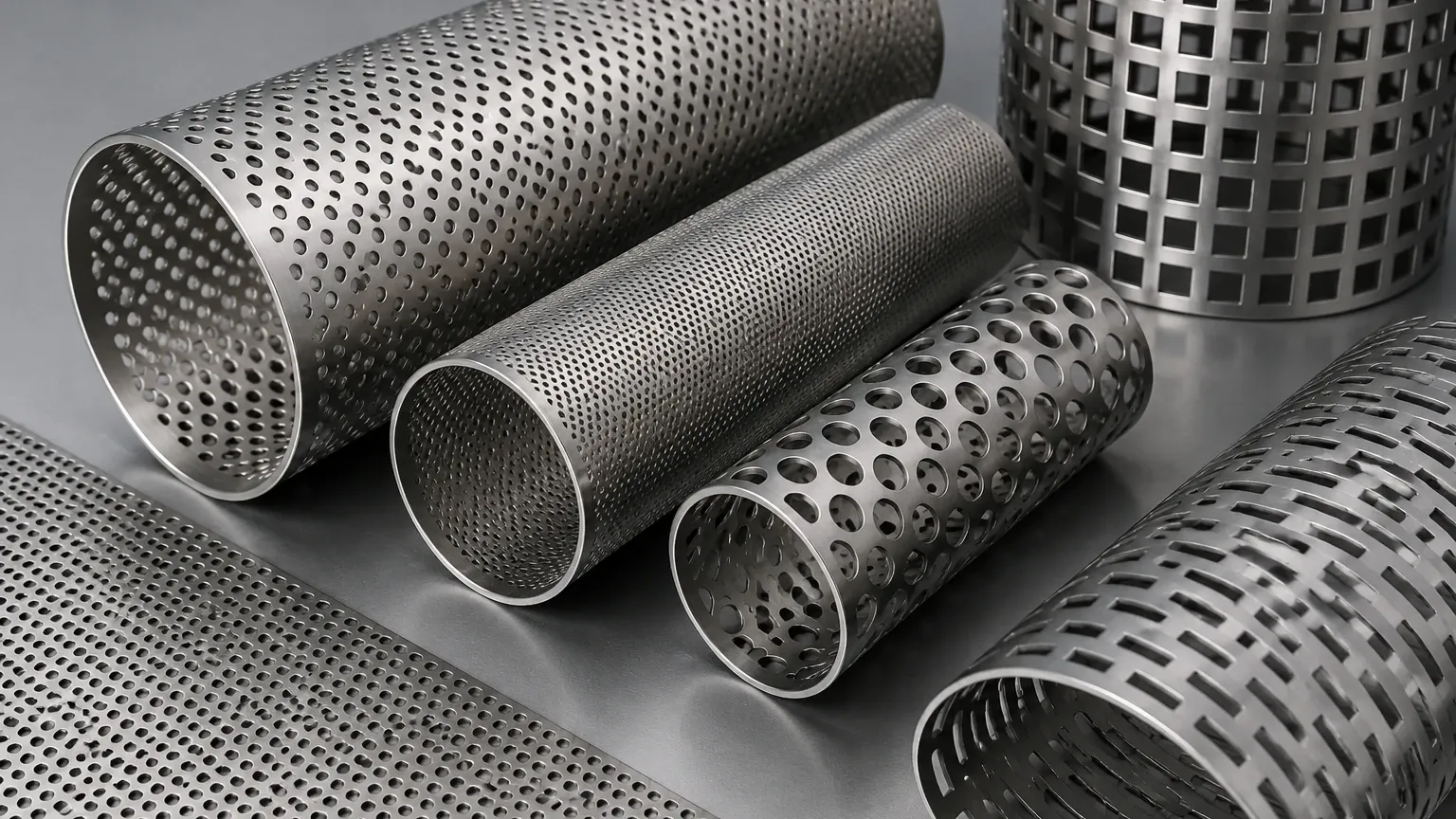
Comparative Analysis: Perforated vs. Expanded Metal Liners
While perforated metal is the most common choice for liners, expanded metal is an alternative that engineers may consider depending on the application requirements.
| Feature | Perforated Metal Liner | Expanded Metal Liner |
| :— | :— | :— |
| Manufacturing | Material is punched out (waste generated) | Material is slit and stretched (no waste) |
| Strength | Higher structural rigidity and collapse resistance | Higher strength-to-weight ratio in specific directions |
| Surface | Smooth, flat surface (ideal for media contact) | Slightly raised or flattened edges (may be abrasive) |
| Open Area | Highly precise and customizable | Fixed by the expansion ratio |
| Cost | Generally higher due to material waste | Generally lower for high-volume, low-spec needs |
For most high-precision industrial filtration tasks, the perforated metal liner is preferred because it offers a smoother surface that will not damage the filter media and allows for more precise control over the open area and hole geometry.
Key Evaluation Criteria for Purchasing Teams
When sourcing perforated metal liners for OEM or replacement projects, purchasing teams should confirm the following technical details to ensure the product meets the application's demands:
1. Dimensional Tolerances: Confirm the acceptable variance in diameter, length, and wall thickness. Even a millimeter of deviation can prevent a filter from seating correctly in its housing.
2. Burr-Free Requirements: Specify that the liner must be deburred. For high-purity applications, request a "no-burr" guarantee to prevent downstream contamination.
3. Weld Integrity: Inquire about the welding method and whether the welds are ground smooth. For high-pressure systems, ask if the welds undergo non-destructive testing (NDT).
4. Chemical Compatibility: Ensure the selected alloy (e.g., 316L vs. 304) is compatible with the process fluid, especially if the fluid is acidic or operates at elevated temperatures.
5. Total Cost of Ownership (TCO): While a cheaper liner made of thinner material or a lower-grade alloy may reduce initial costs, it often leads to shorter filter life and increased downtime due to structural failure.
Maintenance and Replacement Cycles
Perforated metal liners are designed to be durable, but they are not indestructible. In many systems, the liner is a permanent or semi-permanent part of the filter assembly, while the media is replaced. However, the liner should be inspected during every filter change for the following signs of wear:
* Deformation: Any bowing or ovality in the tube indicates that the system is operating near or above the liner's collapse pressure.
* Corrosion: Look for pitting or discoloration, which suggests that the chemical environment is too aggressive for the current alloy.
* Weld Fatigue: Check for cracks along the seam, particularly in systems subject to pressure pulsations or vibration.
If a liner shows signs of structural fatigue, it must be replaced immediately. A collapsed liner can release the filter media into the downstream flow, causing catastrophic damage to pumps, valves, and other sensitive equipment.
Conclusion
The perforated metal liner is a fundamental component that ensures the reliability of industrial filtration systems. By providing the structural backbone for filter media, these components enable processes to operate under high pressure and in harsh chemical environments. Whether you are designing a new filtration system or sourcing replacement parts, focusing on material grade, open area precision, and manufacturing quality will lead to optimized performance and reduced operational risks. For those seeking specific configurations or high-performance materials, exploring professional options in Perforated & Expanded Metal is the most effective way to secure a solution tailored to your engineering requirements.
