


Perforated Metal Manufacturers
In industrial filtration and structural engineering, perforated metal serves as a fundamental component for media support, fluid diffusion, and particle separation. Selecting the right partner among various perforated metal manufacturers requires a deep understanding of technical specifications, material science, and the specific demands of the application environment. For engineers and procurement professionals in the chemical, pharmaceutical, and food processing industries, the choice of a manufacturer impacts not only the initial component cost but also the long-term efficiency and durability of the entire filtration system.
Perforated metal is produced by mechanically punching or laser-cutting a series of holes into a metal sheet. While the concept is straightforward, the execution involves complex engineering variables including hole geometry, pitch, open area percentages, and structural integrity. This article examines the technical criteria for evaluating manufacturers and the critical factors that define high-performance perforated and expanded metal solutions.
Technical Specifications and Engineering Considerations
When engaging with perforated metal manufacturers, the technical dialogue begins with the specification of the hole pattern and the resulting open area. These parameters dictate the flow rate, pressure drop, and mechanical strength of the filter component.
Hole Patterns and Geometry
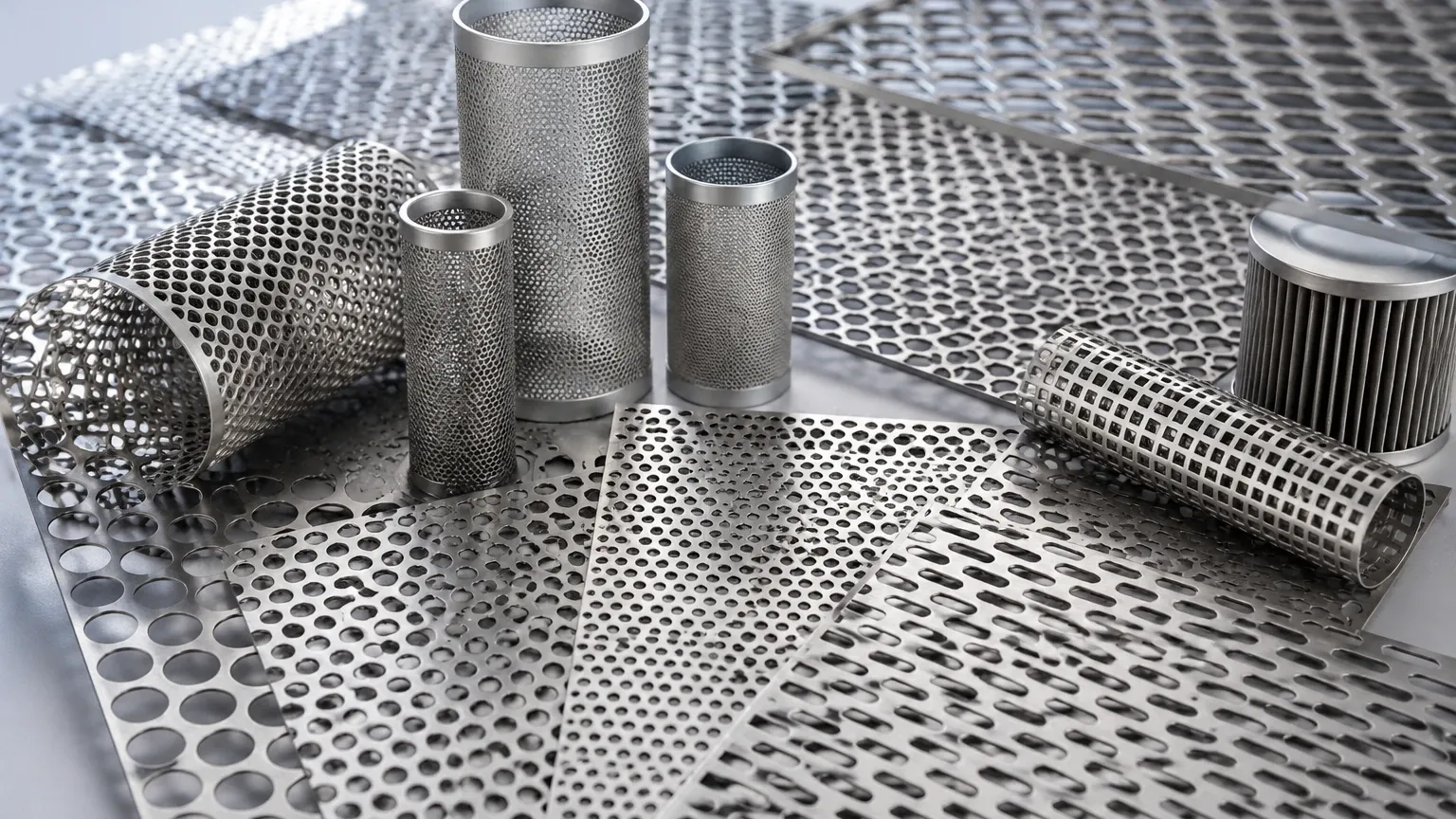
Round holes are the most common due to their structural stability and ease of manufacturing. However, manufacturers also offer square, slotted, and hexagonal patterns.
* Staggered Patterns: Usually set at a 60-degree angle, staggered patterns maximize the open area and provide uniform strength across the sheet. This is the industry standard for most filtration applications.
* Straight Patterns: Holes are aligned in rows and columns. While easier to align with secondary structural elements, they generally offer lower structural integrity under high-pressure loads compared to staggered patterns.
* Slotted Patterns: Often used for the separation of elongated particles or in applications where high flow rates are required with specific directional requirements.
Calculating Open Area
The "Open Area" is the percentage of the sheet that is occupied by holes. For a 60-degree staggered round hole pattern, the formula is:
Open Area % = (D² × 90.69) / P²
Where *D* is the hole diameter and *P* is the pitch (the distance from the center of one hole to the center of the adjacent hole). A higher open area reduces pressure drop but decreases the mechanical strength of the sheet. Experienced manufacturers help engineers find the optimal balance between these two competing requirements.
Material Selection for Industrial Environments
The performance of perforated metal is inextricably linked to the alloy from which it is fabricated. Industrial filtration often occurs in corrosive, high-temperature, or high-pressure environments, making material selection a critical step in the procurement process.
Stainless Steel (304 and 316L)
Stainless steel is the preferred material for most high-end industrial applications. Grade 304 provides excellent corrosion resistance for general use, while Grade 316L (low carbon) is essential for chemical processing and marine environments due to its superior resistance to pitting and crevice corrosion. In the pharmaceutical and food industries, the smooth, non-porous surface of stainless steel ensures that the components can be effectively cleaned and sterilized.
Specialty Alloys and Carbon Steel
For applications involving extreme temperatures or specific chemical reactivities, manufacturers may utilize Monel, Inconel, or Hastelloy. Conversely, for non-corrosive structural applications where cost is a primary driver, galvanized or cold-rolled carbon steel may be specified. However, for filtration components, the longevity and contamination-free nature of stainless steel usually justify the higher initial investment.
Evaluating Perforated Metal Manufacturers
Not all manufacturers possess the same capabilities. When vetting a supplier for Perforated & Expanded Metal, technical teams should evaluate the following criteria:
Precision and Tolerances
In precision filtration, even minor deviations in hole diameter or pitch can lead to bypass or inconsistent flow. A reputable manufacturer should provide clear data on their manufacturing tolerances. This includes the "margin"—the unperforated area around the edges of the sheet—which is critical for subsequent welding or mounting processes.
Flatness and Surface Quality
The punching process naturally introduces internal stresses into the metal, which can cause the sheet to curl or bow. Leading manufacturers utilize precision leveling equipment to ensure the final product is perfectly flat. Furthermore, the removal of burrs (deburring) is essential. In filtration, a burr can trap particles, cause turbulence, or even break off and contaminate the downstream fluid.
Customization and Tooling Capabilities
Standard stock patterns are often insufficient for specialized industrial needs. Engineers should look for manufacturers that offer custom tooling. Whether it is a unique hole size to match a specific catalyst or a non-standard sheet thickness for high-pressure hydraulic support, the ability to customize is a hallmark of a professional filtration partner.
Integration into Filtration Systems
Perforated metal rarely stands alone in an industrial setting; it is typically a component of a larger assembly. Understanding how it integrates with other media is vital for system performance.
Support for Wire Mesh
In many liquid and gas filtration systems, perforated metal acts as the "skeleton" for finer filter media, such as woven wire mesh. The perforated sheet provides the mechanical strength to withstand high differential pressures, while the wire mesh provides the actual filtration rating (micron level). Manufacturers who understand this relationship can provide perforated cores that are optimized to support mesh without causing abrasion or structural failure.
Cylindrical and Conical Forming
Many industrial filters are cylindrical. This requires the perforated sheet to be rolled and welded. The manufacturer must ensure that the hole pattern remains consistent across the seam and that the welding process does not compromise the corrosion resistance of the material. Precision in the diameter and roundness of these cylinders is critical for ensuring a proper seal within the filter housing.
Secondary Operations and Value-Added Services
To streamline the supply chain, many purchasing teams prefer manufacturers that offer secondary processing. This reduces the risk of damage during transit between different vendors and ensures accountability for the final component's performance.
* Degreasing and Cleaning: Essential for oxygen service or pharmaceutical applications where any residual manufacturing oils could cause catastrophic failure or contamination.
* Annealing: Heat treatment to relieve stresses induced during the punching and forming processes, improving the component's fatigue life.
* Welding and Assembly: Providing finished filter baskets, strainers, or cartridges rather than just raw sheets.
Total Cost of Ownership in Procurement
While the per-unit price is a necessary consideration, the total cost of ownership (TCO) is a more accurate metric for industrial components. A lower-quality perforated sheet from an unverified manufacturer may lead to:
1. Premature Fatigue Failure: If the bridge between holes is too narrow or the material quality is poor, the sheet may crack under pressure cycles.
2. Increased Maintenance: Burrs and irregular surfaces can lead to faster fouling of the filter media, requiring more frequent cleaning cycles.
3. System Downtime: If a support core fails, it can lead to the collapse of the primary filter media, allowing contaminants to reach sensitive downstream equipment like pumps and turbines.
By partnering with experienced perforated metal manufacturers who prioritize technical accuracy and material integrity, companies can ensure their filtration systems operate at peak efficiency with minimal unplanned interventions.
Conclusion
Perforated metal is a critical engineering material that demands more than a simple commodity purchase approach. From the calculation of open areas to the selection of high-grade stainless steel alloys, every detail influences the performance of industrial filtration systems. Engineers and purchasing professionals must look beyond the surface and evaluate manufacturers based on their technical expertise, precision capabilities, and understanding of the demanding environments in which these products operate. Whether providing the structural core for a hydraulic filter or a custom strainer for chemical processing, the right manufacturer serves as a technical partner in achieving reliable, long-term filtration performance.
