


Perforated Metal Mesh Sheet
In the landscape of industrial filtration and structural engineering, the perforated metal mesh sheet serves as a foundational component for high-performance systems. Unlike standard woven wire mesh, which relies on the interlacing of wires, a perforated metal mesh sheet is created by mechanically punching or laser-cutting holes into a solid metal plate. This manufacturing process results in a product with superior structural integrity, precise open areas, and the ability to withstand significant mechanical stress. For industries ranging from chemical processing to food and beverage production, understanding the technical nuances of these components is essential for optimizing filtration efficiency and equipment longevity.
As a specialized manufacturer, Kaifil provides custom stainless steel filtration solutions that leverage the unique properties of perforated and expanded metals. This guide explores the engineering considerations, material specifications, and application-specific advantages that technical professionals must evaluate when selecting perforated metal for industrial use.
Understanding the Role of Perforated Metal Mesh Sheet in Industrial Systems
The primary function of a perforated metal mesh sheet varies depending on its placement within a system. In many filtration applications, the perforated sheet acts as a "support core" or "outer cage" for finer filtration media, such as multi-layered sintered mesh or fine wire cloth. Because fine meshes are often thin and susceptible to deformation under high pressure, the perforated sheet provides the necessary rigid framework to maintain the filter's shape and prevent media migration.
Beyond support, perforated sheets are frequently used as primary filters for coarse filtration tasks. In these scenarios, they are responsible for removing large particulates from fluid or gas streams. The choice between using a perforated sheet as a primary filter or a support structure depends on the required micron rating and the flow dynamics of the specific application. Engineers must balance the need for high flow rates with the requirement for mechanical durability, a task that requires precise calculations of open area and hole geometry.
Material Selection and Chemical Compatibility
The performance of a perforated metal mesh sheet is heavily dictated by the alloy from which it is manufactured. In industrial filtration, stainless steel is the gold standard due to its corrosion resistance and thermal stability. Kaifil specializes in several key grades to meet diverse environmental demands:
AISI 304 Stainless Steel
Grade 304 is the most common choice for general industrial applications. It offers excellent formability and good resistance to atmospheric corrosion. It is widely used in food processing and architectural applications where extreme chemical exposure is not a primary concern.
AISI 316 and 316L Stainless Steel
For more demanding environments, such as pharmaceutical manufacturing or marine applications, Grade 316 is preferred. The addition of molybdenum enhances its resistance to pitting and crevice corrosion, particularly in chloride-rich environments. The "L" in 316L denotes low carbon content, which is critical for components that require welding, as it prevents carbide precipitation and ensures the integrity of the weld zones in a perforated metal mesh sheet.
Special Alloys
In highly specialized chemical processing, alloys such as Duplex stainless steel or Monel may be utilized to handle aggressive acids or high-temperature steam. Selecting the correct material ensures that the filter does not degrade prematurely, which would otherwise lead to system contamination and unplanned downtime.
Engineering Specifications: Hole Patterns and Open Area
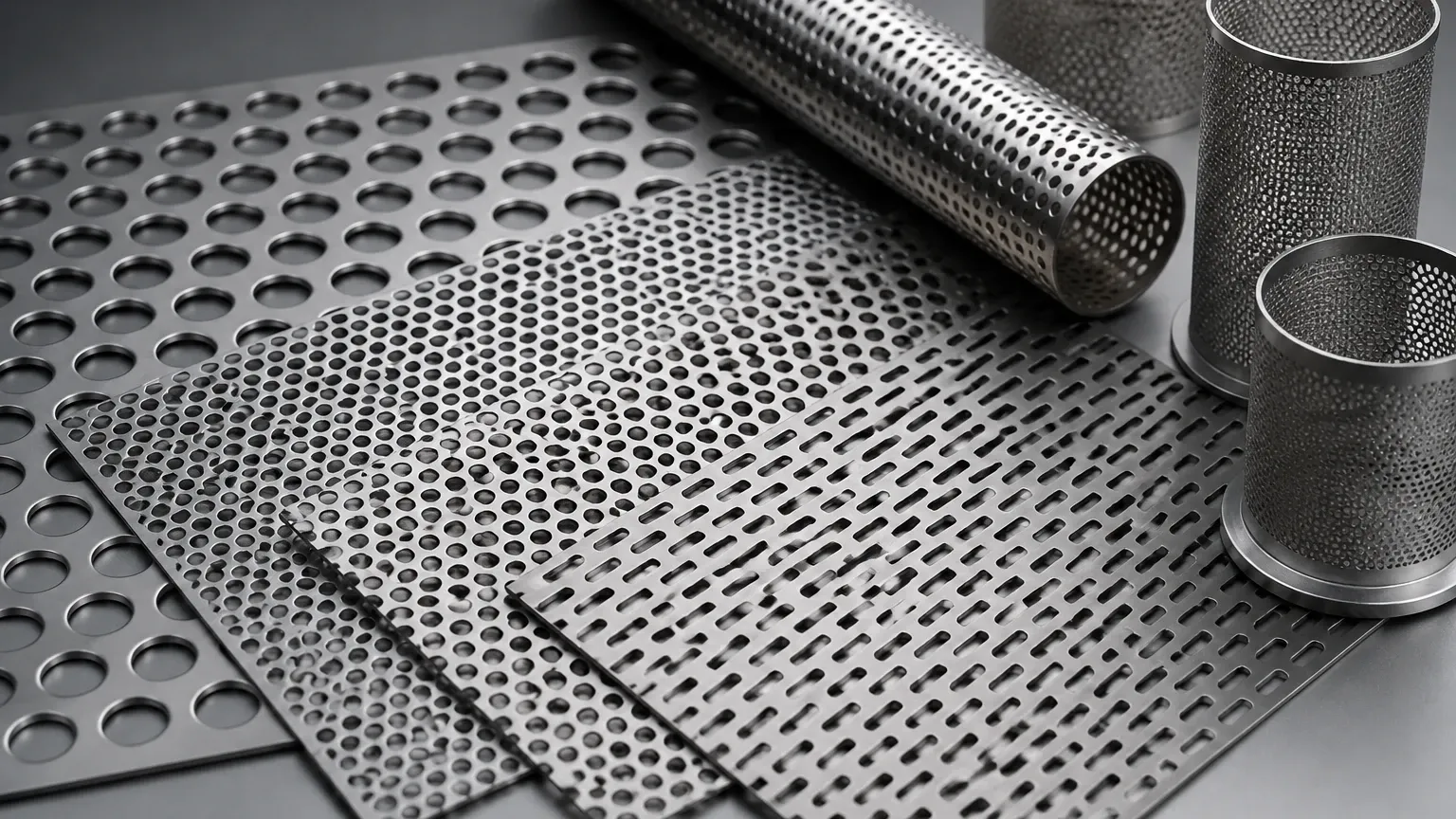
The efficiency of a perforated metal mesh sheet is defined by its hole pattern and the resulting percentage of open area. These factors directly influence the pressure drop across the filter and the volume of fluid that can pass through the system per unit of time.
Round Hole Patterns
Round holes are the most versatile and cost-effective pattern. They are typically arranged in a 60-degree staggered configuration, which provides the highest strength-to-weight ratio and a uniform distribution of stress. Straight-row configurations are also available but are generally less structurally sound than staggered layouts.
Square and Slotted Holes
Square holes offer a higher open area percentage, which is beneficial for high-flow applications, though they may compromise some structural rigidity. Slotted holes are often used for the filtration of elongated particles or in applications where specific directional flow is required, such as in grain drying or centrifugal separators.
Calculating Open Area
The open area is the ratio of the total area of the holes to the total area of the sheet, expressed as a percentage. For a staggered round hole pattern, the formula is:
Open Area % = (D² × 90.69) / P²
*(Where D = Hole Diameter and P = Center-to-Center Pitch)*
Maintaining an optimal open area is a balancing act. A higher open area reduces pressure drop but can weaken the sheet, making it prone to buckling under high differential pressures. For more information on optimizing these specifications, engineers can Review product options and application support to determine the best configuration for their specific hydraulic or pneumatic requirements.
Perforated Metal vs. Expanded Metal: Choosing the Right Substrate
While often grouped together, perforated metal and expanded metal serve different engineering needs. Perforated & Expanded Metal components are both used in filtration, but their manufacturing methods result in distinct physical properties.
* Perforated Metal: Created by removing material (the "slugs"). This allows for extremely precise hole sizes and shapes, which is critical for accurate filtration. The margins (the solid areas around the edges) can be customized to facilitate easier welding and assembly into filter housings.
* Expanded Metal: Created by slitting and stretching a single sheet. This process involves no waste of material and results in a three-dimensional, truss-like structure. Expanded metal is often lighter and provides a unique surface area that can be beneficial for certain catalytic or decorative applications, but it lacks the precision hole sizing of a perforated metal mesh sheet.
For most high-precision industrial filtration cartridges, perforated metal is the preferred choice due to its predictable flow characteristics and ease of cleaning.
Manufacturing Precision and Customization Options
In B2B procurement, the ability to customize a perforated metal mesh sheet to exact specifications is a significant advantage. Kaifil’s manufacturing capabilities allow for a high degree of precision in several areas:
1. Thickness and Gauge: Sheets can range from thin foils used in delicate laboratory filters to heavy-gauge plates used in industrial mining or water intake screens.
2. Margin Customization: Engineers can specify "blank" or unperforated areas along the edges of the sheet. This is essential for ensuring strong, leak-proof welds when the sheet is formed into a cylinder or pleated into a cartridge.
3. Secondary Processing: After perforation, sheets can be leveled to ensure flatness, degreased to remove manufacturing oils (critical for food and pharma applications), and deburred to eliminate sharp edges that could damage other filter layers.
4. Forming and Welding: Perforated sheets can be rolled into tubes, welded into cones, or fabricated into complex multi-layer assemblies. Kaifil utilizes advanced welding techniques to ensure that the joints are as strong as the base material.
Applications in High-Demand Industries
The versatility of the perforated metal mesh sheet makes it indispensable across several sectors:
* Chemical and Petrochemical: Used in catalyst recovery, fluid bed dryers, and intake strainers where resistance to aggressive chemicals and high pressures is mandatory.
* Food and Beverage: Employed in juice extraction, beer brewing (lauter tun screens), and dairy processing. The smooth surface of stainless steel perforated sheets allows for efficient Clean-in-Place (CIP) cycles.
* Pharmaceuticals: Precision-perforated components are used in centrifuges and tablet coating machines, where hygiene and exact particle size control are paramount.
* Water Treatment: Perforated sheets act as the first line of defense in large-scale filtration systems, removing debris and protecting sensitive downstream membranes.
Key Considerations for Procurement and Engineering Teams
When specifying a perforated metal mesh sheet for a project, purchasing teams and engineers should confirm several critical factors to ensure the total cost of ownership is minimized:
* Differential Pressure (ΔP): What is the maximum pressure the sheet will encounter? This determines the required thickness and hole pitch.
* Filtration Accuracy: If the perforated sheet is the primary filter, what is the smallest particle it must retain? If it is a support layer, how does its open area align with the flow requirements of the inner mesh?
* Maintenance and Cleaning: Will the filter be cleaned via backpulsing, ultrasonic baths, or manual scraping? Stainless steel perforated sheets are highly durable and can withstand aggressive cleaning methods that would destroy synthetic or lighter wire meshes.
* OEM Integration: For equipment manufacturers, sourcing a component that is ready for assembly—pre-cut, pre-formed, and cleaned—can significantly reduce production lead times.
Conclusion
The perforated metal mesh sheet is more than just a piece of metal with holes; it is a precision-engineered component that determines the reliability and efficiency of industrial filtration systems. By selecting the appropriate material grade, hole pattern, and manufacturing tolerances, engineers can ensure that their systems operate at peak performance even in the most demanding environments.
Kaifil’s expertise in custom stainless steel filtration allows for the development of tailored solutions that meet the specific needs of global industrial applications. Whether you require a high-strength support core for a hydraulic filter or a precision-cut screen for chemical processing, understanding the technical fundamentals of Perforated & Expanded Metal is the first step toward achieving optimized, cost-effective filtration performance.
