


Lightweight Perforated Metal
In industrial engineering and filtration, the selection of materials often involves a critical trade-off between structural durability and weight. Lightweight perforated metal has emerged as a primary solution for engineers seeking to optimize flow rates, reduce mechanical load, and maintain high levels of corrosion resistance. As a specialized manufacturer, Kaifil provides precision-engineered filtration components that leverage the unique properties of perforated and expanded materials to meet the rigorous demands of chemical, pharmaceutical, and food processing environments.
Understanding the technical specifications of lightweight perforated metal is essential for procurement teams and design engineers. This guide examines the engineering principles, material considerations, and performance metrics that define the utility of these components in modern industrial systems.
The Engineering Principles of Lightweight Perforated Metal
Lightweight perforated metal is defined not just by its gauge, but by the relationship between the material thickness and the open area ratio. In filtration and acoustic applications, "lightweight" typically refers to sheets or tubes manufactured from thinner gauges of stainless steel or aluminum, or those featuring a high percentage of open area achieved through dense perforation patterns.
From a mechanical perspective, the primary challenge is maintaining the structural integrity of the sheet once a significant portion of the material has been removed. The remaining material, known as the "ligament," must be wide enough to withstand the operational pressures of the system—whether that is the force of a hydraulic fluid or the weight of a granular catalyst bed. Engineers must calculate the yield strength of the perforated sheet, which is inherently lower than that of a solid sheet of the same material and thickness. However, by selecting specific hole patterns, such as a 60-degree staggered orientation, manufacturers can distribute stress more evenly across the surface, allowing for a reduction in total weight without a proportional loss in functional strength.
Material Selection: Stainless Steel vs. Alternative Alloys
For most industrial filtration applications, material selection is the most critical factor in determining the longevity and performance of lightweight perforated metal. Kaifil specializes in stainless steel solutions due to the material's inherent resistance to oxidation and chemical degradation.
1. Grade 304 Stainless Steel: This is the standard choice for general industrial use. It offers excellent formability and is highly effective in applications involving water treatment or food processing where sanitation is a priority.
2. Grade 316 Stainless Steel: For environments involving high salinity, acidic chemicals, or pharmaceutical processing, Grade 316 is preferred. The addition of molybdenum enhances its resistance to pitting and crevice corrosion, making it a more durable choice for lightweight components exposed to harsh reagents.
3. Aluminum Alloys: When extreme weight reduction is the primary goal and chemical exposure is minimal, aluminum may be used. However, it lacks the tensile strength and high-temperature stability of stainless steel, which often limits its use in high-pressure hydraulic or steam-cleaning environments.
When specifying materials for Perforated & Expanded Metal, engineers must also consider the "work hardening" effect that occurs during the punching process. Stainless steel tends to harden as it is perforated, which can increase the brittleness of the ligaments if not managed through proper annealing or precision tooling.
Structural Integrity and Open Area Calculations
The "open area" of a perforated sheet is the percentage of the total area that is occupied by holes. This is the most important variable for determining flow velocity and pressure drop. For lightweight perforated metal, achieving a high open area (often exceeding 50% or 60%) is a common requirement to minimize the weight of large-scale filtration assemblies.
The formula for calculating the open area of a staggered round hole pattern is:
Open Area % = (D² × 90.69) / P²
*Where D is the hole diameter and P is the center-to-center pitch.*
While increasing the open area reduces the weight of the component, it also reduces the mechanical stiffness. In high-pressure applications, such as those found in hydraulic return-line filters, a lightweight perforated metal core may require additional reinforcement, such as longitudinal welding or a secondary mesh wrap, to prevent collapsing under differential pressure. Designers must balance the need for a lightweight profile with the "collapse pressure" rating required by the specific industrial application.
Perforated & Expanded Metal: Comparing Manufacturing Methods
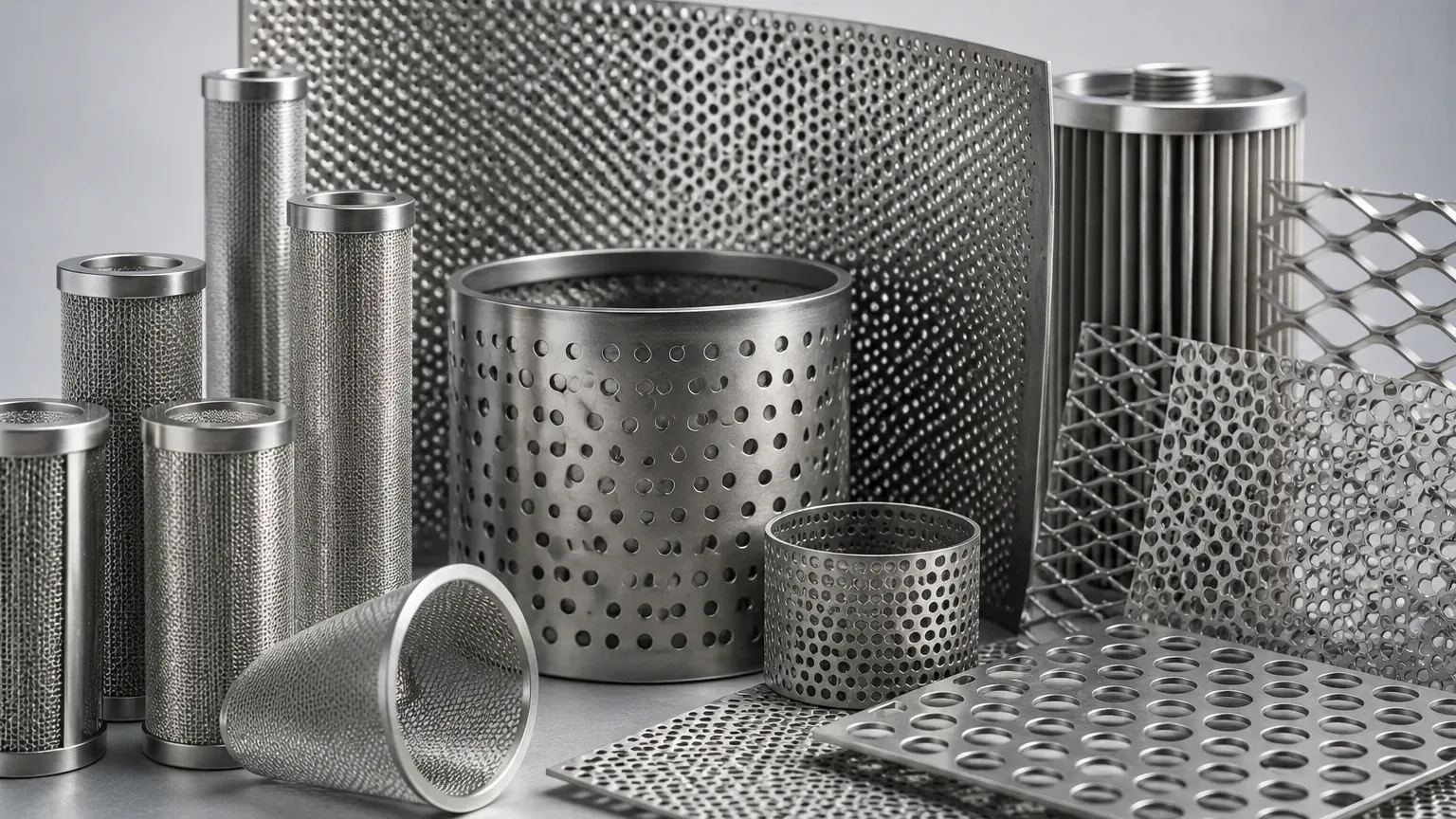
In the context of industrial filtration, it is important to distinguish between perforated metal and expanded metal, as both can be used to create lightweight structures but offer different performance characteristics.
Perforated Metal is produced by punching holes into a solid sheet. This process allows for extreme precision in hole size and placement. It is the preferred method for filtration applications where specific particle retention (micron rating) is required. The edges of the holes are clean, and the sheet remains flat, making it easier to weld into cylindrical filter cartridges or pleat into complex shapes.
Expanded Metal is created by simultaneously slitting and stretching the material. This process is highly cost-effective because it produces no scrap metal, and the resulting diamond-shaped openings provide a high strength-to-weight ratio. Because the metal is "expanded" rather than punched, the final product is often lighter than a perforated sheet of the same thickness. However, expanded metal has a three-dimensional texture that can create more turbulence in fluid flow and is more difficult to clean in "clean-in-place" (CIP) systems.
For engineers, the choice between these two often comes down to whether the component is a primary filter media (where perforated precision is needed) or a secondary support structure (where expanded metal’s lightweight rigidity is an advantage).
Applications in Industrial Filtration and Fluid Dynamics
Lightweight perforated metal is a versatile component used across various sectors. Its primary role is often as a support structure for finer mesh media, but it also serves as a standalone filter in specific contexts.
* Chemical Processing: In reactor vessels, lightweight perforated plates are used as catalyst support grids. They must be light enough for easy removal during maintenance but strong enough to hold tons of catalyst material while resisting corrosive vapors.
* Food and Beverage: Perforated stainless steel is used in centrifugal baskets and straining equipment. The lightweight nature of the metal reduces the energy required to spin the baskets at high speeds, improving the overall efficiency of the processing line.
* Hydraulic Systems: Lightweight perforated cores are used inside hydraulic filters to provide a rigid backbone for the filter paper or wire mesh. Reducing the weight of these cores helps in mobile hydraulic applications (such as construction machinery) where every kilogram saved contributes to fuel efficiency.
* Acoustic Damping: In industrial machinery enclosures, lightweight perforated metal acts as a facing for sound-absorbing materials. The perforations allow sound waves to pass through into the insulation while providing a durable, fire-resistant protective surface.
Specification Guidelines for Procurement and OEM Customization
When sourcing lightweight perforated metal for an OEM project, providing a complete set of technical specifications is vital to ensure the component performs as expected. Standard "off-the-shelf" perforated sheets rarely meet the tight tolerances required for precision industrial filtration.
Key specifications to confirm with the manufacturer include:
1. Hole Shape and Pattern: Round holes are the most common and offer the best structural stability. Square or hexagonal holes provide higher open areas but can create stress concentrators at the corners.
2. Margin Requirements: "Margins" are the unperforated areas along the edges of the sheet. For lightweight components, specifying exact margins is necessary for successful welding or mounting into a frame. Without proper margins, the thin ligaments at the edge of the sheet may tear during fabrication.
3. Flatness and Levelling: The perforation process can cause the metal to curl or warp. For lightweight gauges, precision leveling is required to ensure the sheet can be integrated into automated assembly lines without jamming.
4. Surface Finish: Depending on the industry, the metal may require electropolishing (common in pharma and food) to remove burrs and improve corrosion resistance, or simple degreasing for hydraulic applications.
Kaifil works closely with engineering teams to develop customized designs that address these variables, ensuring that the final product meets both the weight targets and the mechanical requirements of the system.
Maintenance and Lifecycle Management of Metal Filters
The total cost of ownership for lightweight perforated metal components is often lower than that of disposable plastic or synthetic filters, primarily due to their durability and cleanability. However, maintaining these components requires a technical approach.
In filtration systems, the accumulation of debris leads to an increase in differential pressure. Because lightweight perforated metal has thinner ligaments, it is more susceptible to fatigue if subjected to frequent pressure spikes or aggressive mechanical cleaning (such as high-pressure power washing).
To extend the lifecycle of these components, Kaifil recommends:
* Ultrasonic Cleaning: This is the most effective method for removing fine particles from the perforations without causing mechanical stress to the metal.
* Chemical Passivation: Periodically treating stainless steel components with a mild acid solution helps restore the protective oxide layer, especially in lightweight components where surface-to-volume ratios are high.
* Regular Inspection: Checking for "ligament cracking" or signs of erosion around the hole edges is essential, particularly in high-velocity gas or liquid streams.
Conclusion
Lightweight perforated metal represents a sophisticated intersection of material science and mechanical engineering. By carefully selecting the appropriate stainless steel grade, optimizing the open area through precise calculations, and choosing the right manufacturing method—whether perforated or expanded—engineers can achieve significant weight savings without compromising industrial performance.
For organizations looking to optimize their filtration processes or structural designs, collaborating with a manufacturer that understands the nuances of custom metal fabrication is critical. Whether the goal is to improve flow efficiency in a chemical plant or reduce the weight of a hydraulic system, the right specification of lightweight perforated metal is a foundational step toward operational excellence. For more information on custom configurations and material grades, engineers are encouraged to Review product options and application support to find the optimal solution for their specific technical requirements.
