


Perforated Metal Screen Panels
In industrial filtration and structural engineering, perforated metal screen panels serve as foundational components for fluid management, particle separation, and mechanical protection. Unlike woven wire mesh, which relies on the interlacing of wires, perforated panels are manufactured by punching or laser-cutting holes into solid metal sheets. This process results in a rigid, durable medium that offers high structural integrity and precise control over aperture geometry. For engineers and procurement teams, selecting the right perforated solution requires a deep understanding of material properties, hole patterns, and the mechanical stresses inherent in specific industrial environments.
As a specialist in custom stainless steel filtration, Kaifil provides high-performance Perforated & Expanded Metal solutions designed to meet the rigorous demands of chemical processing, food production, and hydraulic systems. This guide examines the technical parameters that define perforated metal screen panels and the engineering considerations necessary for optimizing their performance in industrial applications.
Engineering Fundamentals: Materials and Geometry
The performance of perforated metal screen panels is dictated by the interaction between the base material and the perforation geometry. In industrial settings, the choice of material is the first line of defense against corrosion, heat, and mechanical wear.
Material Selection
Stainless steel is the industry standard for most filtration and screening applications due to its excellent strength-to-weight ratio and resistance to oxidation.
* Grade 304: Suitable for general industrial use, providing good corrosion resistance and formability.
* Grade 316L: The preferred choice for marine environments, pharmaceutical manufacturing, and chemical processing. The addition of molybdenum and a lower carbon content enhances resistance to pitting and crevice corrosion in chloride-rich environments.
* Specialty Alloys: For high-temperature or highly acidic environments, alloys such as Monel or Hastelloy may be utilized, though stainless steel remains the most cost-effective solution for the majority of B2B filtration needs.
Hole Patterns and Open Area
The "Open Area" is the percentage of the total area of the sheet that is occupied by the holes. This is a critical metric for engineers as it directly influences flow rates and pressure drop.
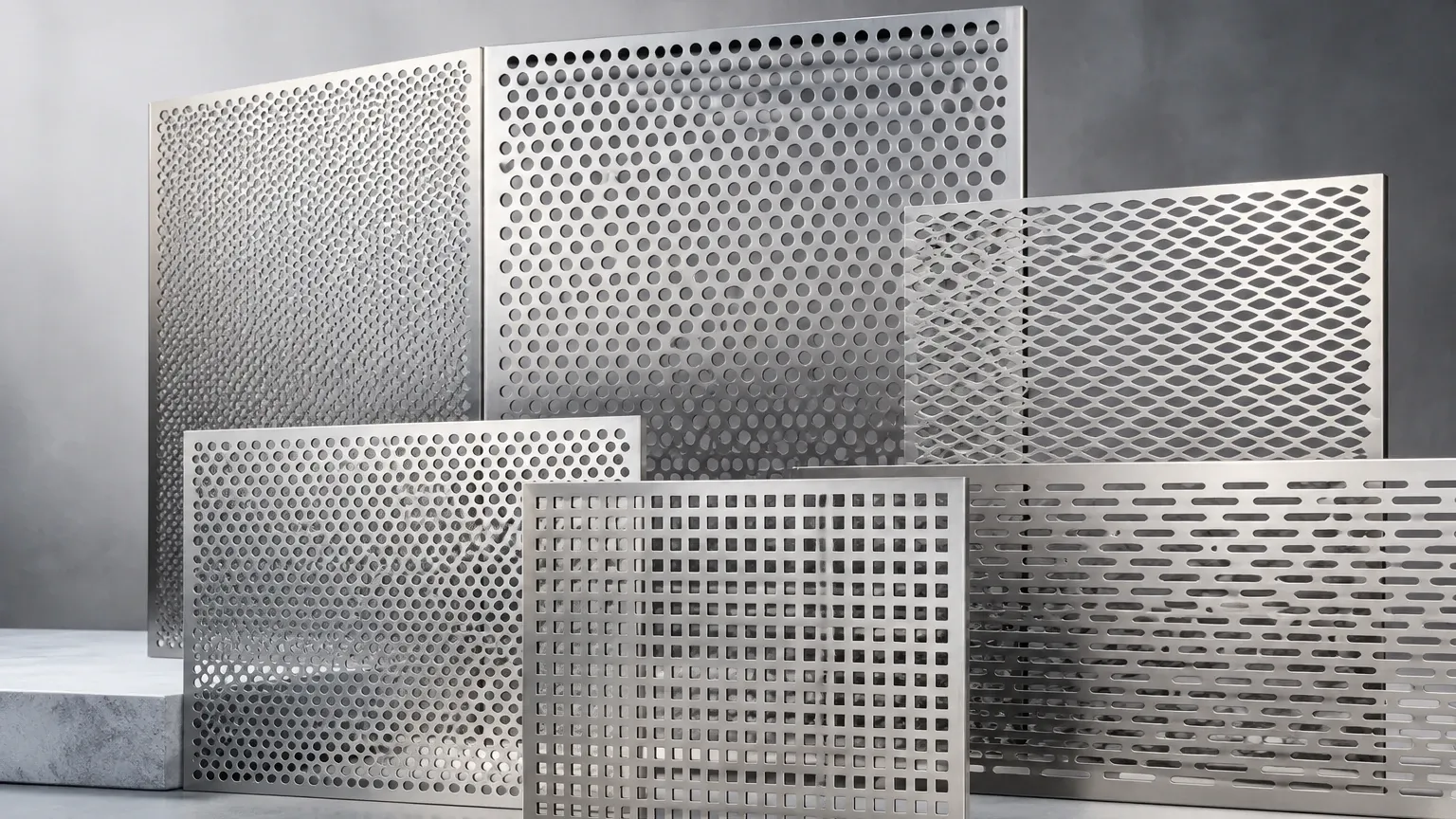
1. Round Holes: The most common pattern, offering the best balance of structural strength and filtration efficiency. Round holes can be arranged in a 60-degree staggered pattern (maximizing open area and strength) or a straight-row pattern.
2. Square Holes: Often used when a higher open area is required, though they may offer less structural rigidity than round holes under high-pressure conditions.
3. Slotted Holes: Frequently employed in dewatering and solid-liquid separation applications where the orientation of the particles requires an elongated aperture.
Calculating the open area involves precise formulas. For a 60-degree staggered round hole pattern, the formula is:
`% Open Area = (D² x 90.69) / R²`
Where `D` is the hole diameter and `R` is the center-to-center distance (pitch).
Performance Evaluation Criteria for Industrial Filtration
When specifying perforated metal screen panels for filtration systems, engineers must look beyond simple hole size. The interaction of the fluid with the screen surface determines the long-term viability of the component.
Filtration Accuracy and Micron Ratings
While perforated metal is typically used for coarse to medium filtration (macro-filtration), it can be engineered for precision. The hole diameter determines the "cut point" of the filter. For finer filtration requirements, perforated panels often serve as a rigid support structure for finer wire mesh layers, creating a composite filter element that combines the precision of mesh with the durability of a perforated plate.
Pressure Drop and Flow Velocity
Every filter medium introduces a resistance to flow, known as pressure drop (ΔP). High open-area percentages reduce initial pressure drop but may compromise the panel's ability to withstand high differential pressures as the screen becomes loaded with contaminants. Engineers must balance the need for high throughput with the mechanical requirement for the panel to remain flat and undeformed during the filtration cycle.
Surface Smoothness and Cleaning
In the food and beverage and pharmaceutical industries, the "cleanability" of the screen is paramount. Perforated panels offer a smoother surface than woven mesh, which minimizes the risk of particle entrapment and bacterial growth. For these applications, Kaifil emphasizes burr-free punching and electropolishing to ensure that the perforated metal screen panels meet stringent hygienic standards.
Manufacturing Precision and Customization Options
The utility of perforated metal screen panels in B2B applications often depends on the manufacturer's ability to customize the product to fit existing machinery or specific process flows.
Punching vs. Laser Cutting
Most industrial perforated panels are produced via high-speed punching presses. This method is highly efficient for large production runs and standard patterns. However, for thicker plates or complex, non-repetitive patterns, CNC laser cutting or waterjet cutting may be used. Laser cutting provides exceptional precision and allows for the creation of "margins" (unperforated areas) at specific locations on the panel to facilitate welding or mounting.
Edge Treatments and Forming
Perforated panels are rarely used as flat sheets alone. They often require secondary fabrication, including:
* Rolling: Forming the panel into a cylindrical shape for use in filter cartridges.
* Bending: Creating flanges or channels for structural mounting.
* Welding: Utilizing TIG or plasma welding to join panels without compromising the integrity of the filtration area.
Customized margins are essential for these processes. By leaving the edges of the panel unperforated, manufacturers ensure a stronger weld and a cleaner interface with the filter housing.
Perforated vs. Expanded Metal: Selecting the Right Media
While perforated metal screen panels are created by removing material, expanded metal is produced by slitting and stretching a single sheet. Both are covered under the category of Perforated & Expanded Metal, but they serve different engineering purposes.
When to Choose Perforated Metal
* Precision: When exact hole sizes and shapes are required for consistent particle separation.
* Smoothness: When the application requires a flat surface to prevent material buildup or to allow for mechanical scraping/cleaning.
* Strength: Perforated metal generally handles high-pressure differentials better than expanded metal because the remaining "bridges" of metal are undisturbed and retain the original material thickness.
When to Choose Expanded Metal
* Cost-Efficiency: Since no material is lost during production, expanded metal is often more economical for large-scale applications.
* Grip and Diffusion: The raised edges of expanded metal are excellent for non-slip surfaces or for diffusing flow in air filtration systems.
* Weight: Expanded metal provides a high open-area-to-weight ratio, making it ideal for protective guards and architectural screening.
Installation and Maintenance in Demanding Environments
The lifespan of perforated metal screen panels is heavily influenced by how they are installed and maintained. Even the highest-quality stainless steel panel can fail if subjected to improper mechanical stress or neglected maintenance cycles.
Support Structures and Vibration
In high-flow applications, perforated panels can be subject to vibration, which leads to metal fatigue and eventual cracking. Engineers should ensure that the panels are properly supported by internal frames or ribs. The spacing of these supports should be calculated based on the maximum expected pressure drop and the thickness of the panel.
Corrosion Management
In chemical processing, "crevice corrosion" can occur where the perforated panel meets the housing. Using gaskets made of compatible materials (such as PTFE or EPDM) and ensuring a tight seal can mitigate this risk. Additionally, regular passivation treatments for stainless steel panels can help maintain the protective oxide layer that prevents rusting.
Cleaning Protocols
One of the primary advantages of perforated metal screen panels is their compatibility with various cleaning methods:
* Backwashing: Reversing the flow to dislodge particles from the surface.
* Ultrasonic Cleaning: Using high-frequency sound waves in a solvent bath to remove fine particulates from the apertures.
* Chemical CIP (Clean-In-Place): Utilizing caustic or acidic washes, provided the panel material (e.g., 316L stainless steel) is chemically compatible.
Total Cost of Ownership and Procurement Considerations
For purchasing teams, the initial price of perforated metal screen panels is only one component of the total cost of ownership (TCO). A lower-cost panel that requires frequent replacement or causes excessive downtime due to cleaning difficulties will ultimately be more expensive than a precision-engineered solution.
Key Confirmation Points for Procurement
Before finalizing a purchase order, technical teams should confirm the following with their manufacturer:
1. Aperture Tolerance: What is the allowable variance in hole diameter? For precision filtration, tight tolerances are non-negotiable.
2. Flatness Requirements: Will the panel remain flat after the punching process, or is secondary leveling required?
3. Certification: Can the manufacturer provide material mill certificates (MTRs) to verify the grade of stainless steel?
4. OEM Compatibility: If the panel is a replacement part, does it match the original equipment manufacturer's specifications for thickness, pitch, and margin width?
By focusing on these technical details, companies can ensure they receive components that optimize process efficiency and minimize maintenance overhead. Kaifil’s expertise in manufacturing customized Perforated & Expanded Metal ensures that every panel is tailored to the specific mechanical and chemical demands of the client's application.
Conclusion
Perforated metal screen panels are indispensable in modern industrial operations, providing the necessary balance of filtration precision and structural durability. Whether used as a standalone screen in a water treatment plant or as a support core in a complex chemical filter, the effectiveness of these panels depends on rigorous engineering selection. By understanding the nuances of material grades, open area calculations, and manufacturing techniques, engineers can specify solutions that deliver reliable performance in the most demanding environments. As industrial processes become more specialized, the role of custom-fabricated perforated solutions will continue to grow, driven by the need for higher purity, greater efficiency, and longer service life.
