


Perforated Metal Sheet Uk
In the landscape of industrial manufacturing and filtration, the selection of high-precision components is critical for operational efficiency and equipment longevity. For engineers and procurement specialists sourcing perforated metal sheet UK solutions, understanding the technical nuances of material properties, hole geometries, and manufacturing tolerances is essential. Perforated metal is not a singular product but a highly engineered component used across chemical processing, food and beverage production, and pharmaceutical manufacturing.
As a professional manufacturer specializing in Perforated & Expanded Metal, Kaifil provides the technical foundation required to integrate these components into complex industrial systems. This guide examines the engineering considerations necessary for selecting the right perforated metal specifications to meet the rigorous demands of the UK industrial sector.
Understanding Technical Specifications for Industrial Perforated Sheets
The performance of a perforated metal sheet is primarily defined by its geometric configuration. For filtration and mechanical separation, the relationship between hole size, pitch, and open area determines the flow rate and pressure drop across the medium.
Hole Patterns and Geometries
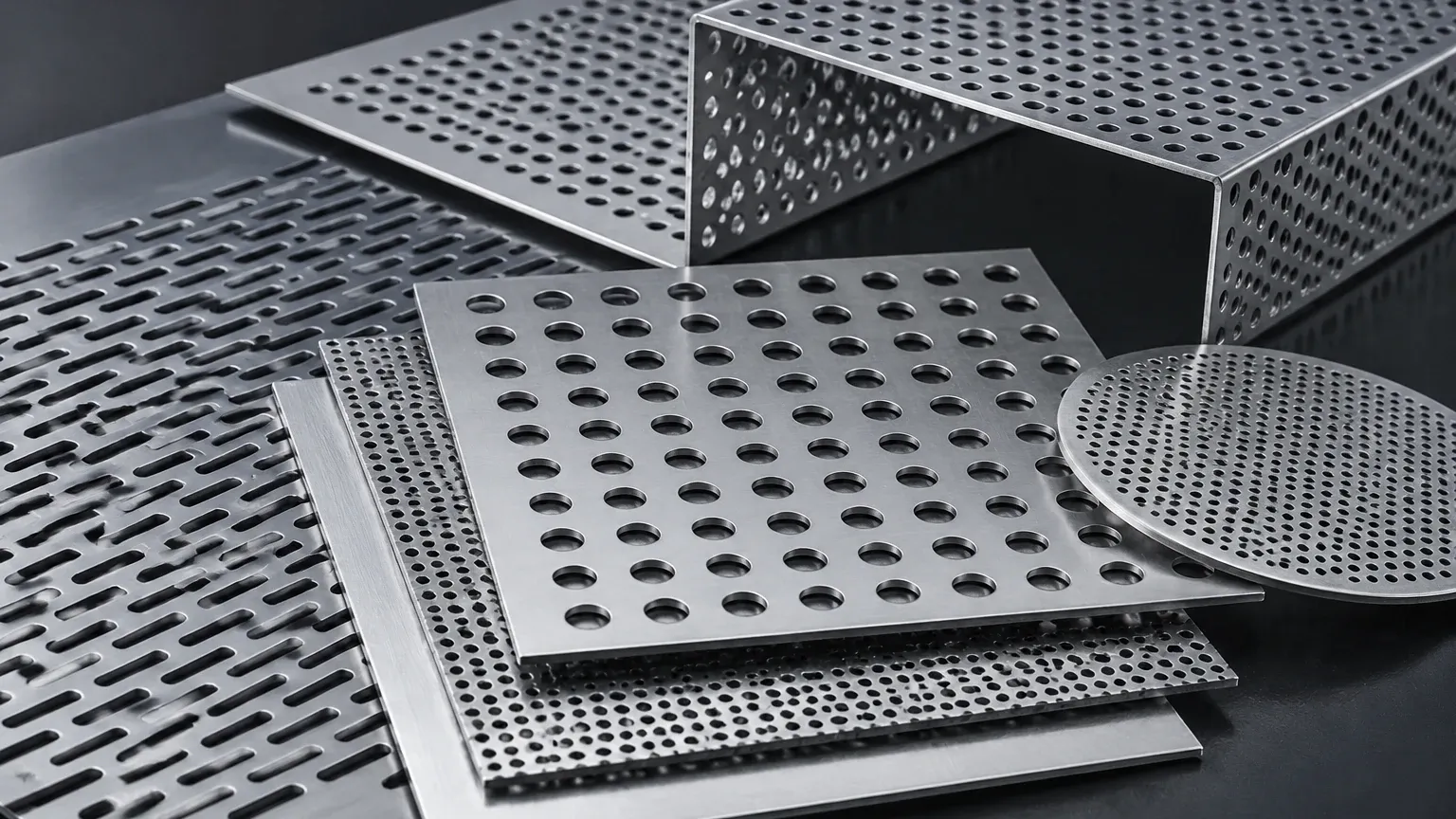
Industrial applications typically utilize three primary hole patterns:
1. Round Holes (60° Staggered): This is the most common configuration due to its inherent structural strength and high open-area-to-strength ratio. The 60-degree orientation provides uniform stress distribution across the sheet.
2. Square Holes: Often selected for applications requiring a high open area where structural rigidity is less of a priority than maximum throughput.
3. Slotted Holes: Frequently used in screening and sorting applications where the shape of the particles or the flow characteristics of the fluid require an elongated aperture.
Calculating the Open Area
The "Open Area" is a percentage that represents the total area of the holes compared to the total area of the sheet. For an engineer, this is the most critical metric for calculating flow resistance. For a standard 60-degree staggered round hole pattern, the formula is:
Open Area % = (D² × 90.69) / P²
Where *D* is the hole diameter and *P* is the pitch (the distance from the center of one hole to the center of the adjacent hole). Accurate calculations ensure that the perforated metal sheet UK provides the necessary throughput without compromising the structural integrity of the filter housing or support frame.
Material Selection: Stainless Steel Grades for Demanding Environments
The choice of material is the primary factor in determining the service life of a perforated component, especially in the corrosive environments common in UK chemical and water treatment facilities. While various metals can be perforated, stainless steel remains the industry standard for high-performance filtration.
Grade 304 Stainless Steel
Grade 304 is the most versatile and widely used stainless steel. It offers excellent corrosion resistance in most atmospheric conditions and is suitable for food-grade applications. However, in environments with high chloride exposure, it may be susceptible to pitting.
Grade 316L Stainless Steel
For pharmaceutical and marine applications, Grade 316L (low carbon) is preferred. The addition of molybdenum enhances resistance to chloride-induced corrosion and acetic acid. In B2B filtration solutions, 316L is often the baseline requirement for components that undergo frequent chemical cleaning or operate in aggressive fluid environments.
Mechanical Properties and Thickness
When sourcing perforated metal sheet UK, engineers must balance sheet thickness with hole diameter. A general engineering rule of thumb is that the hole diameter should not be smaller than the material thickness. Attempting to punch holes smaller than the thickness increases internal stress in the metal and can lead to tool failure or distorted hole geometries.
Perforated vs. Expanded Metal: Engineering Trade-offs
While often grouped together, perforated metal and expanded metal serve different engineering functions. Choosing between them requires an analysis of the application's mechanical requirements.
Perforated Metal Characteristics
Perforated metal is produced by punching holes into a solid sheet. This process allows for precise control over hole size and placement. It is ideal for applications requiring specific filtration ratings, decorative consistency, or exact margins (unperforated areas) around the edges for welding and mounting.
Expanded Metal Characteristics
Expanded metal is created by simultaneously slitting and stretching the material. This results in a diamond-shaped mesh with no material waste. Because the strands and bonds of expanded metal are set at a sharp angle, the material has a high strength-to-weight ratio and provides excellent grip in structural applications. However, it lacks the precise aperture control found in perforated sheets, making it more suitable for support structures, safety guards, or coarse filtration stages.
For more detailed technical comparisons and product specifications, engineers can Review product options and application support to determine which material structure suits their specific pressure and flow requirements.
Sourcing Perforated Metal Sheet UK: Quality Standards and Tolerances
In a B2B procurement context, the quality of a perforated metal sheet is measured by its adherence to tight tolerances. Inconsistent perforations can lead to bypass in filtration systems or mechanical failure under pressure.
Key Evaluation Criteria for Procurement
1. Flatness: The perforating process introduces internal stresses that can cause the sheet to curl or buckle. High-quality suppliers use leveling rollers to ensure the finished sheet meets flatness specifications required for automated assembly.
2. Burr Removal: Punching metal inevitably creates burrs on the exit side of the hole. For food processing or pharmaceutical applications, these burrs must be removed through deburring or polishing to prevent contamination and ensure easy cleaning.
3. Margin Precision: Custom filtration components often require specific "blank" or unperforated margins at the edges to facilitate seam welding or gasket seating. Specifying exact margin dimensions is critical for the integration of the sheet into a filter cartridge or housing.
4. Hole Concentricity: In multi-stage filtration, the alignment of holes across different layers of perforated metal is vital for maintaining consistent flow paths.
Integration into Filtration Systems: Custom OEM Solutions
Kaifil’s expertise as an OEM manufacturer allows for the development of customized perforated components that go beyond standard off-the-shelf sheets. In industrial filtration, the perforated metal often serves as the "center tube" or the external support cage for wire mesh filter elements.
Customization Capabilities
* Secondary Forming: Perforated sheets can be rolled into cylinders, welded into cones, or folded into pleated support structures. This is essential for the production of stainless steel filter cartridges used in hydraulic systems and chemical reactors.
* Surface Treatments: Depending on the application, perforated sheets may undergo electropolishing to improve corrosion resistance and surface smoothness, or pickling and passivation to remove surface contaminants introduced during the manufacturing process.
* Variable Pitch: For specialized flow control, it is possible to design sheets with variable hole density, allowing for higher flow rates in specific areas of a filtration vessel.
Maintenance and Longevity in Industrial Applications
The total cost of ownership for perforated metal components is heavily influenced by their maintenance requirements and replacement cycles. In the UK industrial sector, where downtime is costly, selecting a durable perforated metal sheet UK is a strategic investment.
Cleaning and Sterilization
In food and beverage or pharmaceutical sectors, perforated components must withstand Clean-in-Place (CIP) and Sterilization-in-Place (SIP) cycles. Stainless steel 316L perforated sheets are resistant to the high temperatures and caustic chemicals used in these processes. The absence of burrs and the smoothness of the hole edges are critical to prevent the buildup of biological films or chemical residues.
Monitoring Wear and Fatigue
While perforated metal is highly durable, it is subject to mechanical fatigue, especially in high-pressure hydraulic applications or systems with significant vibration. Regular inspection for stress cracks between holes (ligament failure) is necessary to prevent catastrophic failure of the filtration system. Choosing a supplier that provides material certifications and adheres to strict manufacturing standards reduces the risk of premature fatigue.
Conclusion: Making Informed Procurement Decisions
Selecting a perforated metal sheet UK involves more than just choosing a hole size. It requires a comprehensive understanding of fluid dynamics, material science, and mechanical engineering. For B2B buyers and engineers, the priority should be on sourcing components that offer verifiable material grades, precise tolerances, and the ability to be customized for specific industrial housings.
By focusing on the technical parameters—such as the open area calculation, the choice between 304 and 316L stainless steel, and the specific requirements for margins and flatness—organizations can ensure their filtration systems operate at peak efficiency. As a dedicated manufacturer of Perforated & Expanded Metal, Kaifil supports global industrial sectors by delivering high-performance, customized filtration components designed to meet the most demanding application requirements.
