


Perforated Metal Texture Revit
In the realm of industrial engineering and architectural design, the transition from a conceptual model to a functional filtration or structural component requires high-fidelity digital representation. Building Information Modeling (BIM) software, specifically Autodesk Revit, has become the standard for detailing these components. When engineers specify perforated or expanded metal for filtration systems, acoustic panels, or protective guards, the accuracy of the perforated metal texture revit application is not merely an aesthetic choice; it is a critical step in communicating technical requirements, open area ratios, and structural integrity to manufacturers like Kaifil.
Achieving a realistic and technically accurate representation of Perforated & Expanded Metal within Revit involves understanding both the software’s material engine and the physical properties of the metal itself. This guide explores the engineering considerations, modeling techniques, and procurement factors necessary to bridge the gap between a digital texture and a physical industrial component.
The Role of Perforated Metal in Industrial Applications
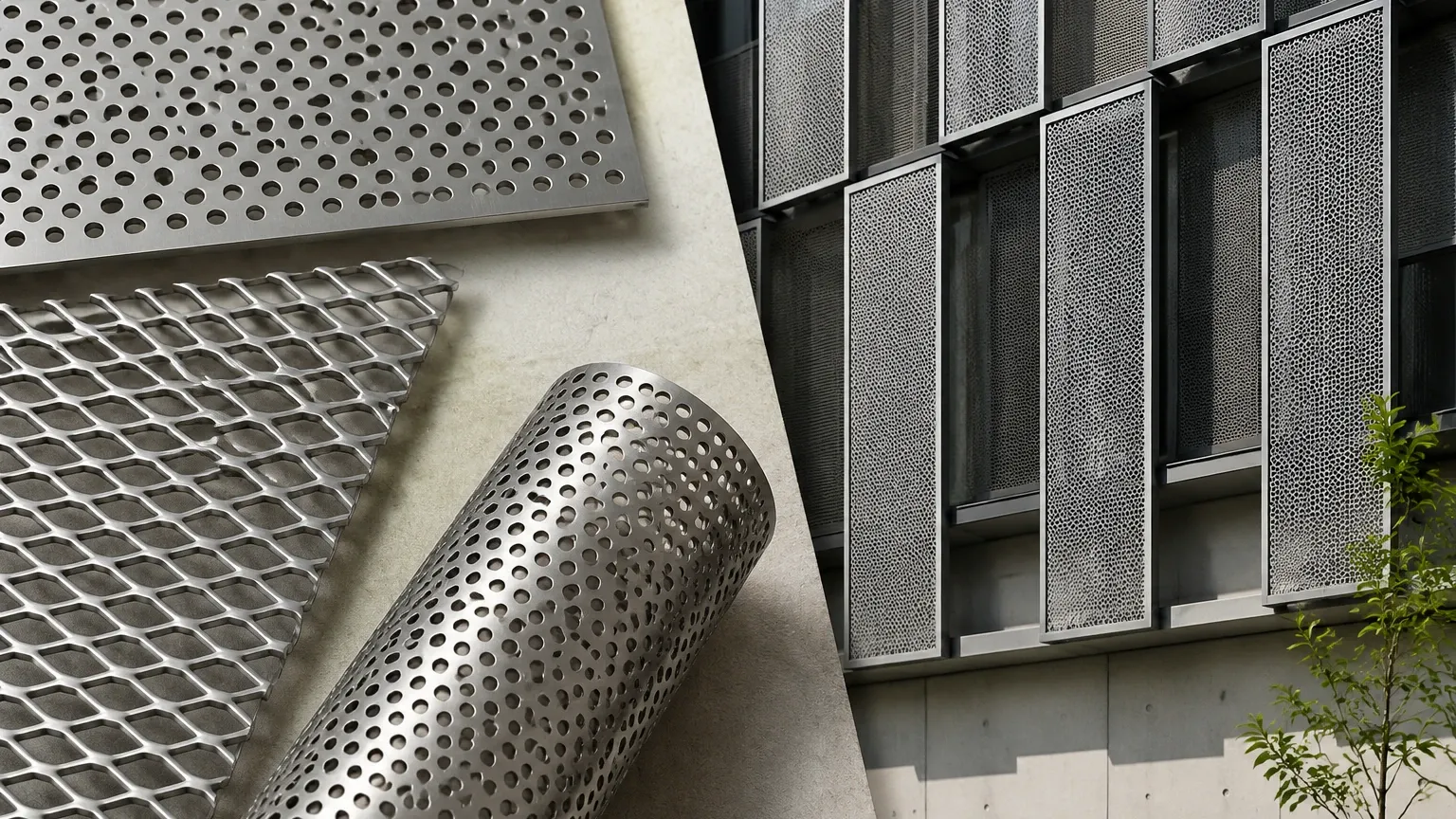
Before delving into the digital modeling aspects, it is essential to understand why perforated and expanded metals are selected for industrial environments. Unlike standard wire mesh, perforated metal is created by punching a series of holes into a solid metal sheet, while expanded metal is slit and stretched to create a diamond-shaped pattern.
In B2B sectors such as chemical processing, pharmaceuticals, and water treatment, these materials serve several vital functions:
1. Filtration and Separation: Perforated sheets act as support structures for finer filter media or serve as primary filters for coarse particles. The precision of the hole size determines the filtration rating.
2. Structural Support: In hydraulic systems, perforated tubes provide the necessary rigidity to withstand high-pressure differentials without collapsing.
3. Flow Control: Perforated plates are used to diffuse gas or liquid flow, ensuring even distribution across a treatment bed or heat exchanger.
4. Protection and Safety: Expanded metal is often used for machine guards and walkways where high strength-to-weight ratios and slip resistance are required.
Technical Implementation: Perforated Metal Texture Revit
When modeling these components in Revit, engineers often face a choice: model every individual hole as a geometric void or use a material texture with an opacity map. For large-scale industrial projects, modeling thousands of individual holes is computationally expensive and can lead to significant performance degradation of the BIM model. Therefore, the use of a high-quality perforated metal texture revit asset is the preferred professional approach.
Material Assets and Cutout Maps
To represent perforated metal accurately, Revit utilizes "Cutout" maps within the Material Browser. A cutout map is a black-and-white image where the black areas represent the holes (transparency) and the white areas represent the metal (opacity).
* Scaling and Tiling: The most common error in digital specification is improper scaling. If a design requires a 5mm round hole with an 8mm staggered pitch, the texture coordinates in Revit must be precisely mapped to match these dimensions. Failure to do so results in a visual representation that does not reflect the actual open area of the physical product.
* Bump Maps for Realism: To simulate the depth of the metal sheet, a bump map or normal map should be used in conjunction with the cutout map. This provides the appearance of thickness at the edges of the perforations, which is critical for high-resolution renderings and technical reviews.
Calculating Open Area in the Digital Model
One of the most critical engineering metrics for perforated metal is the "Percentage of Open Area." This figure dictates the flow rate and pressure drop across the component. When selecting or creating a texture for Revit, engineers must ensure the visual density aligns with the calculated open area formula:
* Round Holes (Staggered 60°): $OA = (D^2 \times 90.69) / P^2$
* Square Holes (Straight): $OA = (D^2 \times 100) / P^2$
*(Where D is the hole diameter and P is the pitch)*
By aligning the digital perforated metal texture revit parameters with these formulas, the BIM model becomes a reliable data source for hydraulic and thermal simulations.
Engineering Considerations for Material Selection
While the digital model focuses on geometry and appearance, the physical performance of Perforated & Expanded Metal depends heavily on material science. Kaifil specializes in custom stainless steel solutions, which are often the preferred choice for demanding industrial applications.
Stainless Steel Grades
* Grade 304: The standard stainless steel for general industrial use, offering excellent formability and basic corrosion resistance. It is suitable for food and beverage applications where frequent cleaning is required.
* Grade 316L: Containing molybdenum, 316L provides superior resistance to chlorides and pitting. This is the industry standard for pharmaceutical processing and marine environments where the metal is exposed to harsh chemicals or saline conditions.
Mechanical Properties
The perforation process can introduce internal stresses into the metal sheet. Depending on the hole pattern and the thickness of the material, the sheet may require leveling after production to ensure flatness. In Revit, this flatness is assumed, but in the procurement phase, specifying "Precision Leveling" is necessary for components that must fit into tight-tolerance assemblies or filter housings.
Customization and OEM Capabilities
Industrial applications rarely rely on off-the-shelf perforated sheets. Customization is often required to meet specific filtration or structural goals. When moving from a Revit model to a purchase order, engineers should confirm several customization options with the manufacturer:
Hole Patterns and Geometry
While round holes are the most common due to their structural efficiency and ease of manufacturing, other geometries serve specific purposes:
* Slotted Holes: Used primarily for vibrating screens and applications where elongated particles must be oriented in a specific direction.
* Square Holes: Offer a higher open area but may have lower structural rigidity compared to staggered round patterns.
* Hexagonal Patterns: Provide the maximum possible open area (up to 80%+) for high-flow air filtration or weight-sensitive applications.
Margin and Border Requirements
In a Revit model, textures often tile infinitely across a surface. However, physical perforated sheets require "margins"—unperforated areas along the edges. These margins are essential for welding the sheet into a frame or filter cartridge. Engineers must specify the width of these margins to ensure the final product can be integrated into the larger assembly without compromising the integrity of the perforations.
Transitioning from Revit to Production
To ensure the successful procurement of Perforated & Expanded Metal, the data captured in the Revit model must be translated into a technical specification sheet. This document should include:
1. Material Type and Grade: (e.g., Stainless Steel 316L).
2. Thickness: (e.g., 2.0mm / 14 Gauge).
3. Hole Shape and Size: (e.g., 3mm Round).
4. Pitch and Arrangement: (e.g., 5mm Staggered).
5. Dimensions and Margins: Exact sheet size and the width of unperforated borders.
6. Surface Finish: Options such as pickling, passivating, or electropolishing to enhance corrosion resistance and remove burrs from the punching process.
Common Risks in Specification
One of the primary risks in specifying perforated metal is the "Burr Side" vs. "Smooth Side." The punching process creates a slight burr on the exit side of the tool. For filtration applications, the orientation of this burr can affect flow dynamics and cleaning efficiency (backwashing). While a perforated metal texture revit cannot easily show these microscopic details, they must be noted in the technical requirements provided to the manufacturer.
Furthermore, the "Minimum Hole Size" rule should be respected: generally, the hole diameter should not be smaller than the material thickness. Attempting to punch holes smaller than the thickness can lead to tool breakage and inconsistent hole geometry, increasing production costs and lead times.
Why Quality Control Matters in Industrial Filtration
For B2B buyers, the total cost of ownership is often more important than the initial purchase price. A poorly manufactured perforated component can lead to premature filter failure, increased pressure drops, or contamination of the process stream.
Kaifil’s commitment to quality involves rigorous inspection of hole diameters and pitch consistency. In high-precision industries like pharmaceutical manufacturing, even a minor deviation in the open area can alter the validated flow characteristics of a system. By utilizing advanced manufacturing capabilities, Kaifil ensures that the physical product matches the engineering intent captured in the Revit model.
Conclusion
The use of a perforated metal texture revit is an essential tool for modern industrial design, allowing engineers to visualize and simulate complex filtration and structural components. However, the digital model is only as effective as the technical data behind it. By understanding the relationship between hole patterns, material grades, and manufacturing constraints, professionals can specify perforated and expanded metal solutions that are both high-performing and cost-effective.
When your project moves from the design phase to implementation, partnering with an experienced manufacturer ensures that the precision of your Revit model is reflected in the final product. For those seeking reliable, custom-engineered filtration components, exploring the range of available Perforated & Expanded Metal options is the first step toward achieving optimal system performance. Confirming material compatibility, open area requirements, and finishing standards with a technical specialist will mitigate risks and ensure long-term durability in demanding industrial environments.
