


Perforated Metal Texture Png
In the initial phases of industrial design and architectural planning, a perforated metal texture png serves as a vital tool for visualization. These digital assets allow engineers and designers to simulate how light, air, and fluids might interact with a physical surface. However, transitioning from a high-resolution digital rendering to a functional industrial component requires a deep understanding of the mechanical properties and manufacturing constraints of Perforated & Expanded Metal.
For procurement teams and design engineers, the visual representation found in a png file is only the starting point. To ensure the final product meets the rigorous demands of chemical processing, food production, or hydraulic filtration, one must translate digital patterns into precise engineering specifications. This guide explores the technical bridge between digital texture visualization and the physical reality of perforated metal production.
The Role of Digital Textures in Industrial Specification
A perforated metal texture png is frequently used in Computer-Aided Design (CAD) and 3D modeling to represent a material's transparency and aesthetic. In professional contexts, these files are often "alpha maps" or "transparency masks" that dictate where a material exists and where the holes are located.
While these textures are excellent for aesthetic approval, they often lack the critical data required for manufacturing. When an engineer moves from a visual model to a purchase order, they must define several physical variables that a png cannot convey:
* Material Gauge: The thickness of the metal sheet, which dictates structural integrity.
* Hole Diameter and Pitch: The exact size of the perforations and the distance between their centers.
* Margins: The solid areas around the edges of the sheet required for mounting or welding.
* Open Area Percentage: A mathematical calculation that determines the flow rate and filtration efficiency.
Understanding these factors ensures that the specified Perforated & Expanded Metal performs reliably in its intended environment, whether as a protective screen or a high-precision filter element.
Technical Parameters: Beyond the Visual Pattern
When selecting a pattern based on a perforated metal texture png, it is essential to calculate the "Open Area." This is the ratio of the total area of the holes to the total area of the sheet, expressed as a percentage. In filtration applications, the open area directly impacts the pressure drop across the filter and the volume of media that can pass through the system.
Round Hole Patterns
Round holes are the most common specification due to their versatility and structural stability. They are typically arranged in two ways:
1. 60-Degree Staggered: This is the industry standard. It provides the highest open area and the greatest strength-to-weight ratio.
2. Straight Line: Holes are aligned in both horizontal and vertical rows. This is often chosen for aesthetic reasons or specific sorting applications but offers less structural rigidity than staggered patterns.
Square and Slotted Holes
While a png might show square or slotted patterns for architectural flair, in industrial filtration, these shapes serve specific purposes. Slotted perforations are often used in sieving and sorting equipment where elongated particles must be oriented in a specific direction. Square holes offer a higher open area than round holes but can lead to stress concentrations at the corners, which must be considered if the component is under high mechanical load.
Material Selection for Demanding Environments
A digital texture does not account for the corrosive nature of chemical processing or the hygiene requirements of the pharmaceutical industry. At Kaifil, we emphasize that material selection is as critical as the perforation pattern itself.
Stainless Steel 304 vs. 316
Most industrial applications utilize stainless steel due to its durability.
* Type 304: The most common grade, offering excellent corrosion resistance and value for general industrial use, food processing, and architectural applications.
* Type 316: Contains molybdenum, providing superior resistance to chlorides and marine environments. This is the preferred choice for chemical filtration and pharmaceutical applications where aggressive cleaning agents are used.
Specialized Alloys
For extreme environments involving high temperatures or highly acidic media, specialized alloys like Monel, Inconel, or Hastelloy may be required. These materials ensure that the perforated metal maintains its structural integrity and filtration accuracy over long service cycles, reducing the total cost of ownership by extending replacement intervals.
Perforated vs. Expanded Metal: A Functional Comparison
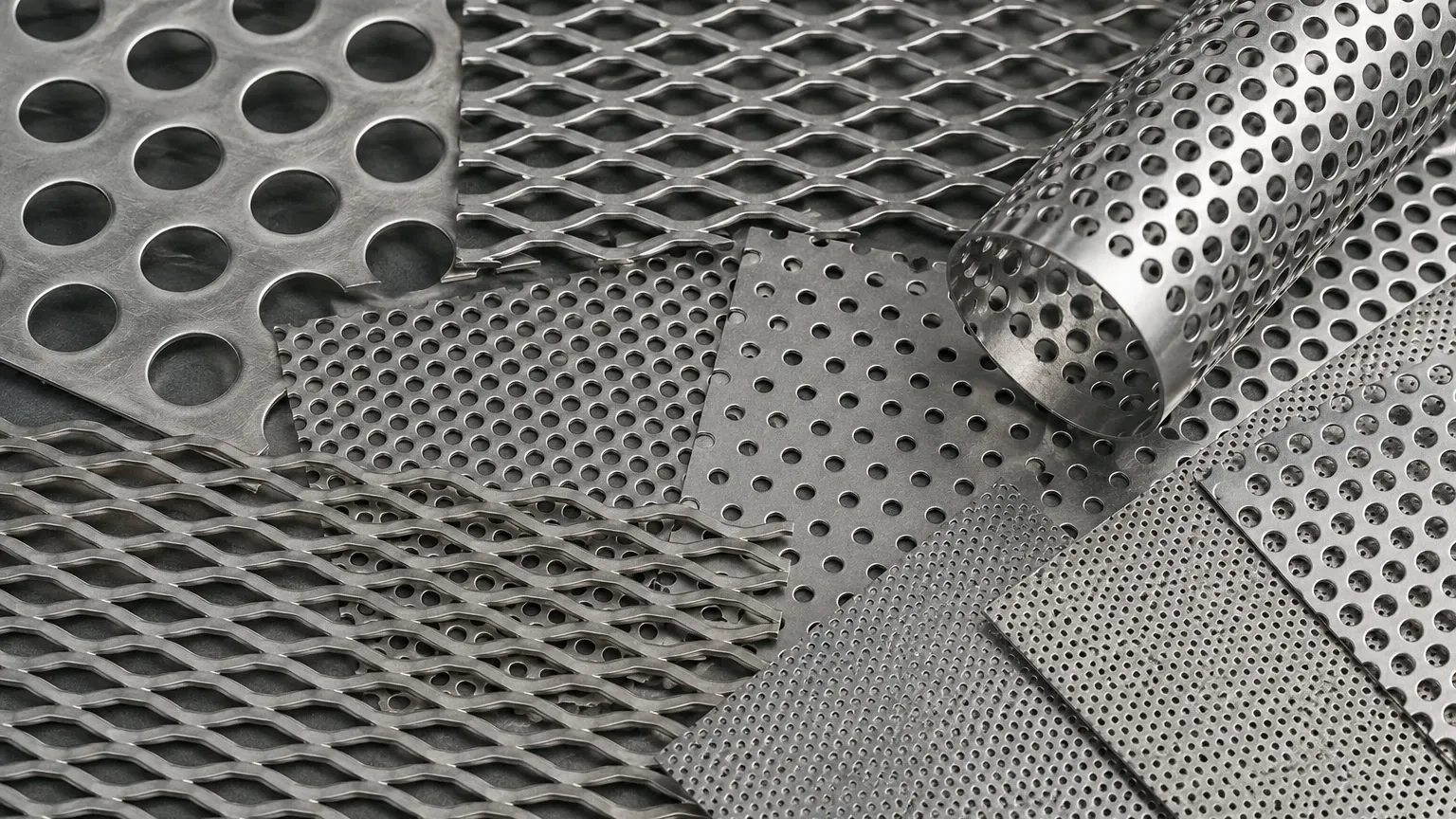
In many design libraries, a perforated metal texture png might be grouped with expanded metal textures. However, the manufacturing processes and physical characteristics of these two products are significantly different.
Perforated Metal
Perforated metal is created by punching a series of holes into a solid sheet. This process allows for extreme precision in hole size and placement. It is ideal for applications requiring specific filtration ratings (microns) and smooth surfaces that are easy to clean. The primary advantage is the ability to maintain wide margins and create custom hole shapes.
Expanded Metal
Expanded metal is produced by simultaneously slitting and stretching a sheet of metal. This creates a diamond-shaped mesh. Because no material is lost during the process, it is often more cost-effective for large-scale applications like walkways, security fencing, or coarse filtration. Expanded metal provides a three-dimensional texture that offers excellent grip and structural rigidity, but it lacks the precise filtration control of perforated sheets.
Engineering Considerations for Custom Filtration
When moving from a digital concept to a custom filtration solution, engineers must evaluate how the perforation pattern will affect the performance of the filter cartridge or screen. Kaifil specializes in translating these requirements into high-performance components.
Pressure Drop and Flow Rate
A common mistake in specifying Perforated & Expanded Metal is overlooking the pressure drop. If the open area is too low, the pump or system must work harder to move fluid through the filter, leading to increased energy costs and potential equipment failure. Conversely, if the open area is too high, the structural integrity of the filter may be compromised under high-pressure conditions.
Filtration Accuracy
In multi-layer filter cartridges, the perforated metal often serves as a support core or an outer protective shroud. The hole size must be smaller than the media it supports to prevent migration, yet large enough to not impede the flow. Technical teams must confirm the "bridge" width—the amount of metal between the holes—to ensure the component can withstand the differential pressure during the filtration cycle.
Quality Standards and Manufacturing Precision
Achieving the precision suggested by a high-resolution perforated metal texture png requires advanced manufacturing capabilities. Industrial-grade perforation involves CNC-controlled punching presses that can handle heavy gauges and complex patterns with minimal deviation.
Key quality factors to confirm before production include:
* Flatness Tolerances: The punching process can introduce internal stresses that cause the metal to curl. Professional manufacturers utilize leveling rollers to ensure the final sheet is perfectly flat for easy installation.
* Burr Removal: Punching naturally creates a sharp edge (burr) on the exit side of the hole. For food and beverage or pharmaceutical applications, these burrs must be removed through deburring or polishing to prevent contamination and ensure safety.
* Dimensional Accuracy: Ensuring the overall dimensions of the sheet and the placement of the perforated area (the "pattern") are within specified tolerances for seamless integration into larger assemblies.
Conclusion: From Digital Texture to Industrial Solution
While a perforated metal texture png is an excellent starting point for visual conceptualization, the success of an industrial project depends on the technical specification of the physical material. By understanding the nuances of hole patterns, open area calculations, and material science, engineers can ensure that their Perforated & Expanded Metal components provide the durability and performance required for demanding industrial environments.
At Kaifil, we bridge the gap between design and manufacturing. Our expertise in custom stainless steel filtration allows us to take your visual requirements and transform them into precision-engineered components that meet the highest standards of quality and reliability. Whether you are designing a new hydraulic system or upgrading a chemical processing line, confirming the technical details of your perforation pattern is the most critical step toward an optimized filtration solution.
