


Perforated Metal with Holes
In the landscape of industrial filtration and structural engineering, perforated metal with holes serves as a critical component that balances mechanical strength with precise permeability. Unlike generic hardware materials, industrial-grade perforated metal is an engineered product where the geometry, spacing, and alignment of every perforation are calculated to meet specific flow rates, pressure drop requirements, and particle retention standards. For engineers and procurement specialists, selecting the right perforated media is not merely about choosing a pattern; it is about understanding how material properties and hole configurations interact under operational stress.
Kaifil, as a specialist in custom stainless steel filtration solutions, focuses on the manufacturing of high-precision Perforated & Expanded Metal to support demanding applications in chemical processing, pharmaceutical manufacturing, and the food and beverage industry. This guide examines the technical nuances of perforated metal with holes, providing the factual foundation necessary for informed equipment design and component selection.
Understanding the Engineering Behind Perforated Metal with Holes
Perforated metal is produced through a mechanical punching or laser-cutting process that creates a series of holes, slots, or decorative shapes in a metal sheet. In industrial filtration, the primary function of these perforations is to allow the passage of fluids or gases while intercepting solid contaminants. However, the utility of perforated metal extends beyond simple straining; it often serves as the rigid support structure (the "core" or "cage") for finer wire mesh filter elements, providing the structural integrity needed to withstand high differential pressures.
When evaluating perforated metal with holes, engineers must consider the relationship between the hole diameter (D) and the material thickness (T). As a general rule of industrial manufacturing, the hole diameter should ideally be equal to or greater than the material thickness. Attempting to punch holes smaller than the plate thickness increases the risk of tool breakage and can lead to structural irregularities in the metal, which may compromise the filter's long-term durability.
Hole Geometry and Pattern Configurations
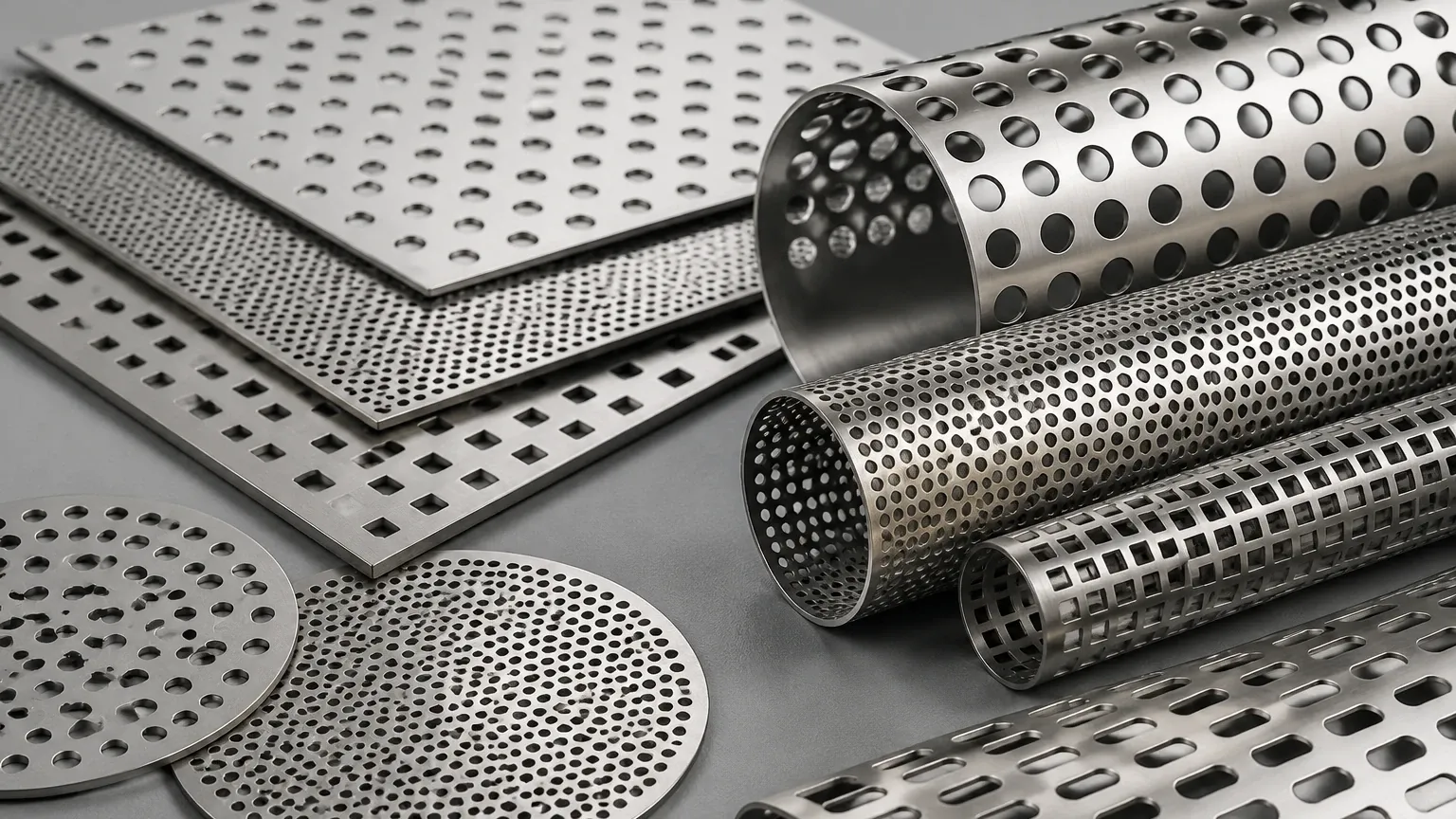
The performance of a filter is largely dictated by the shape and arrangement of its perforations. While custom shapes are available, three primary configurations dominate the industrial sector:
1. Round Holes
Round holes are the most common and cost-effective configuration. They offer the greatest structural strength and a wide range of open area percentages. Round perforations are typically arranged in two patterns:
* 60-Degree Staggered: This is the industry standard. It provides the highest open area and maximum strength because the holes are equidistant from one another, ensuring uniform stress distribution across the sheet.
* Straight Line: Holes are aligned in both horizontal and vertical rows. This is generally weaker than staggered patterns and is used primarily when specific flow paths or aesthetic alignments are required.
2. Square Holes
Square holes provide a larger open area than round holes of the same width. They are often used in applications requiring high flow rates where the structural demands are less intensive than those requiring round-hole staggered patterns.
3. Slotted Holes
Slotted or elongated holes are essential for filtering fibrous materials or elongated particles that might pass through round holes. These are frequently used in the pulp and paper industry or in specialized food processing equipment.
Material Selection: The Importance of Stainless Steel Grades
The environment in which the perforated metal with holes will operate dictates the material choice. Because filtration often involves exposure to corrosive fluids, high temperatures, or strict hygiene requirements, stainless steel is the preferred substrate for industrial applications.
* Grade 304 Stainless Steel: The most versatile and widely used grade. It offers excellent corrosion resistance for general industrial applications, such as water treatment and basic chemical processing.
* Grade 316/316L Stainless Steel: Contains molybdenum, which significantly enhances resistance to chlorides and pitting. This grade is the standard for marine environments, pharmaceutical production, and high-acid food processing. The "L" (low carbon) variant is preferred for components that require welding, as it prevents carbide precipitation that can lead to corrosion at the weld sites.
* Specialty Alloys: For extreme environments involving high-temperature oxidation or highly aggressive chemicals, alloys like Monel, Inconel, or Duplex stainless steel may be utilized to ensure the longevity of the filtration system.
Calculating Open Area and Filtration Efficiency
The "Open Area" is the total area of the holes expressed as a percentage of the total area of the sheet. This is the most critical metric for engineers because it determines the flow capacity and the pressure drop across the filter.
For a standard 60-degree staggered round hole pattern, the formula for calculating open area is:
Percentage Open Area = (D² × 90.69) / R²
*(Where D = Hole Diameter and R = Center-to-Center Pitch)*
A higher open area reduces the resistance to flow but decreases the mechanical strength of the sheet. In high-pressure hydraulic or steam applications, a balance must be struck. If the open area is too high, the metal may deform or fail under the pressure of the fluid. Conversely, if the open area is too low, the pump or system must work harder to push fluid through the filter, leading to energy inefficiency and potential system overheating.
Customization Parameters for Industrial Applications
Off-the-shelf perforated metal rarely meets the exact requirements of specialized industrial machinery. Customization is necessary to ensure the component integrates seamlessly into the larger system. Key parameters to confirm during the design phase include:
Margins and Unperforated Areas
Margins are the blank areas along the edges of the sheet. In filter cartridge manufacturing, specific margins are required to allow for clean welding or mechanical fastening. For example, a stainless steel filter cylinder requires unperforated edges to create a strong longitudinal seam weld without damaging the hole pattern.
Flatness and Tolerances
The punching process can introduce internal stresses into the metal, causing it to curl or bow. For precision applications, such as those involving rotating machinery or tight-tolerance housings, the metal must undergo a leveling process to ensure industrial-grade flatness. Standard tolerances for hole diameter and pitch must also be strictly maintained to ensure consistent filtration performance across the entire surface.
Surface Finishes
Depending on the application, perforated metal with holes may require post-production treatments. Electropolishing is common in the pharmaceutical and food industries to remove burrs and create a microscopically smooth surface that prevents bacterial growth and simplifies the cleaning process (CIP – Clean-In-Place).
Performance Expectations and Maintenance
When integrated into a filtration system, perforated metal is expected to provide a predictable service life. However, several factors can influence performance:
* Blinding and Plugging: If the particle size in the fluid stream matches the hole size too closely, particles can become wedged in the openings, a phenomenon known as "blinding." This increases pressure drop and necessitates cleaning.
* Erosion: In high-velocity systems, abrasive particles can gradually wear down the edges of the holes, enlarging them and reducing filtration accuracy. Selecting a harder material or a thicker gauge can mitigate this.
* Replacement Cycles: While stainless steel perforated metal is highly durable, it is not permanent. Regular inspection for signs of stress cracking (particularly around the hole edges) and corrosion is essential. In many OEM applications, the perforated element is designed as a replaceable cartridge to minimize system downtime.
How to Select the Right Perforated Metal Solution
For purchasing teams and engineers, the selection process should begin with a clear definition of the operating environment. Before finalizing a specification for perforated metal with holes, confirm the following:
1. Fluid Compatibility: Will the material withstand the chemical composition of the process fluid?
2. Differential Pressure: What is the maximum pressure the sheet will encounter when the filter is dirty?
3. Filtration Grade: Is the perforated metal the primary filter, or is it a support for a finer mesh?
4. Dimensional Accuracy: Are the margins and tolerances compatible with the final assembly method (welding, bolting, or clamping)?
Kaifil provides technical support to help customers navigate these variables, ensuring that the resulting Perforated & Expanded Metal components deliver optimal performance in their specific industrial context. By focusing on precision manufacturing and material integrity, Kaifil supports the development of filtration systems that are both efficient and cost-effective over their entire lifecycle.
In summary, perforated metal with holes is a sophisticated engineering material that requires careful consideration of geometry, material science, and manufacturing constraints. Whether used as a primary strainer or a structural support for high-precision filter cartridges, the quality of the perforation determines the reliability of the entire filtration process.
