


Perforated Sheet Metal 4×8 Near Me
In industrial manufacturing and filtration engineering, the 4-foot by 8-foot (4×8) sheet is the standard dimensional unit for metal substrates. When engineers and procurement professionals search for "perforated sheet metal 4×8 near me," the objective is typically a balance between immediate availability and the technical precision required for specific industrial applications. While local metal service centers often stock general-purpose sheets, specialized applications—particularly in filtration, chemical processing, and food production—require a deeper understanding of material science, hole geometry, and structural integrity.
Perforated metal is a functional material created by mechanically punching or laser-cutting holes, slots, or decorative shapes into metal sheets. The 4×8 format is preferred because it aligns with standard industrial machinery, storage racks, and shipping dimensions, making it a cost-effective starting point for various fabrication projects. However, selecting the right sheet involves more than just finding a local supplier; it requires evaluating the specific performance characteristics of Perforated & Expanded Metal to ensure long-term reliability in demanding environments.
Technical Specifications of Perforated Sheet Metal
When sourcing perforated sheet metal, technical specifications dictate the material's performance under pressure, its filtration efficiency, and its structural durability. The most critical parameters include the hole pattern, the hole size, the pitch, and the resulting open area percentage.
Hole Patterns and Geometry
The arrangement of holes significantly impacts the strength and flow characteristics of the sheet.
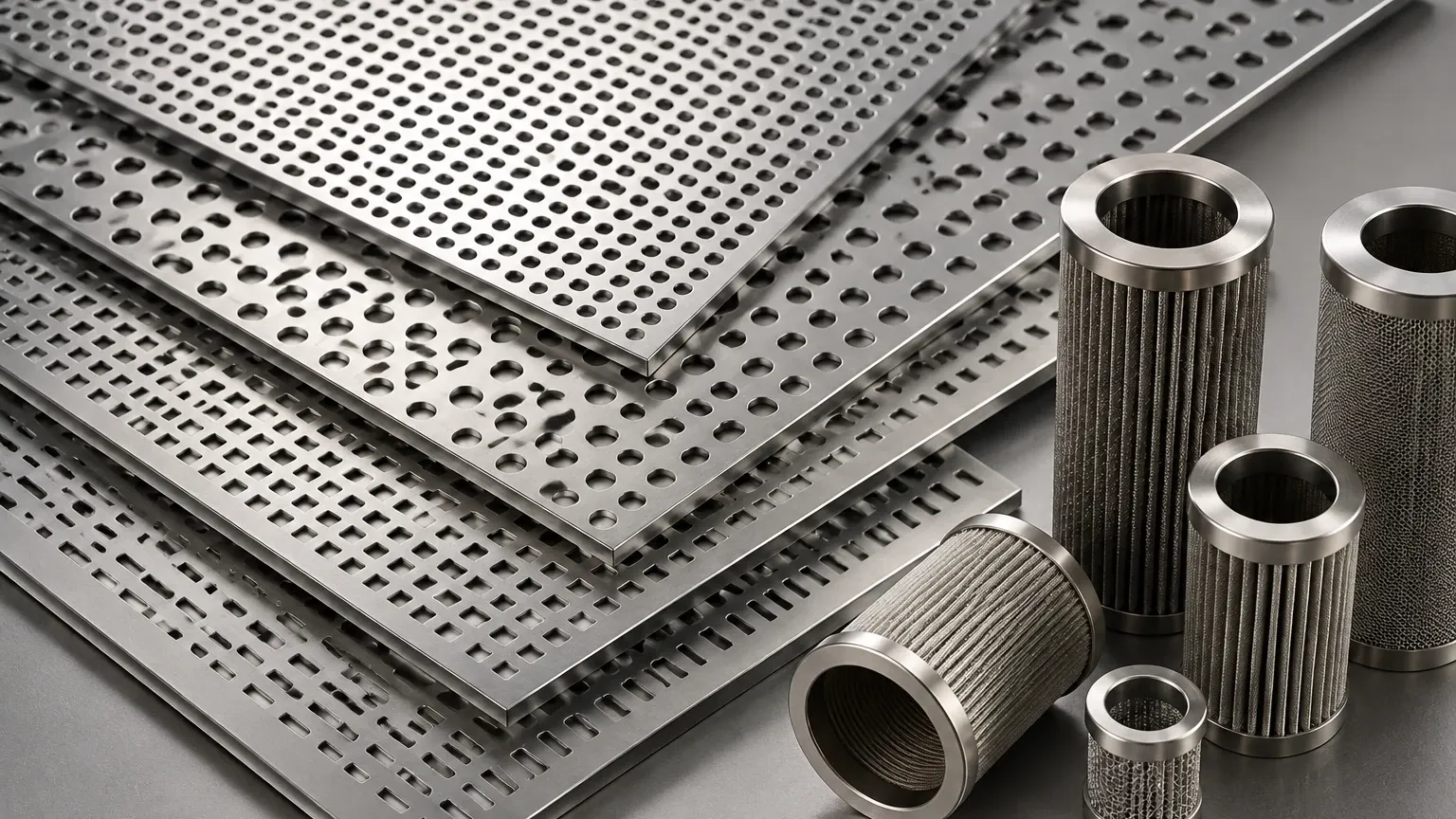
* Staggered Pattern (60-degree): This is the most common industrial configuration. It provides the highest open area and superior strength-to-weight ratios. The 60-degree orientation ensures that the material remains rigid while allowing for uniform fluid or air distribution.
* Straight Pattern: Holes are aligned in both horizontal and vertical rows. While simpler to align for aesthetic architectural applications, straight patterns generally offer lower structural integrity than staggered patterns.
* Slotted Holes: Often used in screening and sifting applications where elongated particles must be separated. Slotted perforations are typically staggered to prevent material buildup.
Calculating Open Area
The "open area" is the percentage of the sheet that consists of holes. This is the primary metric for engineers designing filtration systems or ventilation covers. For a standard staggered round hole pattern, the formula is:
Open Area % = (D² × 90.69) / R²
Where *D* is the hole diameter and *R* is the center-to-center distance (pitch). Achieving the correct open area is vital; too low, and the pressure drop across the filter becomes excessive; too high, and the sheet may deform under mechanical load.
The Difference Between Perforated and Expanded Metal
While often grouped together, perforated and expanded metals are manufactured through different processes and serve distinct roles in industrial settings. Understanding these differences is essential when evaluating "perforated sheet metal 4×8 near me" for specific project requirements.
Perforated Metal is produced by punching holes into a solid sheet. This process removes material, creating a flat, precise surface. It is ideal for high-precision filtration where specific hole diameters (down to microns in some custom applications) are required. Because the sheet remains flat, it is easier to weld into cylindrical filter cartridges or integrate into complex machinery.
Expanded Metal is created by simultaneously slitting and stretching the metal sheet. This process does not remove material, making it a more resource-efficient option. The resulting diamond-shaped openings are slightly angled, which can be beneficial for applications requiring directional airflow or anti-slip surfaces. However, expanded metal typically lacks the precise filtration accuracy of perforated sheets and has a higher profile (thickness) due to the strands being turned at an angle.
For filtration components that require fine particulate retention and a smooth surface for easy cleaning, perforated stainless steel is generally the preferred choice.
Engineering Considerations for Filtration Applications
In the context of industrial filtration, a 4×8 sheet is rarely the end product. It is usually a raw material that will be rolled, welded, or pleated into a filter element. Professionals sourcing these materials must consider how the perforation process affects the material's mechanical properties.
Edge Margins and Blank Areas
When ordering a 4×8 sheet, engineers must specify the "margins." Margins are the unperforated areas along the edges of the sheet. For a filter cartridge manufacturer, having a solid margin is critical for creating a clean longitudinal weld. If the perforations extend to the very edge, the welding process becomes significantly more difficult, often leading to structural weaknesses or bypass leaks in the final filter assembly.
Flatness and Stress Relieving
The punching process introduces significant internal stress into the metal. If not properly managed, a 4×8 sheet can develop "oil canning" (buckling) or camber (curving). High-quality industrial perforated sheets undergo leveling processes to ensure they remain flat. This is particularly important for automated fabrication lines where a warped sheet can cause machine jams or misalignment.
Sourcing Perforated Sheet Metal 4×8 Near Me: Local vs. Specialized Suppliers
For many maintenance and repair operations (MRO), a local metal service center is the first point of contact. Local sourcing offers the advantage of reduced shipping costs and immediate pickup. However, for specialized industrial applications, there are several risks associated with general-purpose local suppliers:
1. Limited Material Grades: Local suppliers often stock standard carbon steel or 304 stainless steel. If your application involves highly corrosive chemicals or high temperatures, you may require 316L stainless steel, Monel, or Inconel, which are rarely available in 4×8 sheets at a local level.
2. Inconsistent Tolerances: General-purpose perforated metal may have wider tolerances for hole diameter and pitch. In precision filtration, even a 5% variance in open area can disrupt the flow dynamics of a system.
3. Lack of Certification: Industrial projects often require Mill Test Reports (MTRs) to verify the chemical composition and physical properties of the metal. Specialized manufacturers like Kaifil provide full traceability, which is essential for pharmaceutical, food and beverage, and aerospace sectors.
4. Secondary Processing: A local supplier sells you a sheet. A specialized manufacturer can provide the sheet cut-to-size, degreased, deburred, and even formed into the final component, reducing the workload for your internal production team.
Material Grades and Corrosion Resistance in Industrial Environments
The longevity of a perforated metal component is dictated by its material grade. When searching for "perforated sheet metal 4×8 near me," the environment in which the metal will operate must be the primary driver of the selection process.
* Stainless Steel 304: The most common grade, offering good corrosion resistance and excellent formability. It is suitable for most indoor industrial applications and general filtration.
* Stainless Steel 316/316L: Contains molybdenum, which provides superior resistance to chlorides and marine environments. This is the standard for chemical processing and pharmaceutical filtration where aggressive cleaning agents are used.
* Carbon Steel: Economical but requires coating (galvanizing or painting) to prevent rust. It is typically used for structural supports or large-scale air intake screens where moisture is not a primary concern.
* Aluminum: Lightweight and naturally corrosion-resistant. Aluminum perforated sheets are often used in HVAC systems and architectural elements where weight reduction is a priority.
Customization and Secondary Processing for Industrial Filters
While the 4×8 sheet is a standard size, many industrial applications require customization that goes beyond simple dimensions. Manufacturers specializing in filtration solutions offer several secondary processes that add value to the base perforated material:
Deburring and Surface Finishing
The punching process inevitably leaves small metal burrs on the "exit" side of the hole. In food processing or hydraulic filtration, these burrs can break off and contaminate the fluid stream. Industrial-grade perforated metal undergoes mechanical or chemical deburring to ensure a smooth, safe surface. Additionally, processes like electropolishing can be applied to stainless steel sheets to enhance corrosion resistance and facilitate easier cleaning (CIP – Clean-In-Place).
Precision Cutting and Forming
Using CNC fiber lasers or waterjets, 4×8 sheets can be cut into precise shapes with minimal heat-affected zones. For filtration applications, these sheets are often rolled into cylinders and seam-welded. The quality of the initial perforation—specifically the accuracy of the margins—determines the roundness and structural integrity of the resulting filter tube.
Multi-Layer Integration
In many advanced filtration systems, perforated metal serves as the structural support (the "core" or "cage") for finer filter media, such as woven wire mesh or sintered metal fibers. The perforated sheet provides the mechanical strength to withstand high differential pressures, while the finer mesh handles the actual particulate separation.
Total Cost of Ownership and Logistics
When evaluating "perforated sheet metal 4×8 near me," it is important to look beyond the sticker price per sheet. The total cost of ownership (TCO) includes:
* Freight and Handling: Shipping 4×8 sheets requires LTL (Less Than Truckload) freight. While a local supplier might seem cheaper, a specialized manufacturer may have better freight contracts or the ability to ship finished, smaller components that are much more cost-effective to transport.
* Scrap Rates: If your final parts are not multiples of 4×8, you may end up with significant material waste. A manufacturer that offers custom-sized sheets or parts can reduce this waste, often resulting in a lower total project cost.
* Longevity: Using a sub-optimal material grade because it was "available locally" can lead to premature failure, system downtime, and expensive replacement costs. Investing in the correct specification from the outset is always more economical in an industrial context.
Conclusion
Finding "perforated sheet metal 4×8 near me" is the start of a procurement process, but for engineers, the technical details are what ensure project success. Whether you are designing a new filtration system, replacing worn-out screens in a chemical plant, or fabricating protective guards for industrial machinery, the choice of material, hole pattern, and supplier expertise is paramount.
Specialized manufacturers like Kaifil bridge the gap between raw material supply and precision engineering. By focusing on high-quality stainless steel filtration solutions and offering extensive customization, they provide the technical support and reliable performance that general metal distributors cannot match. When performance is non-negotiable, selecting a partner with deep expertise in perforated and expanded metal ensures that your components will meet the rigorous demands of your specific industrial application.
