


Perforated Steel Nearby
In industrial procurement, the search for "perforated steel nearby" is often driven by the need for rapid prototyping, reduced logistics costs, and immediate technical support. For engineers and procurement specialists in sectors such as chemical processing, pharmaceuticals, and water treatment, identifying a reliable source for perforated and expanded metal is not merely a matter of geography; it is a critical step in ensuring the structural integrity and efficiency of filtration systems.
While local availability simplifies the supply chain, the technical requirements of industrial-grade filtration often demand specialized manufacturing capabilities that go beyond standard architectural or decorative metalwork. This guide examines the engineering considerations, material specifications, and evaluation criteria necessary when sourcing perforated and expanded metal for demanding industrial applications.
Understanding the Technical Distinctions: Perforated vs. Expanded Metal
When evaluating Perforated & Expanded Metal for industrial use, it is essential to understand how the manufacturing process influences the final performance of the filtration component.
Perforated Metal Manufacturing
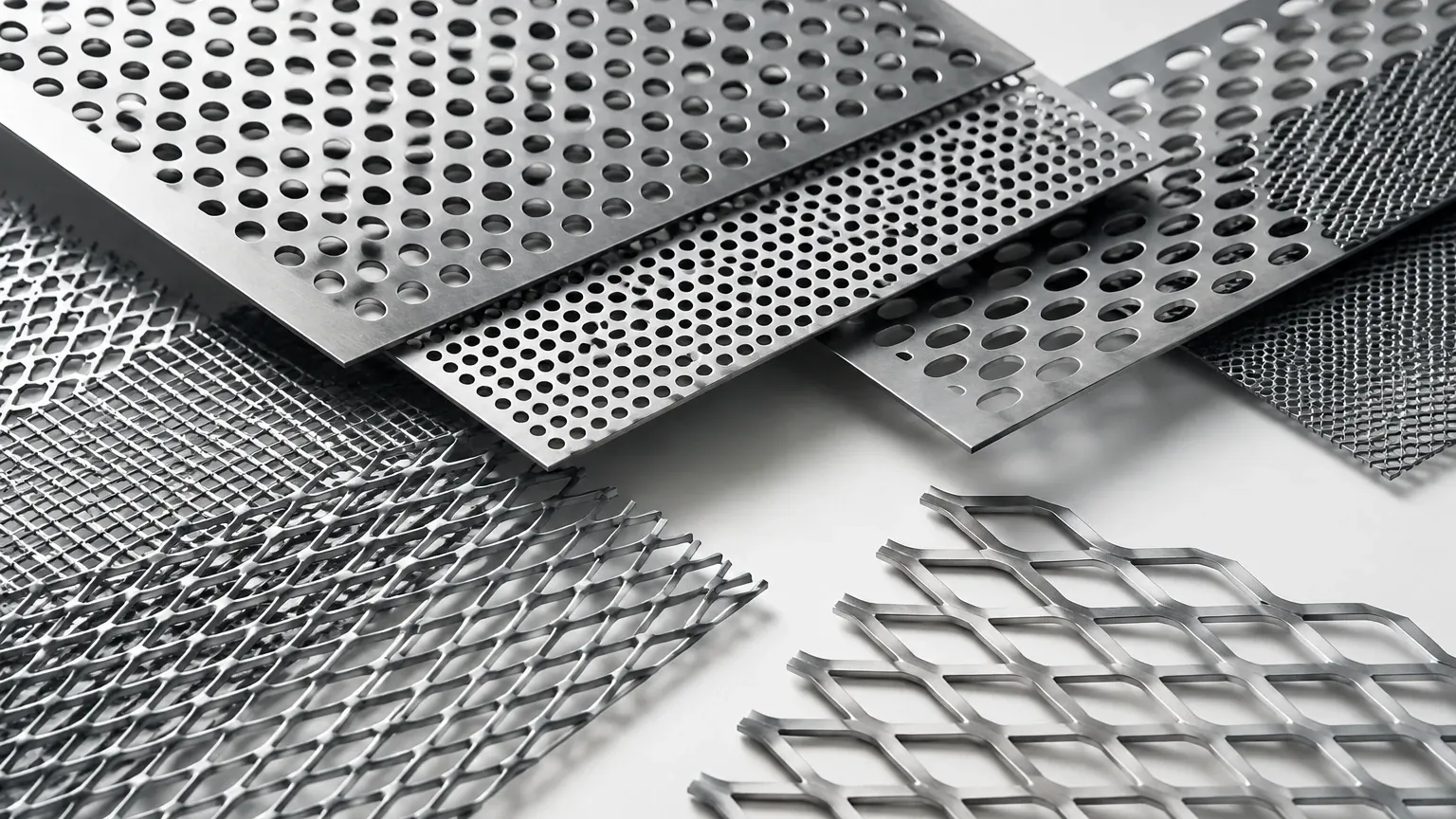
Perforated metal is produced by mechanically punching or laser-cutting a series of holes into a solid metal sheet. This process allows for high precision in hole size, shape, and spacing. In filtration, round holes are the industry standard due to their structural uniformity and predictable flow characteristics. However, square, slotted, or hexagonal patterns may be specified for unique mechanical or aesthetic requirements. The primary advantage of perforated steel is its ability to maintain high structural rigidity while providing a specific open area for fluid or gas passage.
Expanded Metal Manufacturing
Expanded metal is created by simultaneously slitting and stretching a metal sheet. This process results in a diamond-shaped mesh pattern without any material waste. Expanded metal can be supplied in two forms: "standard" (raised), where the strands are at an angle to the plane of the sheet, and "flattened," where the sheet is passed through a cold-roll reducing mill to create a smooth surface. In filtration applications, expanded metal is frequently used as a support structure or a coarse pre-filter due to its high strength-to-weight ratio.
Key Engineering Considerations for Material Selection
When searching for perforated steel nearby, the material grade is the most significant factor in determining the component's lifespan and resistance to environmental stressors. For B2B industrial applications, stainless steel is the preferred substrate due to its corrosion resistance and mechanical durability.
1. Type 304 Stainless Steel: This is the most common grade used for general industrial applications. It offers excellent formability and weldability, making it suitable for standard water treatment and food processing environments where extreme chemical exposure is not a primary concern.
2. Type 316L Stainless Steel: For chemical processing, marine environments, or pharmaceutical manufacturing, 316L is the industry standard. The addition of molybdenum provides superior resistance to pitting and crevice corrosion, particularly in chloride-rich environments. The "L" denotes low carbon content, which minimizes carbide precipitation during welding, ensuring the integrity of the filter assembly.
3. Specialty Alloys: In high-temperature or highly corrosive environments, engineers may require nickel alloys or duplex stainless steels. These materials are selected based on specific chemical compatibility charts and thermal expansion coefficients.
Evaluating "Perforated Steel Nearby" Beyond Logistics
While proximity reduces shipping times, the technical capability of the supplier is paramount. A local steel service center may offer standard sheets, but an industrial filtration specialist like Kaifil provides the precision required for OEM integration. When evaluating a supplier, engineers should confirm the following:
Precision and Tolerances
Filtration components often require tight tolerances to ensure a proper fit within a housing or as part of a multi-layer filter cartridge. Suppliers must be able to provide specific data on hole diameter tolerances, pitch accuracy, and sheet flatness. Variations in these parameters can lead to bypass issues or mechanical failure under high-pressure conditions.
Edge Configurations and Margins
In many industrial designs, "margins" (the unperforated area around the edges of the sheet) are critical for welding or mechanical fastening. A supplier capable of providing custom margins helps eliminate secondary trimming processes, reducing the total cost of ownership. Engineers should specify whether they require "finished" margins (where the pattern stops cleanly) or "random" margins (where the pattern is sheared through the holes).
Burrs and Surface Finish
For pharmaceutical and food-grade applications, the presence of burrs or surface imperfections is unacceptable. Burrs can trap contaminants or shed metal particles into the process stream. High-quality perforated steel should undergo de-burring and, in some cases, electropolishing to ensure a smooth, hygienic surface that facilitates easy cleaning and sterilization.
The Role of Open Area in Filtration Efficiency
The "Open Area" is perhaps the most critical specification for any perforated or expanded metal component. It represents the percentage of the sheet that is comprised of holes, directly impacting flow rate and pressure drop.
For a standard round-hole staggered pattern, the open area is calculated using the formula:
`OA = (0.907 * D²) / P²`
*Where D is the hole diameter and P is the center-to-center pitch.*
Engineers must balance the need for a high open area (to minimize pressure drop) with the requirement for mechanical strength. A sheet with an excessively high open area may deform under hydraulic surges or the weight of the filter cake. Conversely, too small an open area will lead to premature blinding and increased energy consumption by the pump system.
Customization and OEM Capabilities
Searching for perforated steel nearby often leads to the realization that off-the-shelf products do not meet specific engineering requirements. Customization is often necessary for:
* Cylindrical Forming: Perforated sheets are often rolled and seam-welded to form the inner cores or outer shrouds of filter cartridges. This requires precise calculation of the "stretch" factor during the rolling process to maintain hole alignment.
* Multi-Layer Integration: Perforated metal is frequently used as a drainage layer or support mesh for fine wire mesh filters. This requires the supplier to understand how different layers interact under thermal and mechanical stress.
* Custom Hole Patterns: In some high-viscosity applications, non-standard hole patterns or tapered holes (where the exit diameter is larger than the entry diameter) may be required to prevent clogging.
Total Cost of Ownership and Replacement Cycles
When procurement teams look for perforated steel nearby, they should consider the total cost of ownership (TCO) rather than the initial purchase price alone. A lower-cost local option that uses inferior alloys or lacks precision finishing will ultimately cost more due to:
* Frequent Replacements: Poor material selection leads to premature corrosion or mechanical fatigue.
* System Downtime: Unexpected filter failure can halt an entire production line, leading to significant financial losses.
* Cleaning Inefficiency: Rough surfaces or irregular hole patterns make backwashing less effective, shortening the interval between manual cleanings.
By partnering with a manufacturer that specializes in industrial filtration, such as Kaifil, companies can ensure that their perforated and expanded metal components are engineered for longevity. This includes selecting the correct thickness (gauge) to withstand the maximum differential pressure (ΔP) expected during the filtration cycle.
Final Verification Before Procurement
Before finalizing a purchase of perforated steel, technical professionals should confirm the following with their supplier:
1. Material Certification: Request Mill Test Reports (MTRs) to verify the chemical composition and mechanical properties of the steel.
2. Compliance Standards: Ensure the product meets relevant industry standards, such as ISO 9001 for quality management or specific FDA/3-A standards for food and beverage applications.
3. Application Support: Does the supplier provide engineering guidance on hole selection and structural support?
4. Prototyping Services: For custom OEM projects, can the supplier provide small-batch samples for validation testing?
In conclusion, while the convenience of finding "perforated steel nearby" is a valid logistical goal, the technical requirements of industrial filtration must remain the priority. By focusing on material integrity, precision manufacturing, and application-specific engineering, procurement teams can secure components that optimize system performance and reduce long-term operational costs.
