


Perforations in Metal
In industrial engineering and manufacturing, the term "perforations in metal" refers to the systematic creation of holes, slots, or decorative shapes in metallic sheets or coils. This process transforms solid metal into a functional component capable of managing fluid flow, sound attenuation, light diffusion, and structural support. For engineers and procurement specialists, selecting the right type of perforation—whether through traditional punching or the expanding process—is critical to the performance and longevity of industrial equipment.
As a specialized manufacturer, Kaifil provides high-precision Perforated & Expanded Metal solutions designed to meet the rigorous demands of chemical processing, water treatment, and hydraulic systems. Understanding the technical nuances of these materials is essential for optimizing filtration efficiency and ensuring mechanical reliability.
Understanding the Engineering of Perforated Metal
Perforated metal is produced by mechanically punching or laser-cutting patterns into a metal sheet. This method allows for extreme precision in hole size, spacing, and arrangement. In B2B applications, the choice of perforation pattern is rarely aesthetic; it is driven by the specific requirements of the application, such as pressure drop, particle retention, or structural load-bearing capacity.
Hole Patterns and Geometries
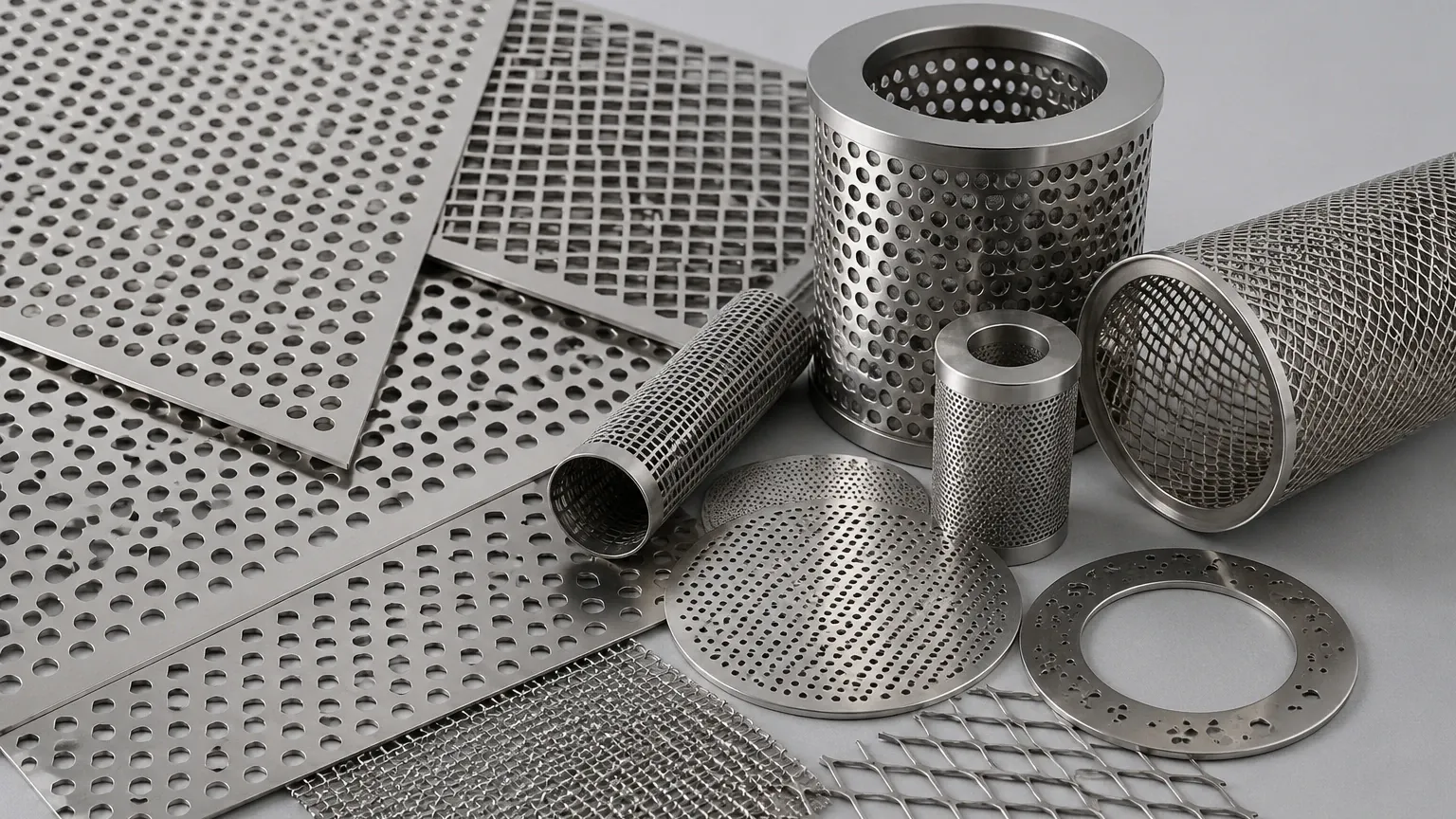
The geometry of the perforations in metal significantly influences the material's behavior. The most common patterns include:
* Round Holes: The most versatile and cost-effective option. Round holes provide the best balance of structural strength and open area. They are typically arranged in a 60-degree staggered pattern, which maximizes the number of holes per square inch while maintaining the integrity of the metal "bridges" between them.
* Square Holes: Often used when a higher open area is required. While square holes offer excellent visibility and flow, they can create stress concentration points at the corners, which may lead to cracking under high-vibration or high-pressure conditions.
* Slotted Holes: These are elongated perforations used primarily for sorting and sifting applications. They are effective in preventing "blinding" or clogging when filtering elongated particles.
Calculating the Open Area Percentage
For filtration and ventilation, the "open area" is the most critical technical specification. It is the ratio of the area of the holes to the total area of the sheet, expressed as a percentage. This value determines the flow rate and pressure drop across the medium.
For a standard 60-degree staggered round hole pattern, the formula is:
Open Area % = (D² × 90.69) / P²
Where *D* is the hole diameter and *P* is the pitch (the distance from the center of one hole to the center of the adjacent hole). Accurate calculation of this percentage is vital for engineers to ensure that the filtration system does not suffer from excessive backpressure.
The Mechanics of Expanded Metal
Unlike perforated metal, which involves removing material to create holes, expanded metal is manufactured by simultaneously slitting and stretching the sheet. This process creates a diamond-shaped mesh without any material waste, making it an economically efficient alternative for many industrial applications.
Standard vs. Flattened Expanded Metal
When specifying expanded metal, engineers must choose between two primary forms:
1. Standard (Raised) Expanded Metal: The strands and bonds are set at a uniform angle to the plane of the sheet. This creates a three-dimensional surface that provides excellent grip and can deflect light or sound. In filtration, this 3D structure can help break up fluid flow and reduce turbulence.
2. Flattened Expanded Metal: This is standard expanded metal that has been cold-rolled to create a smooth, flat surface. Flattened metal is thinner and wider than the original sheet. It is often preferred when the material needs to be bonded to other layers, such as in multi-layer stainless steel filter cartridges.
Because expanded metal is a single piece of material without joins or welds, it maintains a high strength-to-weight ratio. The "perforations" in this case are the diamond openings, which are defined by the Long Way of Design (LWD) and Short Way of Design (SWD).
Material Considerations for Industrial Environments
The performance of perforations in metal is heavily dependent on the base alloy. In harsh industrial environments, material selection is the primary defense against premature failure.
* Stainless Steel (304/316L): This is the industry standard for filtration. Grade 316L is particularly valued for its resistance to pitting and crevice corrosion in chloride-rich environments, such as marine or chemical processing applications.
* Carbon Steel: Suitable for dry environments or applications where the metal will be coated or galvanized. It offers high strength at a lower cost but lacks inherent corrosion resistance.
* Aluminum: Used when weight reduction is a priority. Aluminum is naturally corrosion-resistant and highly formable, though it lacks the high-temperature stability of stainless steel.
Kaifil focuses on high-performance alloys to ensure that the perforated and expanded components can withstand chemical exposure, high temperatures, and mechanical stress without deforming or corroding.
The Role of Perforations in Industrial Filtration
In the context of industrial filtration, perforated and expanded metals serve two primary functions: as a primary filter medium or as a support structure.
Primary Filtration
For coarse filtration, such as intake strainers or large-particle separators, perforated metal acts as the primary barrier. The hole size is specified to be slightly smaller than the smallest particle intended for capture. The rigidity of the metal allows it to withstand high differential pressures that would collapse a standard wire mesh.
Support and Protection
In high-precision filtration, fine wire mesh or fiber felt is often too delicate to withstand the force of fluid flow on its own. Perforated metal cylinders or sheets are used as "inner cores" or "outer cages" to provide structural reinforcement. The perforations in metal must be carefully aligned to ensure they do not impede the flow through the finer mesh layer while providing maximum support to prevent the mesh from pleating or tearing.
Structural Integrity and Mechanical Properties
One of the most common engineering challenges is balancing the need for a high open area with the requirement for structural stiffness. As the percentage of open area increases, the mechanical strength of the sheet decreases.
The Importance of Margins
Margins are the unperforated areas along the edges of the sheet. For industrial components, specifying the correct margin is essential for welding and installation.
* Safe Side Margins: These are standard margins that ensure the perforation pattern does not reach the very edge of the sheet, providing a solid area for mounting.
* Finished Ends: This means the pattern is completed across the width of the sheet, which is often necessary for aesthetic applications but can complicate welding in industrial settings.
Engineers must also consider the "direction of the stagger." In most cases, the stagger should run parallel to the flow or the direction of mechanical stress to minimize the risk of deformation.
Quality Control and Manufacturing Tolerances
When sourcing industrial filters, precision is non-negotiable. Minor variations in hole diameter or pitch can lead to significant changes in filtration performance. Key quality metrics for perforations in metal include:
1. Hole Diameter Tolerance: Ensuring that the holes are not oversized, which would allow bypass of contaminants.
2. Flatness: Perforating and expanding processes introduce internal stresses into the metal, which can cause bowing or camber. High-quality manufacturers use leveling rollers to ensure the final product meets strict flatness specifications.
3. Burr Height: The punching process can leave sharp edges or burrs on the "exit" side of the hole. In food and beverage or pharmaceutical applications, these burrs must be removed through electropolishing or mechanical deburring to prevent bacterial growth and ensure safety.
Procurement and Technical Specification Checklist
To ensure a successful procurement process for perforated or expanded metal components, technical teams should confirm the following details with their manufacturer:
* Material Grade: (e.g., SS304, SS316L, Hastelloy).
* Thickness: Specified in gauge or millimeters.
* Hole Shape and Pattern: (e.g., Round, 60-degree staggered).
* Hole Size and Pitch: Crucial for calculating open area.
* Sheet Dimensions and Margins: Specify top, bottom, and side margins.
* Post-Processing: Requirements for leveling, degreasing, or surface finishing.
By focusing on these technical parameters, engineers can select Perforated & Expanded Metal solutions that offer the optimal balance of flow efficiency and structural durability. Kaifil’s expertise in custom fabrication ensures that every component is engineered to the specific tolerances required by demanding industrial applications, providing a reliable foundation for complex filtration systems.
