


Perforated Metal in Sketchup
In the modern industrial landscape, the transition from a conceptual engineering design to a physical, high-performance component requires precision at every stage. For engineers and designers working within the filtration, architectural, and processing industries, 3D modeling has become an indispensable part of the workflow. SketchUp, known for its intuitive interface and rapid prototyping capabilities, is frequently used to visualize complex assemblies. However, representing specialized materials like perforated metal within this environment requires a nuanced understanding of both software limitations and physical manufacturing constraints. This guide explores the technical integration of perforated metal designs, the engineering principles governing material selection, and the critical steps required to move from a digital model to a manufactured solution.
The Strategic Value of 3D Visualization in Filtration Engineering
For B2B industrial applications, a 3D model is far more than a visual aid; it is a functional tool used to verify spatial clearances, flow paths, and assembly sequences. In sectors such as chemical processing, pharmaceutical manufacturing, and large-scale water treatment, filtration components must fit into tight tolerances within existing infrastructure. Using SketchUp allows engineering teams to identify potential interference issues before a single sheet of metal is punched or expanded.
When designing filtration systems, the structural support provided by Perforated & Expanded Metal is often the backbone of the entire unit. Whether it is acting as a cage for a pleated filter element or as a primary strainer in a hydraulic system, the digital representation must accurately reflect the physical properties of the material. This includes the thickness of the gauge, the orientation of the patterns, and the specific margins required for welding and mounting. By visualizing these elements in a 3D space, procurement teams and lead engineers can better communicate their requirements to manufacturers like Kaifil, reducing the risk of costly design revisions.
Implementing Perforated Metal in SketchUp: Optimization and Accuracy
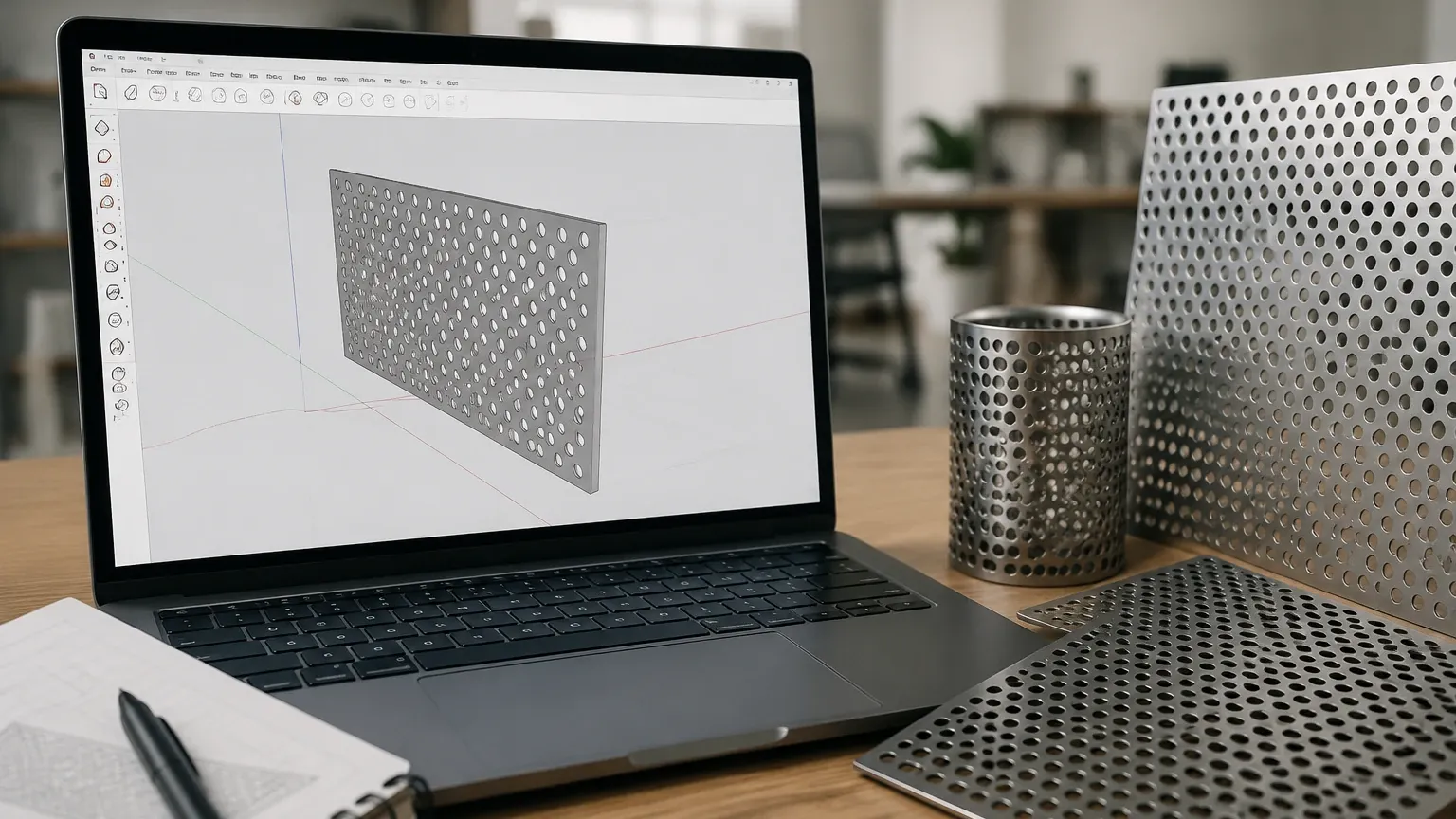
One of the most significant technical challenges when working with perforated metal in sketchup is managing the complexity of the geometry. A standard industrial sheet may contain thousands of individual perforations. If a designer attempts to model each hole as a physical 3D void, the resulting polygon count can overwhelm the software’s processing engine, leading to lag, file corruption, or rendering failures. To maintain an efficient workflow while ensuring technical accuracy, designers typically employ two primary strategies.
Texture-Based Representation (Alpha Mapping)
For large-scale applications—such as industrial enclosures, acoustic damping panels, or architectural facades—the most efficient method is using high-resolution textures with alpha channels (transparency). By applying a PNG texture that represents the hole pattern onto a simple plane, the designer can simulate the visual effect of perforated metal without adding to the geometric complexity. This method is ideal for checking the aesthetic impact or the general placement of the material within a larger assembly. However, it is important to ensure the scale of the texture accurately matches the intended physical pitch and hole diameter to avoid misleading visual data.
Geometric Component Tiling
When the design requires precise interaction with other components—such as a custom-fitted filter end cap or a threaded connector—modeling the actual geometry becomes necessary. To optimize this, engineers should model a single "tile" or unit cell of the perforation pattern as a component. This component can then be arrayed across the surface. This approach allows for the calculation of the material's actual volume and weight, which is critical for shipping logistics and structural load-bearing calculations. When using this method for perforated metal in sketchup, it is advisable to keep the geometry hidden on a separate tag or layer until the final export to preserve system performance during the active design phase.
Technical Specifications for Perforated & Expanded Metal
Moving beyond the digital model requires a deep dive into the mechanical specifications that define the performance of the material. Perforated metal is characterized by several key variables that must be clearly communicated during the procurement process. At Kaifil, we emphasize that the digital design is a blueprint that must be supported by rigorous data.
1. Hole Patterns and Staggering: The most common industrial configuration is the 60-degree staggered pattern. This layout provides the highest structural integrity and the most uniform distribution of stress across the sheet. Other options include 45-degree staggered patterns and straight-row configurations, which are often chosen for specific aesthetic reasons or to align with secondary filtration mesh layers.
2. The Concept of "Open Area": This is perhaps the most critical metric for any filtration application. The percentage of open area determines the flow rate and the pressure drop across the filter. For a 60-degree staggered pattern, the open area is calculated using the formula: `(D² × 90.69) / P²`, where `D` is the hole diameter and `P` is the pitch (the distance between the centers of two adjacent holes). A higher open area allows for better flow but reduces the mechanical strength of the sheet.
3. Expanded Metal Variations: Unlike perforated metal, which is produced by punching holes and removing material, expanded metal is created by slitting and stretching the sheet. This results in a diamond-shaped pattern with raised or flattened strands. Expanded metal is often preferred for high-grip surfaces or when a high strength-to-weight ratio is required without the waste of material associated with punching.
Material Science and Corrosion Resistance in Industrial Applications
The environment in which the perforated component will operate dictates the choice of material. In industrial filtration, where exposure to corrosive chemicals, high pressures, and extreme temperatures is common, the selection of the correct stainless steel grade is paramount.
* Type 304 Stainless Steel: This is the industry standard for general-purpose applications. It offers excellent forming and welding characteristics and provides good resistance to atmospheric corrosion and many organic and inorganic chemicals. It is frequently used in food processing equipment where hygiene and durability are required.
* Type 316L Stainless Steel: For more demanding environments, such as marine applications, pharmaceutical production, or chemical processing involving chlorides, 316L is the preferred choice. The addition of molybdenum and a lower carbon content significantly enhances its resistance to pitting and crevice corrosion. When modeling these components, engineers should specify the grade to ensure the manufacturer can provide the appropriate material certifications.
* Specialized Alloys: In highly specialized sectors like aerospace or advanced chemical refining, materials such as Monel, Inconel, or Hastelloy may be required. These alloys maintain their structural integrity at temperatures where standard stainless steels would fail or oxidize.
Transitioning from Digital Models to Physical Production
A common pitfall in the design process is failing to account for the physical realities of the punching process. When an engineer creates a model of perforated metal in sketchup, they may envision a perfectly flat sheet with holes extending to the very edge. In practice, several manufacturing factors must be considered:
Unperforated Margins
To facilitate welding or to provide a clean edge for mounting, perforated sheets usually require "margins"—solid areas around the perimeter of the hole pattern. These margins are essential for maintaining the structural stability of the part during secondary operations like rolling or bending into a filter cartridge shape. The SketchUp model should clearly define the width of these margins to ensure the finished part fits perfectly into its housing.
Burr Direction and Surface Finishing
The punching process creates a "smooth" side where the punch enters and a "burr" side where it exits. In filtration applications, the orientation of these burrs is critical. For example, in a self-cleaning filter, the smooth side should face the flow to prevent debris from snagging. Furthermore, secondary processes like electropolishing or passivating are often required to remove microscopic burrs and enhance the corrosion resistance of the stainless steel. These requirements should be noted alongside the 3D design files.
Leveling and Flatness
Punching thousands of holes into a metal sheet introduces significant internal stresses, which can cause the material to bow or curl. For high-precision applications, such as rotating screens or fine-tolerance strainers, the material must undergo a leveling process. This is a critical step that cannot be visualized in a 3D model but must be specified in the technical requirements provided to the manufacturer.
Quality Control and Performance Evaluation in Filtration
Once the design has transitioned from the SketchUp environment to the production floor, quality control measures ensure that the final product meets the performance expectations of the engineer. For custom filtration solutions, this involves more than just dimensional checks.
At Kaifil, we utilize advanced manufacturing capabilities to ensure that every Perforated & Expanded Metal component adheres to strict tolerances. This includes verifying the consistency of the hole diameters and the accuracy of the pitch, as even minor deviations can significantly alter the filtration efficiency and pressure drop of the system. For OEM applications, we work closely with purchasing teams to establish a testing protocol that may include pressure testing, material analysis, and flow rate verification.
Furthermore, the durability of the component over its lifecycle is a key consideration. In many industrial settings, filters are subjected to rigorous cleaning cycles, including backwashing and chemical sterilization. The structural integrity of the perforated support must be sufficient to withstand these stresses without deforming. By considering these factors during the initial design phase in SketchUp, engineers can create more robust systems that offer a lower total cost of ownership.
Conclusion: Achieving Engineering Excellence with Kaifil
The use of perforated metal in sketchup serves as a vital first step in the complex journey of industrial product development. It allows for the visualization of ideas, the testing of spatial constraints, and the communication of design intent. However, the success of the project ultimately depends on the ability to translate that digital vision into a physical component that can withstand the rigors of industrial use.
As a professional manufacturer specializing in custom stainless steel filtration solutions, Kaifil provides the technical expertise and manufacturing precision required to bring these designs to life. From selecting the optimal material grade and calculating the necessary open area to providing customized designs for demanding applications in the chemical, pharmaceutical, and hydraulic sectors, we are committed to delivering reliable, high-performance filtration components. By bridging the gap between advanced 3D modeling and expert metal fabrication, we help engineers and purchasing teams achieve efficient, durable, and cost-effective results for their most challenging projects.
