


Types of Perforated Sheet Metal
In industrial filtration and structural engineering, perforated sheet metal serves as a foundational component for fluid dynamics, particle separation, and mechanical support. Selecting the correct types of perforated sheet metal requires a deep understanding of hole geometries, material properties, and mechanical tolerances. As a specialized manufacturer, Kaifil provides precision-engineered solutions that integrate these components into complex filtration systems. This guide examines the technical variations of perforated metal to assist engineers and procurement teams in optimizing their system performance.
Understanding Perforated Sheet Metal in Industrial Contexts
Perforated sheet metal is a functional material produced by punching or laser-cutting a series of holes, slots, or decorative shapes into a metal substrate. Unlike Perforated & Expanded Metal, where expanded metal is slit and stretched without material loss, perforated metal involves the removal of material to achieve precise open areas and hole dimensions.
In B2B applications, particularly within the chemical processing, pharmaceutical, and food and beverage sectors, perforated sheets are rarely used in isolation. They often serve as the "skeleton" or support core for finer wire mesh filters, providing the structural integrity necessary to withstand high-pressure differentials while maintaining the desired flow rate.
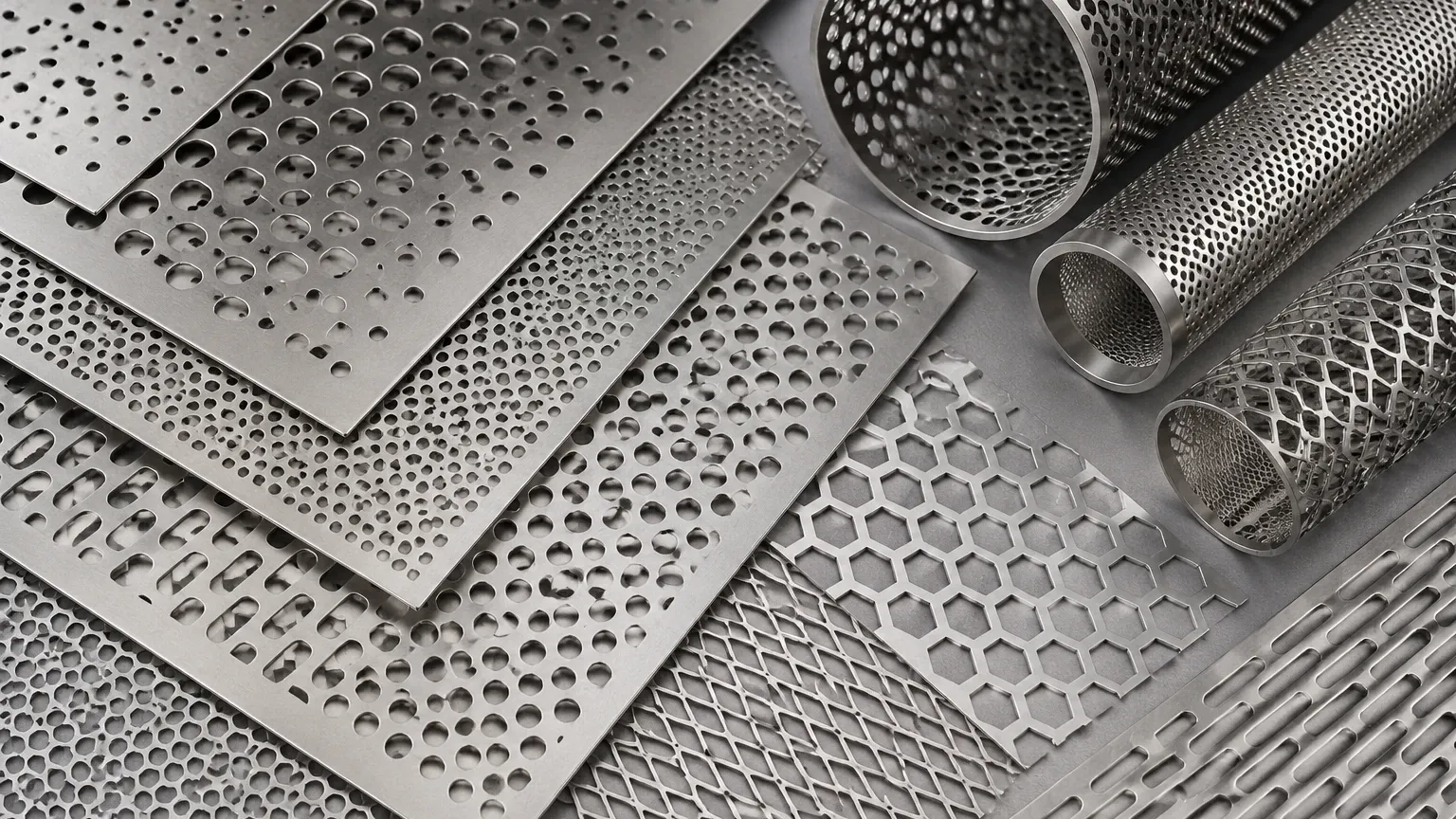
Classification by Hole Pattern
The geometry of the perforation determines the mechanical strength, flow characteristics, and aesthetic properties of the sheet. Choosing between different types of perforated sheet metal patterns is the first step in engineering a filtration or ventilation solution.
1. Round Hole Perforations
Round holes are the most common and versatile pattern. They offer a high strength-to-weight ratio and are the easiest to manufacture, making them the most cost-effective option for most industrial applications.
* Staggered Pattern: Holes are arranged in a 60-degree orientation. This is the most popular configuration because it provides maximum open area and uniform strength in all directions.
* Straight Pattern: Holes are aligned in parallel rows and columns. This is typically used for aesthetic purposes or specific sorting applications where linear alignment is required.
2. Square Hole Perforations
Square holes provide a significantly higher open area compared to round holes of the same diameter. This makes them ideal for applications requiring high visibility or maximum airflow. However, the sharp corners of square holes act as stress concentrators, which can reduce the overall structural durability of the sheet under high mechanical loads.
3. Slotted Perforations
Slotted holes are elongated rectangles with either round or square ends. These are primarily used in screening and sorting equipment. In filtration, slotted perforated metals are effective for separating elongated particles or for use in lateral flow systems where liquid must pass through while solids are retained.
4. Hexagonal (Honeycomb) Perforations
Hexagonal patterns offer the highest possible open area (up to 80% or more) while maintaining surprising structural stability. They are frequently used in architectural applications and high-end electronic cooling where airflow is the primary concern.
Material Selection for Industrial Environments
The performance of perforated metal is inextricably linked to the alloy from which it is fabricated. Material selection must account for corrosion resistance, temperature fluctuations, and chemical compatibility.
Stainless Steel (304, 316, 316L)
As a specialist in stainless steel filtration, Kaifil emphasizes the use of 300-series stainless steel for most industrial environments.
* Grade 304: Suitable for general-purpose applications, offering good corrosion resistance and formability.
* Grade 316/316L: Contains molybdenum, providing superior resistance to chlorides and acidic environments. This is the standard for marine, pharmaceutical, and chemical processing applications.
Carbon Steel
Carbon steel is an economical choice for indoor applications or environments where corrosion is not a primary concern. It can be galvanized or powder-coated to improve its lifespan, though it lacks the inherent durability of stainless steel in harsh processing conditions.
Aluminum
Aluminum perforated sheets are lightweight and naturally resistant to atmospheric corrosion. They are often selected for aerospace, automotive, and architectural applications where weight reduction is critical.
Technical Specifications and Engineering Calculations
When specifying types of perforated sheet metal, engineers must define several key parameters to ensure the component meets the application's demands.
Open Area Percentage
The open area is the ratio of the total area of the holes to the total area of the sheet, expressed as a percentage. This value directly impacts the pressure drop across the filter and the flow velocity.
* Calculation for 60° Staggered Round Holes:
`% Open Area = (D² * 90.69) / R²`
*(Where D = Hole Diameter and R = Center-to-Center Pitch)*
Pitch and Bridge
* Pitch: The distance from the center of one hole to the center of the adjacent hole.
* Bridge: The amount of metal remaining between the holes. A bridge that is too narrow can lead to material deformation during the punching process or structural failure during operation.
Margins
Margins refer to the unperforated area along the edges of the sheet. Standard commercial margins are usually minimal, but custom margins are often required for welding the perforated sheet into a filter frame or housing. Specifying "no margins" (perforations to the edge) can lead to jagged edges and increased manufacturing complexity.
Perforated vs. Expanded Metal: Key Differences
While both fall under the category of Perforated & Expanded Metal, they serve different engineering niches.
| Feature | Perforated Metal | Expanded Metal |
| :— | :— | :— |
| Manufacturing | Material is punched out (waste produced) | Material is slit and stretched (no waste) |
| Hole Geometry | Highly precise and customizable | Limited to diamond-shaped openings |
| Strength | Dependent on bridge width and pattern | High strength due to lack of joins/welds |
| Cost | Generally higher due to material waste | Generally lower for large areas |
| Filtration | Ideal for precise particle retention | Better for coarse support or safety guarding |
Engineering Considerations for Filtration Systems
In the context of industrial filtration, the choice of perforated metal involves more than just selecting a hole size. Engineers must consider the following factors:
1. Structural Integrity and Pressure Drop
The perforated sheet often acts as the support core for a multi-layered filter cartridge. If the open area is too low, the pressure drop (Delta P) increases, forcing the pump to work harder and increasing energy costs. Conversely, if the open area is too high, the sheet may buckle under the pressure of the fluid flow.
2. Surface Finish and Cleanability
For food-grade and pharmaceutical applications, the surface finish is paramount. Perforated sheets can be electropolished to remove burrs and microscopic pits where bacteria could reside. A smooth surface also facilitates easier backwashing and cleaning cycles, extending the total life of the filter.
3. Fabrication Compatibility
Engineers must confirm that the selected type of perforated metal can be rolled, welded, or formed into the required shape (e.g., a cylindrical filter basket) without cracking the bridges or distorting the hole pattern. Stainless steel is particularly favored here for its excellent weldability.
Applications Across Industries
Different types of perforated sheet metal are utilized based on the specific demands of the industry:
* Chemical Processing: Used as support grids for catalyst beds and as internal components in distillation columns where corrosion resistance is mandatory.
* Food & Beverage: Employed in grain drying, fruit juice extraction, and brewery lauter tuns. Here, 316L stainless steel is typically required to meet sanitary standards.
* Hydraulic Systems: Perforated tubes serve as the inner core for hydraulic oil filters, protecting the delicate pleated media from collapsing under high-pressure spikes.
* Water Treatment: Large-scale perforated screens are used for primary intake filtration to remove debris from river or seawater before it enters the treatment plant.
Procurement Checklist: What to Confirm Before Ordering
To ensure a successful procurement process and avoid costly engineering errors, purchasing teams should confirm the following details with their manufacturer:
1. Exact Material Grade: (e.g., SS316 vs. SS304).
2. Hole Diameter and Pitch: Specify staggered or straight centers.
3. Sheet Thickness (Gauge): Ensure it can handle the mechanical load.
4. Margin Requirements: Define the width of the unperforated borders on all four sides.
5. Flatness Tolerances: Critical if the sheet is to be laser-welded into a precision assembly.
6. Secondary Operations: Does the sheet require degreasing, deburring, or electropolishing?
By focusing on these technical nuances, engineers can select the types of perforated sheet metal that provide the best balance of flow efficiency, structural durability, and long-term value. Kaifil’s expertise in custom metal fabrication ensures that every component is tailored to the specific rigors of the intended industrial environment.
