


U Edging for Expanded Metal
In industrial manufacturing and structural engineering, the utility of expanded metal is well-documented. Formed by simultaneously slitting and stretching a solid sheet of metal, expanded metal provides a high strength-to-weight ratio, excellent open area for ventilation or filtration, and a unique aesthetic. However, the process of expanding metal results in sharp, exposed strands at the perimeter of the sheet. For applications ranging from industrial filtration support to safety guards and architectural panels, managing these edges is a critical engineering requirement.
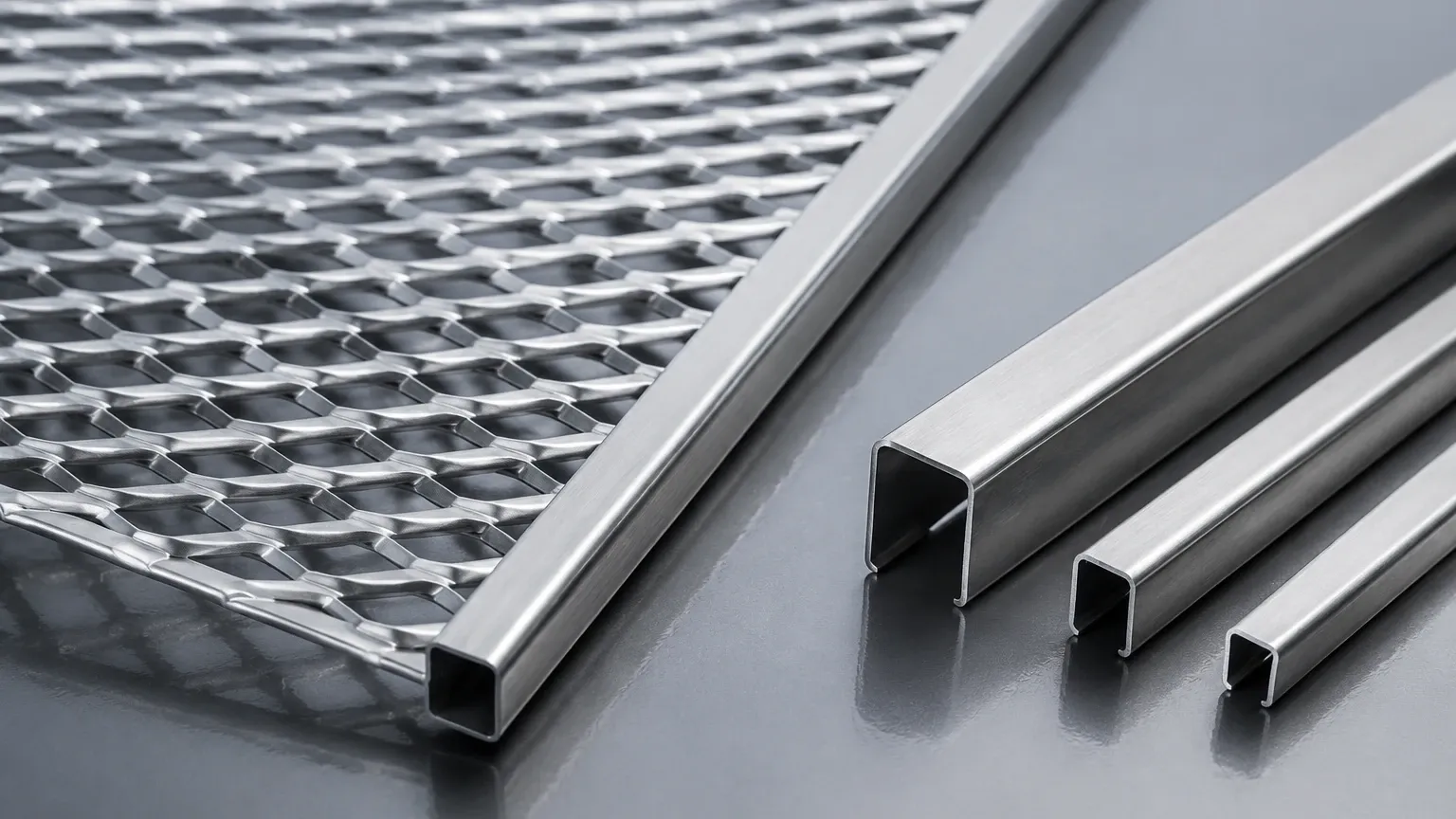
U edging for expanded metal serves as the primary solution for finishing these components. It is a roll-formed or extruded metal channel shaped like the letter "U" that fits over the raw edges of the metal sheet. This guide examines the technical specifications, material selection, and installation methods for U-edging, providing engineers and purchasing teams with the data needed to optimize their filtration and structural projects.
The Engineering Purpose of U Edging
Integrating U-edging into a project involving Perforated & Expanded Metal is rarely a purely cosmetic choice. In B2B and industrial contexts, the edge treatment fulfills several functional roles:
1. Personnel Safety and Handling
The expanding process creates "bonds" and "strands" that are inherently sharp. In environments where workers must handle filters, screens, or guards, raw edges pose a significant laceration risk. U-edging encapsulates these sharp points, creating a smooth, safe perimeter.
2. Structural Rigidity
While expanded metal is rigid in its own right, a large sheet can exhibit flexibility or "oil-canning" effects under load. A U-channel frame acts as a structural perimeter, significantly increasing the moment of inertia for the panel. This prevents bowing and ensures the component remains flat within its housing or mounting bracket.
3. Protection of Adjacent Components
In filtration systems, expanded metal often serves as a support cage for finer wire mesh or filter media. Without proper edging, the sharp strands of the expanded metal can puncture or abrade the delicate filter layers during pressure cycles or cleaning. U-edging provides a blunt interface that protects the integrity of the primary filtration media.
4. Mounting and Installation
U-edging provides a consistent, flat surface for mounting. Whether the panel needs to be bolted, slid into a track, or welded into a larger assembly, a framed edge offers predictable dimensions and contact points that raw expanded metal cannot provide.
Technical Specifications: Matching Edge to Mesh
Selecting the correct u edging for expanded metal requires a precise understanding of the material's geometry. One of the most common mistakes in procurement is failing to account for the "overall thickness" of the expanded metal.
Understanding Overall Thickness vs. Material Gauge
When a metal sheet is expanded, the strands are tilted at an angle. Consequently, the "overall thickness" of the finished expanded metal is significantly greater than the original gauge of the flat sheet. For example, a 16-gauge sheet (0.0598 inches) might result in an expanded metal product with an overall thickness of 0.125 inches or more.
To ensure a proper fit, the interior width of the U-channel must match this overall thickness. If the channel is too narrow, the metal will not seat properly; if it is too wide, the gap will require excessive welding or may result in a rattling, unstable component.
Channel Dimensions
U-edging is typically defined by three dimensions:
* Opening (Width): The internal gap that accepts the metal sheet.
* Leg Length: The height of the sides of the "U." Longer legs provide more surface area for welding and greater structural reinforcement.
* Material Thickness: The gauge of the U-channel itself, which must be robust enough to support the application's mechanical loads.
Material Compatibility and Selection
In industrial filtration and chemical processing, material compatibility is paramount. Using dissimilar metals for the expanded metal and the edging can lead to galvanic corrosion, particularly in moist or chemically aggressive environments.
Stainless Steel (304 and 316)
For most B2B applications, especially in food processing, pharmaceuticals, and water treatment, stainless steel is the standard.
* Grade 304: Offers excellent corrosion resistance and weldability for general industrial use.
* Grade 316: Contains molybdenum, providing superior resistance to chlorides and pitting, making it the preferred choice for marine or high-acid chemical environments.
Carbon Steel
Used in heavy industrial guards and structural applications where corrosion is managed via powder coating or galvanizing. It is a cost-effective solution for indoor machinery guards.
Aluminum
Preferred for weight-sensitive applications or architectural panels. Aluminum U-edging is often extruded rather than roll-formed, allowing for more complex profiles and tighter tolerances.
Installation and Attachment Methods
How the u edging for expanded metal is attached depends on the required durability and the environment in which the component will operate.
1. Resistance Welding (Spot Welding)
This is the most common method for industrial screens. The U-channel is clamped onto the expanded metal, and localized heat and pressure create a series of weld points. It is efficient and provides sufficient strength for most filtration support cages.
2. MIG/TIG Welding
For heavy-duty applications or where a sanitary finish is required (such as in food-grade filtration), TIG welding may be used to create continuous or stitch welds along the seam. This ensures no gaps where debris or bacteria can accumulate.
3. Mechanical Crimping
In some light-duty applications, the U-channel can be mechanically crimped onto the expanded metal. While this avoids the heat-affected zones associated with welding, it may not be suitable for high-vibration environments where the mesh could eventually work loose.
4. Mitered vs. Overlapped Corners
For a professional finish, corners should be mitered at a 45-degree angle and welded shut. This creates a fully enclosed frame. In less critical applications, a "butt joint" or overlapped corner may be used to reduce fabrication time.
Application-Specific Considerations
When specifying Perforated & Expanded Metal with U-edging, engineers must consider the specific demands of their industry.
Filtration and Separation
In liquid filtration, the U-edging must be perfectly aligned to prevent "bypass." If the edging is not securely attached or if the dimensions are off, unfiltered fluid can leak around the edges of the screen. Furthermore, in high-pressure systems, the edging must withstand the differential pressure without deforming.
Chemical Processing
In environments involving caustic chemicals, the weld points between the U-channel and the expanded metal are often the first areas to fail due to intergranular corrosion. Specifying low-carbon stainless steel (like 316L) and ensuring proper post-weld passivation can mitigate these risks.
HVAC and Air Handling
Expanded metal used in air intakes or grease filters requires U-edging to facilitate easy removal and cleaning. The edging must be smooth enough to slide into filter tracks without binding, requiring tight tolerances on the leg length and overall width.
Procurement and Customization: What to Confirm
To ensure a successful B2B procurement process, purchasing teams should confirm the following details with their manufacturer:
1. Cut Type: Is the expanded metal "bond cut" (symmetrical) or "random cut"? Bond cutting creates a more uniform edge that is easier to fit into U-edging, whereas random cutting may result in varying strand lengths that require more careful alignment within the channel.
2. Tolerances: Specify the allowable variance in the outer dimensions of the framed panel. This is critical if the panel must fit into a pre-existing housing.
3. Finish Requirements: Does the assembly require deburring, pickling, or electropolishing? For stainless steel filtration components, electropolishing is often used to improve corrosion resistance and surface smoothness.
4. Quantity and OEM Capabilities: For large-scale production, ensure the manufacturer has the automated equipment to provide consistent U-edging across thousands of units.
Conclusion
U-edging is an essential finishing component that transforms raw expanded metal into a functional, safe, and durable industrial tool. By carefully selecting the material grade, matching the channel dimensions to the overall thickness of the mesh, and employing the appropriate attachment methods, engineers can significantly enhance the performance of their filtration and screening systems.
Whether the goal is to protect a delicate filter membrane or to provide a rigid frame for a heavy-duty industrial guard, understanding the technical nuances of u edging for expanded metal ensures that the final product meets the rigorous standards of modern industrial applications. For those seeking high-precision components, collaborating with a manufacturer that understands the intersection of metal expansion and custom fabrication is key to achieving optimal results.
