


Yellow Expanded Metal
In industrial environments, the choice of materials often extends beyond structural integrity to encompass safety, visibility, and environmental resistance. Yellow expanded metal is a specialized architectural and industrial product that combines the mechanical advantages of expanded metal with a high-visibility finish. This material is frequently utilized in safety guarding, walkways, and as a support structure in complex filtration systems. Engineering teams and procurement professionals must evaluate the base material, the expansion geometry, and the coating technology to ensure the product meets specific operational requirements.
As a critical component in many industrial assemblies, Perforated & Expanded Metal serves as the foundation for durable safety barriers and filtration housings. Understanding the nuances of yellow expanded metal—from its manufacturing process to its compliance with safety standards—is essential for optimizing both performance and total cost of ownership.
Understanding Yellow Expanded Metal in Industrial Environments
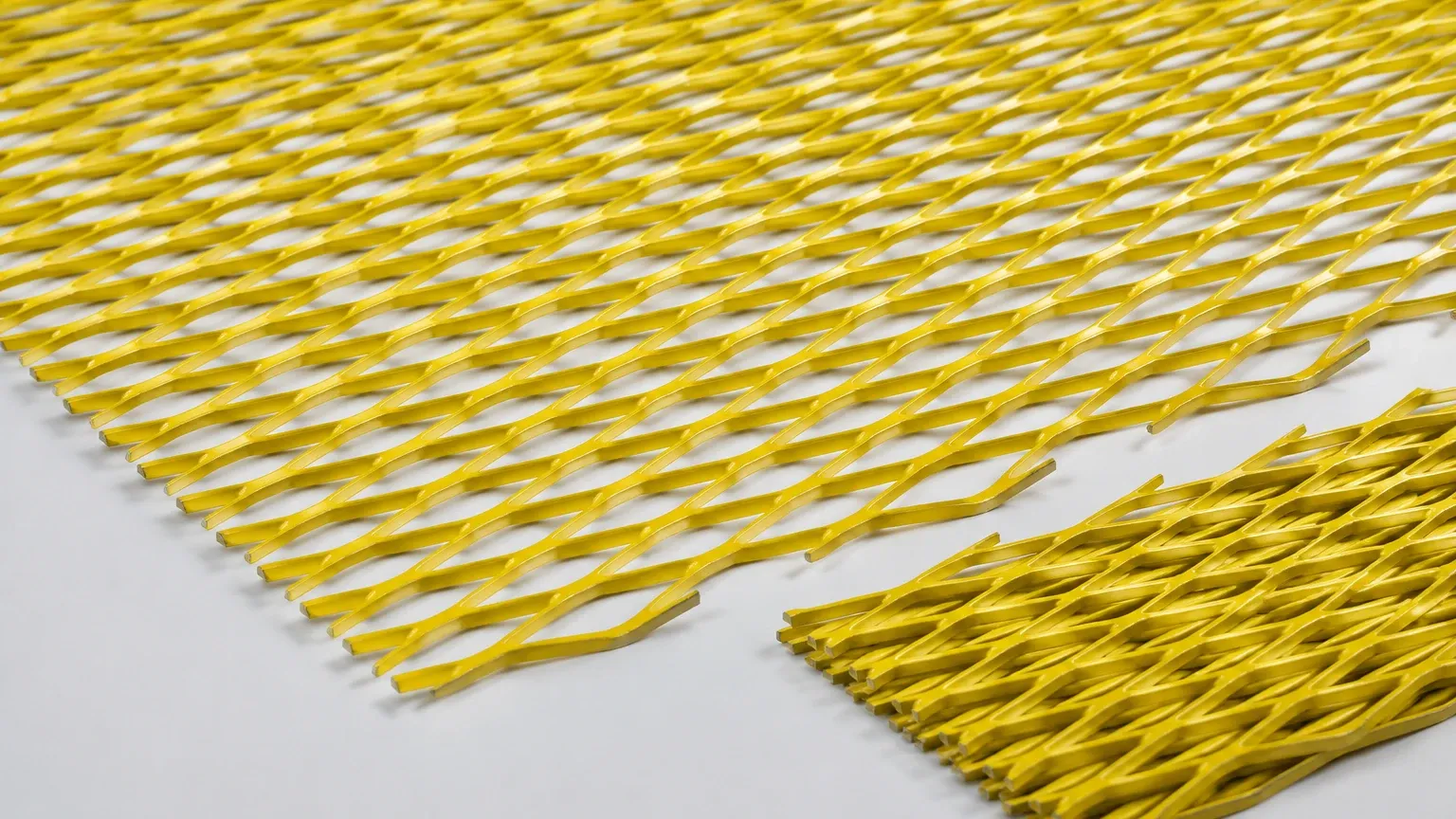
Yellow expanded metal is produced by simultaneously slitting and stretching a solid metal sheet to create a diamond-patterned mesh. Unlike perforated metal, which involves punching out material and creating waste, the expansion process is a zero-waste manufacturing method that increases the overall strength-to-weight ratio of the original sheet. The "yellow" designation typically refers to a post-production finish, usually a powder coating or PVC coating, applied to meet safety visibility standards or specific aesthetic requirements.
In a B2B context, the color yellow is rarely a purely aesthetic choice. It is most often driven by safety regulations, such as those established by OSHA (Occupational Safety and Health Administration) or international ISO standards, which dictate that hazardous areas, machine guards, and physical barriers must be easily identifiable. The high-contrast nature of yellow expanded metal ensures that workers can quickly perceive boundaries, moving parts, or restricted zones, even in low-light industrial settings.
The Manufacturing and Coating Process
The production of yellow expanded metal begins with the selection of a base metal, typically carbon steel, aluminum, or stainless steel. The sheet is fed through an expanding machine where a set of knives slits and stretches the metal in a single motion. This creates a continuous piece of mesh with no joins or welds, which contributes to its inherent structural stability.
Raised vs. Flattened Expanded Metal
After the expansion process, the metal can be left in its "raised" state or processed through a flattening mill.
* Raised Expanded Metal: The strands and bonds are set at a sharp angle to the plane of the sheet. This provides maximum rigidity and a slip-resistant surface, making it ideal for yellow-coated safety walkways or stair treads.
* Flattened Expanded Metal: The raised mesh is passed through a cold-roll reducing mill, which flattens the strands and bonds into the same plane. This results in a smoother surface and a slightly thinner profile, which is often preferred for machine guards where a flush finish is required to prevent snagging.
The Finishing Stage
The yellow finish is applied after the metal has been expanded and, if necessary, flattened. For industrial applications, powder coating is the industry standard. This involves applying a dry powder—typically a polyester or epoxy resin—electrostatically and then curing it under heat. This process ensures that the yellow coating reaches the internal "bonds" and "strands" of the diamond pattern, providing a uniform layer of protection against corrosion and mechanical wear.
Technical Specifications and Material Selection
When specifying yellow expanded metal, engineers must define several geometric and material parameters to ensure the product is fit for purpose. These specifications determine the mesh’s open area, weight, and load-bearing capacity.
Key Geometric Parameters
1. Long Way of the Diamond (LWD): The distance from a point on a bond to a corresponding point on the next bond measured across the long axis of the diamond.
2. Short Way of the Diamond (SWD): The distance measured across the short axis of the diamond.
3. Strand Width: The amount of metal fed into the knives for each stroke.
4. Strand Thickness: The thickness of the original base metal sheet.
Base Metal Considerations
* Carbon Steel: The most common choice for yellow expanded metal due to its cost-effectiveness and high strength. It requires a robust coating (like powder coating) to prevent oxidation.
* Aluminum: Selected for applications where weight reduction is critical or where the environment is naturally corrosive. Yellow-coated aluminum is frequent in aerospace and marine safety applications.
* Stainless Steel: Used in highly corrosive environments, such as chemical processing or food and beverage production. While stainless steel is often left unfinished, a yellow coating may be applied for safety identification purposes.
Why Safety Yellow? Standards and Visibility
The primary driver for the procurement of yellow expanded metal is the need for "Safety Yellow" (often defined by RAL 1003, RAL 1023, or specific Federal Standards). This color is strategically used in industrial plants to signal caution.
Compliance with Safety Standards
In many jurisdictions, machine guarding must be painted or coated in a contrasting color to the machine itself. If a machine is gray or green, a yellow expanded metal guard provides an immediate visual indicator of a protective barrier. This is crucial for preventing accidental contact with rotating shafts, belts, or high-temperature components.
Visibility in Filtration and HVAC
In large-scale filtration systems or HVAC intakes, yellow expanded metal may be used as a coarse pre-filter or debris screen. The yellow color allows maintenance teams to quickly inspect the screen for blockages or damage from a distance. If the yellow coating begins to chip or fade, it also serves as a visual maintenance indicator, suggesting that the component may be reaching the end of its service life or that the environment is more corrosive than initially calculated.
Key Performance Metrics for Industrial Applications
Beyond visibility, yellow expanded metal must perform according to mechanical expectations. For engineers, three metrics are paramount: open area, structural integrity, and coating durability.
Open Area and Airflow
The "open area" percentage determines how much air or fluid can pass through the mesh. In machine guarding, a high open area is necessary to allow for motor cooling and ventilation while still providing a physical barrier. For filtration support, the expanded metal must provide enough open area to prevent significant pressure drops across the filter media.
Structural Integrity and Load Bearing
If the yellow expanded metal is intended for use as a walkway or platform, it must be rated for specific point loads and uniform loads. The orientation of the diamonds (LWD vs. SWD) significantly affects the span capability. Generally, the LWD should run perpendicular to the support members to maximize strength.
Coating Durability (Salt Spray and UV Resistance)
For outdoor applications or facilities with high chemical exposure, the yellow coating must be tested for UV stability and chemical resistance. A low-quality yellow coating will chalk and fade under sunlight, losing its safety-signaling effectiveness. Procurement teams should request salt spray test results (e.g., ASTM B117) to verify how long the coating will protect the underlying metal from rust.
Common Risks and Evaluation Criteria for Procurement
Selecting a supplier for yellow expanded metal involves more than just comparing price per square foot. Poorly manufactured expanded metal can introduce safety hazards and increased maintenance costs.
1. Edge Sharpness and Deburring
The expansion process creates sharp edges at the bonds and strands. For safety guards, these edges must be deburred or framed. A high-quality supplier will provide options for edge treatment to ensure the final product does not pose a cutting hazard to personnel.
2. Coating Adhesion
If the yellow coating is applied to a surface that hasn't been properly cleaned or pre-treated (e.g., phosphating), the coating will flake off, especially at the sharp bends of the diamonds. This is a major risk in food processing or pharmaceutical environments where coating flakes can become contaminants.
3. Dimensional Tolerances
In precision assemblies, such as filter housings, the expanded metal must meet strict dimensional tolerances. Variations in the expansion process can lead to "camber" (a bow in the sheet) or variations in the LWD/SWD dimensions, which can complicate installation.
Customization Options and Engineering Support
At Kaifil, we recognize that standard off-the-shelf expanded metal often falls short of the specific requirements of complex industrial systems. Customization is key to achieving optimal performance in both filtration and safety guarding.
Tailored Mesh Patterns
Depending on the application, you may require a non-standard diamond size to balance visibility with the need to block specific debris sizes. Custom tooling allows for the production of expanded metal that meets exact airflow or fluid dynamics requirements.
OEM and Integrated Solutions
For manufacturers of industrial equipment, yellow expanded metal can be supplied as pre-cut, framed, and coated components ready for immediate assembly. This reduces the need for secondary processing at the client’s facility and ensures that the yellow finish is consistent across all units.
Engineering Consultation
When integrating yellow expanded metal into a filtration system, it is vital to consider how the mesh will interact with the filter media. Our engineering team provides guidance on material compatibility, ensuring that the yellow coating does not react with the filtered substance and that the mesh provides the necessary mechanical support to prevent media migration or collapse under high pressure.
Conclusion: Optimizing Safety and Performance
Yellow expanded metal is a versatile material that fulfills the dual roles of structural reinforcement and safety signaling. Whether used as a protective cage for industrial machinery, a high-visibility walkway in a warehouse, or a support structure for precision filtration, its success depends on the correct alignment of material science and mechanical engineering.
By focusing on the technical specifications—such as LWD/SWD, strand geometry, and coating technology—purchasing teams can ensure they receive a product that not only meets regulatory standards but also provides a long, maintenance-free service life. For those seeking high-performance Perforated & Expanded Metal solutions, partnering with an experienced manufacturer like Kaifil ensures that every component is engineered to the highest standards of durability and precision.
