


Ylh Expanded Metal Co Ltd
In the landscape of industrial manufacturing and filtration, the selection of structural components requires a deep understanding of material mechanics and production standards. For procurement teams and engineers evaluating suppliers such as Ylh Expanded Metal Co Ltd, the focus often centers on the precision, durability, and versatility of expanded metal products. Expanded metal is a unique material produced by simultaneously slitting and stretching a solid sheet of metal, creating a diamond-shaped pattern that remains integral to the original sheet. Unlike woven wire or perforated sheets, expanded metal does not involve material waste or joined seams, making it a critical component in high-performance Perforated & Expanded Metal applications.
This guide examines the technical parameters of expanded metal, the engineering considerations for its use in filtration and structural support, and the criteria for evaluating manufacturers within the global supply chain.
The Role of Expanded Metal in Industrial Filtration
Expanded metal serves several critical functions in industrial environments, particularly when integrated into filtration systems. While companies like Ylh Expanded Metal Co Ltd provide a broad range of mesh for architectural and general industrial use, the requirements for filtration-grade components are significantly more stringent. In these applications, the mesh often acts as a support structure for finer filtration media, such as stainless steel wire cloth or non-woven membranes.
Structural Support and Rigidity
In high-pressure hydraulic or chemical processing systems, fine filter media lack the inherent strength to withstand significant pressure differentials. Expanded metal provides a rigid internal or external cage (filter core) that prevents the media from collapsing or bursting. Because the "bonds" (the intersections of the diamond pattern) are part of the original metal sheet, the structure is exceptionally strong relative to its weight.
Flow Dynamics and Turbulence
The geometry of expanded metal—specifically the angle of the strands—can influence fluid dynamics. In certain gas-liquid separation processes, the angled strands help in coalescing droplets or creating controlled turbulence that can improve filtration efficiency. Engineers must calculate the "open area" percentage to ensure that the support layer does not introduce an unacceptable pressure drop across the system.
Technical Specifications: Decoding Mesh Geometry
When sourcing from specialized manufacturers, engineers must provide precise specifications to ensure the material meets the application's mechanical requirements. The terminology used by Ylh Expanded Metal Co Ltd and similar industry leaders is standardized but requires careful interpretation.
1. LWD and SWD: Long Way of Design (LWD) refers to the dimension across the larger diagonal of the diamond, while Small Way of Design (SWD) refers to the shorter diagonal. These dimensions dictate the density of the mesh.
2. Strand Width and Thickness: The strand width is the amount of metal fed into the precision dies between slits. The thickness refers to the original gauge of the metal sheet. Together, these determine the physical strength and the weight per square foot.
3. Raised vs. Flattened:
* Raised Expanded Metal: The strands are turned at an angle to the plane of the sheet. This provides maximum rigidity and a slip-resistant surface, though it increases the overall profile thickness.
* Flattened Expanded Metal: The raised mesh is passed through a cold-rolling reducing mill, which flattens the strands back into the original plane of the sheet. This is preferred for filter cores where a smooth surface is required to prevent abrasion of the primary filter media.
Material Selection for Harsh Environments
The performance of Perforated & Expanded Metal is heavily dependent on the alloy selected. Manufacturers like Kaifil emphasize the use of high-grade alloys to ensure longevity in demanding B2B sectors like chemical processing and pharmaceutical manufacturing.
Stainless Steel (304, 316, 316L)
Stainless steel is the industry standard for filtration due to its excellent corrosion resistance. Grade 316L is particularly favored in marine and acidic environments because of its molybdenum content, which provides superior resistance to pitting and crevice corrosion. For engineers sourcing from Ylh Expanded Metal Co Ltd, confirming the specific grade and obtaining Material Test Reports (MTRs) is a non-negotiable step in the quality assurance process.
Carbon Steel and Galvanized Options
For less corrosive environments, such as air intake filters or general industrial guards, carbon steel is a cost-effective alternative. To prevent oxidation, these materials are often hot-dip galvanized or electro-galvanized. However, in filtration applications involving moisture or chemicals, the risk of coating failure usually makes stainless steel the more economical choice over the total lifecycle of the component.
Specialty Alloys
In high-temperature applications, such as exhaust filtration or aerospace components, specialty alloys like Inconel or Monel may be required. These materials maintain their structural integrity at temperatures where standard stainless steels would oxidize or lose tensile strength.
Comparing Perforated and Expanded Metal for Filtration
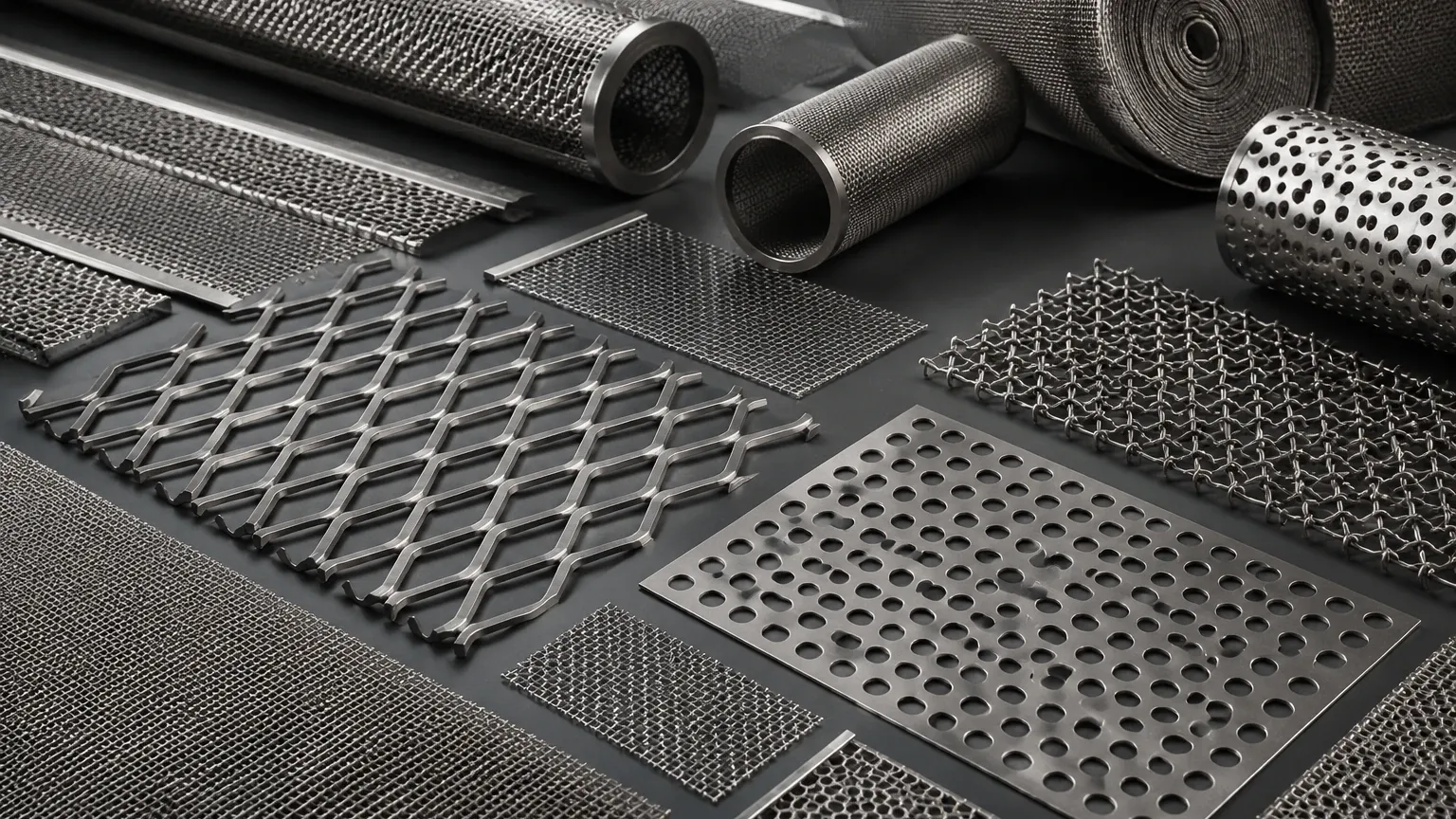
Engineers often face a choice between perforated metal and expanded metal. While both fall under the broader category of Perforated & Expanded Metal, their manufacturing processes and mechanical properties differ significantly.
Material Efficiency
Perforated metal is created by punching holes in a sheet, which results in a significant amount of scrap material (the "slugs"). This increases the cost, especially when using expensive alloys like Titanium or 316L Stainless Steel. Expanded metal, by contrast, is slit and stretched, meaning there is virtually no material waste. For large-scale industrial projects, this can result in a 20% to 40% cost reduction in raw materials.
Strength-to-Weight Ratio
Because the strands of expanded metal are oriented at an angle, they act like structural trusses. This gives expanded metal a higher strength-to-weight ratio than perforated metal of a similar thickness. In mobile equipment or aerospace filtration, where weight is a critical constraint, expanded metal is often the preferred choice for structural reinforcement.
Filtration Accuracy
Perforated metal offers more precise control over hole size and shape (round, square, hexagonal), which is essential if the metal sheet itself is the primary filtration barrier. Expanded metal is generally used for coarser filtration or as a support layer because the diamond-shaped openings are more difficult to calibrate for micron-rated particle retention.
Quality Benchmarks for Suppliers like Ylh Expanded Metal Co Ltd
When evaluating a supplier like Ylh Expanded Metal Co Ltd, technical professionals must look beyond the product catalog. Reliable B2B partnerships are built on consistent quality control and engineering support. Key evaluation criteria include:
* Dimensional Tolerances: Industrial filters require exact dimensions to fit into housings without bypass. Suppliers should provide clear tolerances for LWD, SWD, and overall sheet flatness.
* Edge Treatment: Expanded metal naturally has "random" edges where the diamonds are cut. For safety and assembly, many applications require "bond edges" (closed diamonds) or specialized shearing. A high-quality manufacturer will offer precision shearing to ensure the mesh integrates seamlessly into the final assembly.
* Surface Finish: For pharmaceutical or food-grade applications, the metal must be free of oils, burrs, and scale. Processes such as ultrasonic cleaning, electropolishing, or pickling are often required to meet sanitary standards.
* ISO Certification: Compliance with ISO 9001:2015 ensures that the manufacturer follows documented processes for production and quality inspection, reducing the risk of batch-to-batch variability.
Customization and Secondary Processing
In the B2B filtration sector, "off-the-shelf" solutions are rarely sufficient. Customization is the hallmark of a professional manufacturer. When working with providers like Kaifil or Ylh Expanded Metal Co Ltd, engineers should consider the following secondary processes:
Forming and Welding
Expanded metal can be rolled into cylinders for filter cores or folded into pleated structures to increase surface area. The welding of expanded metal requires expertise, as the thin strands can easily be blown through by high-heat welding processes. TIG (Tungsten Inert Gas) welding or resistance spot welding are typically used to maintain structural integrity at the seams.
Coating and Plating
Beyond galvanization, expanded metal can be powder-coated, PTFE-coated, or plastic-dipped. These coatings can provide additional chemical resistance, electrical insulation, or aesthetic appeal for architectural applications.
Annealing
The process of expanding metal introduces internal stresses into the material. For applications requiring further deep drawing or complex forming, hydrogen annealing or stress-relieving heat treatments may be necessary to restore ductility to the metal.
Procurement Strategy: What Engineers Need to Confirm
Before finalizing a purchase order with a supplier like Ylh Expanded Metal Co Ltd, the following technical details should be confirmed to avoid project delays or performance failures:
1. Open Area Calculation: Request the exact percentage of open area. This is vital for calculating flow velocity and ensuring the filter does not cause excessive backpressure.
2. Material Traceability: Ensure that every shipment is accompanied by a mill test certificate that verifies the chemical composition and mechanical properties of the steel.
3. Loading Requirements: If the mesh is used as a walkway or a heavy-duty support grate, specify the concentrated or uniform load it must support over a given span.
4. Packaging for Transit: Expanded metal, particularly in thin gauges, is susceptible to edge damage during shipping. Specify robust packaging, such as wooden crates or reinforced pallets, to ensure the material arrives flat and square.
Conclusion
Selecting the right Perforated & Expanded Metal solution involves a balance of material science, manufacturing precision, and cost-efficiency. Whether an engineer is considering Ylh Expanded Metal Co Ltd for high-volume industrial mesh or seeking a specialized filtration partner like Kaifil for custom stainless steel components, the technical fundamentals remain the same. By focusing on mesh geometry, material grade, and secondary processing capabilities, procurement teams can ensure they receive components that enhance the performance and reliability of their industrial systems. Expanded metal continues to be a cornerstone of modern engineering, offering a sustainable, high-strength solution for the most demanding filtration and structural challenges.
