


70um Strainers
In industrial filtration, the 70-micron (70um) threshold represents a critical transition point between coarse primary straining and fine secondary filtration. A 70um strainer is engineered to capture particles that are roughly the size of a fine grain of sand or a human hair, making it a vital component in protecting downstream equipment, ensuring fluid purity, and maintaining the integrity of industrial processes. For engineers and procurement teams, selecting the right 70um filtration solution requires a deep understanding of material properties, structural design, and fluid dynamics.
Industrial 70um strainers are typically constructed using high-precision stainless steel wire mesh. At this level of fineness, the mesh is approximately equivalent to a 200-mesh count, depending on the wire diameter and weave style. Because the mesh itself is relatively delicate compared to coarser screens, the engineering of the housing and the internal support structure is paramount to prevent media migration or structural failure under high differential pressure.
Understanding 70um Filtration in Industrial Systems
Filtration at the 70um level is often classified as "fine straining." While many industrial processes use coarse strainers (500um to 5mm) to remove large debris, 70um strainers are deployed when the objective is to protect sensitive components like spray nozzles, precision valves, and high-pressure pumps.
At 70 microns, the filtration mechanism relies primarily on mechanical sieving. The accuracy of the aperture size is critical. In a 70um stainless steel mesh, the consistency of the wire spacing determines the reliability of the filtration. If the weave is inconsistent, larger particles can bypass the filter, leading to downstream contamination. This is why high-quality manufacturing processes, such as those employed by Kaifil, focus on maintaining tight tolerances during the weaving and assembly of the filter elements.
Engineers must also distinguish between nominal and absolute micron ratings. A nominal 70um rating implies that the strainer will stop a large percentage of particles of that size, whereas an absolute rating guarantees that no particle larger than 70um will pass through. For critical applications in chemical processing or pharmaceuticals, absolute-rated 70um elements are often required to ensure process stability.
Material Selection and Construction for 70um Strainers
Stainless steel is the industry standard for 70um strainers due to its mechanical strength, corrosion resistance, and ability to withstand high temperatures. The two most common grades used are 304 and 316L stainless steel.
* 304 Stainless Steel: Suitable for general industrial applications, water treatment, and food processing where moderate corrosion resistance is required.
* 316L Stainless Steel: Preferred for more aggressive environments, such as chemical processing, marine applications, and pharmaceutical production. The lower carbon content and the addition of molybdenum enhance resistance to pitting and crevice corrosion, particularly in chloride-rich environments.
For 70um filtration, the mesh weave style significantly impacts performance. Plain weave is common for standard applications, providing a straightforward square aperture. However, for applications requiring higher strength or specific flow characteristics, twill weaves or Dutch weaves may be utilized. A Dutch weave, for example, allows for a higher mesh count in the warp and shute directions, creating a more robust and tortuous path for particles, which can improve filtration efficiency and dirt-holding capacity.
Integrating 70um Elements into Strainers & Baskets
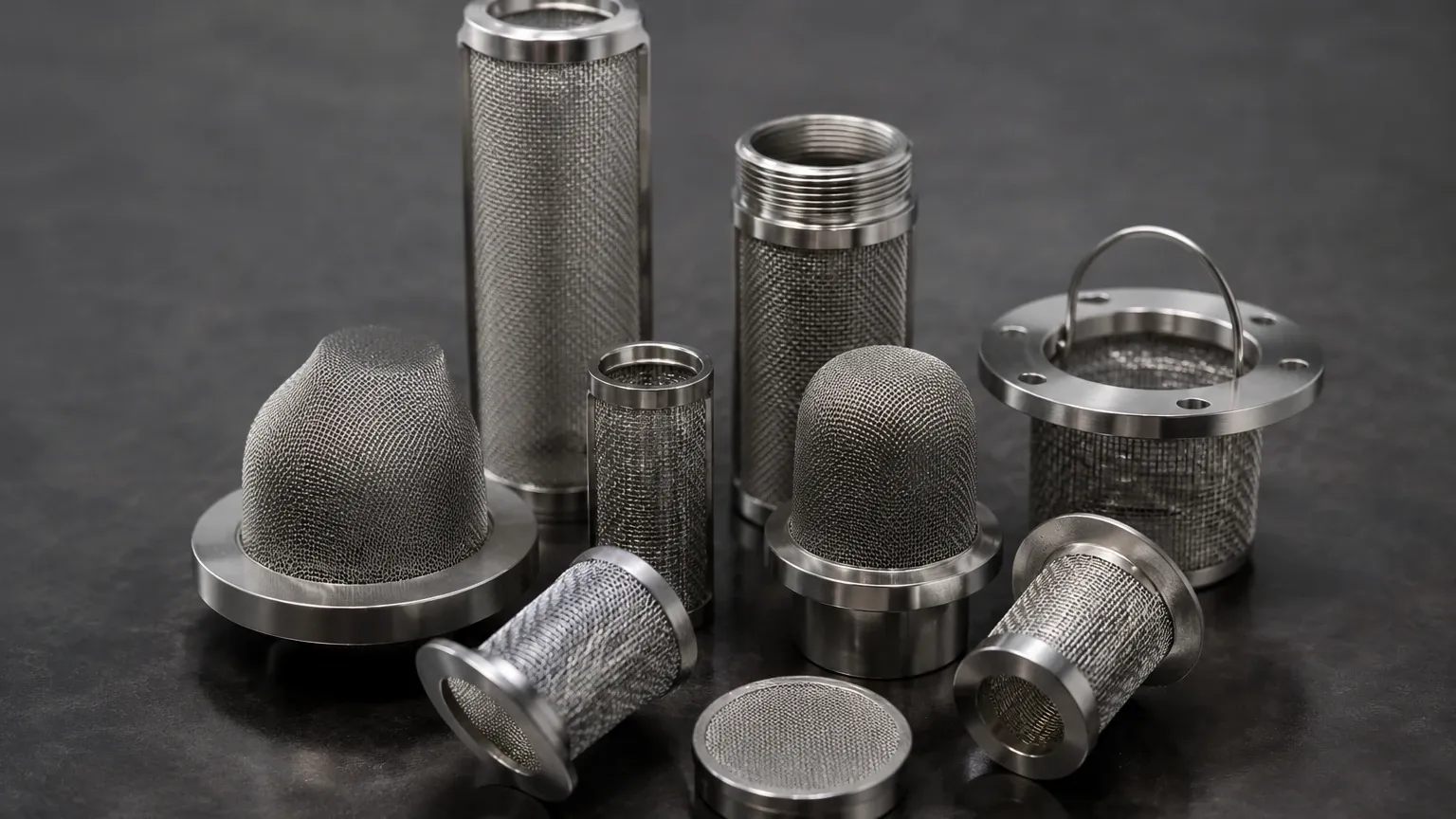
Because 70um wire mesh is fine and lacks the structural rigidity of coarser screens, it is rarely used as a standalone component in high-pressure systems. Instead, the mesh is integrated into more robust Strainers & Baskets that provide the necessary mechanical support.
In a typical configuration, the 70um mesh is bonded or welded to a perforated metal cylinder or a heavier backing mesh. This "basket" design ensures that the fine mesh does not collapse or deform when the differential pressure increases as the filter becomes loaded with contaminants. The design of the basket must account for the total open area. While the 70um mesh has a specific open area percentage (often between 30% and 45%), the supporting perforated metal also restricts flow. Engineers must calculate the "effective filtration area" to ensure that the strainer does not create an excessive pressure drop across the system.
Customization plays a significant role here. Depending on the flow direction (inside-out or outside-in), the reinforcement must be placed on the appropriate side of the fine mesh. Furthermore, the sealing mechanism—whether it is a flange, a threaded connection, or a specialized gasket—must be precision-engineered to prevent any bypass of unfiltered fluid.
Performance Evaluation: Flow Rates and Pressure Drop
One of the most common challenges when moving to a 70um strainer is managing the pressure drop ($ΔP$). As the micron rating decreases, the resistance to flow naturally increases. For a 70um strainer, the initial (clean) pressure drop must be kept low to allow for a reasonable service life before the terminal pressure drop is reached and cleaning is required.
Several factors influence the flow performance of a 70um strainer:
1. Viscosity of the Fluid: Higher viscosity fluids (like oils or syrups) require much larger filtration areas to achieve the same flow rate as water at a 70um rating.
2. Velocity: Higher fluid velocities increase the risk of particle impingement and can force deformable particles through the mesh.
3. Contaminant Loading: The nature of the particles (hard vs. soft, spherical vs. irregular) determines how quickly the mesh will blind. 70um strainers are particularly susceptible to "blinding" if the fluid contains a high concentration of particles exactly at the 70um size.
To optimize performance, engineers often specify a larger housing size than the pipe diameter would suggest. By increasing the surface area of the 70um basket, the flux (flow per unit area) is reduced, which lowers the initial pressure drop and significantly extends the cleaning interval.
Industrial Applications for 70um Strainers
The versatility of 70um strainers makes them essential across a wide spectrum of industries. Their primary role is often as a "security filter" or "polishing filter."
Chemical and Petrochemical Processing
In chemical plants, 70um strainers are used to protect sensitive instrumentation and to ensure that catalysts or additives are free from micro-aggregates. They are also used in the filtration of polymers and resins where maintaining a specific particle size distribution is critical for the final product quality.
Food and Beverage Industry
For food and beverage applications, 70um filtration is often used for the clarification of juices, syrups, and oils. The use of 316L stainless steel ensures compliance with hygienic standards, as the material can be easily cleaned and sterilized. 70um strainers are effective at removing fine pulp, sediment, and crystallized sugars.
Hydraulic and Lubrication Systems
Precision hydraulic systems rely on clean oil to prevent wear on pumps and actuators. While primary filtration might happen at the 10um or 25um level with disposable cartridges, 70um stainless steel strainers are frequently used in the suction lines or return lines as a permanent, cleanable solution to catch larger wear particles and prevent catastrophic component failure.
Water Treatment and Cooling Towers
In industrial water systems, 70um strainers protect spray nozzles in cooling towers and prevent the clogging of heat exchanger plates. They serve as an excellent pre-filter for membrane systems (like Reverse Osmosis), removing the bulk of suspended solids that would otherwise foul expensive membranes prematurely.
Customization and Engineering for Demanding Environments
Standard off-the-shelf strainers often fail to meet the specific requirements of complex industrial systems. This is where custom-engineered 70um strainers become necessary. Manufacturers like Kaifil specialize in OEM solutions that tailor the strainer to the specific operating environment.
Customization options include:
* Dimensional Adjustments: Fitting a 70um basket into existing non-standard housings.
* Reinforcement Strategies: Adding internal ribs or external cages for high-pressure applications (e.g., exceeding 10 bar differential pressure).
* Multi-Layer Sintered Mesh: For extreme conditions, 70um mesh can be sintered with multiple layers of coarser mesh to create a single, high-strength porous plate that combines fine filtration with the structural integrity of a thick plate.
* Specialized Coatings: In some cases, coatings like PTFE can be applied to the mesh to assist in the release of sticky contaminants during cleaning.
When requesting a custom 70um strainer, engineers should provide the fluid type, operating temperature, maximum flow rate, and the nature of the contaminants. This data allows the manufacturer to optimize the mesh selection and basket design for the longest possible service life.
Maintenance Protocols and Service Life Optimization
The total cost of ownership (TCO) for a 70um strainer is largely determined by its cleanability and durability. Unlike disposable synthetic filters, stainless steel 70um strainers are designed to be cleaned and reused multiple times.
Cleaning Methods
Proper cleaning is essential to restore the original flow characteristics. Common methods include:
* Backwashing: Reversing the flow of clean fluid through the strainer to dislodge particles from the mesh surface.
* Ultrasonic Cleaning: For 70um mesh, ultrasonic baths are highly effective at removing fine particles trapped within the weave that mechanical brushing cannot reach.
* Chemical Cleaning: Using mild acids or bases to dissolve organic or mineral deposits, provided the chemical is compatible with the stainless steel grade.
Monitoring and Replacement
Continuous monitoring of differential pressure is the best way to manage maintenance cycles. Automated systems can trigger a cleaning cycle once the $ΔP$ reaches a pre-set limit. While stainless steel strainers are durable, they are not infinite. Over time, repeated cleaning and pressure cycles can lead to work hardening of the wires or fatigue at the weld points. Regular inspection for "pinholes" or mesh deformation is necessary to ensure the 70um rating is still being maintained.
By selecting a high-quality 70um strainer and following a rigorous maintenance schedule, industrial facilities can achieve a balance between high-performance filtration and operational efficiency. Whether used in a simple water line or a complex chemical reactor, the 70um strainer remains a cornerstone of modern industrial fluid management.
