


90 Basket Strainer
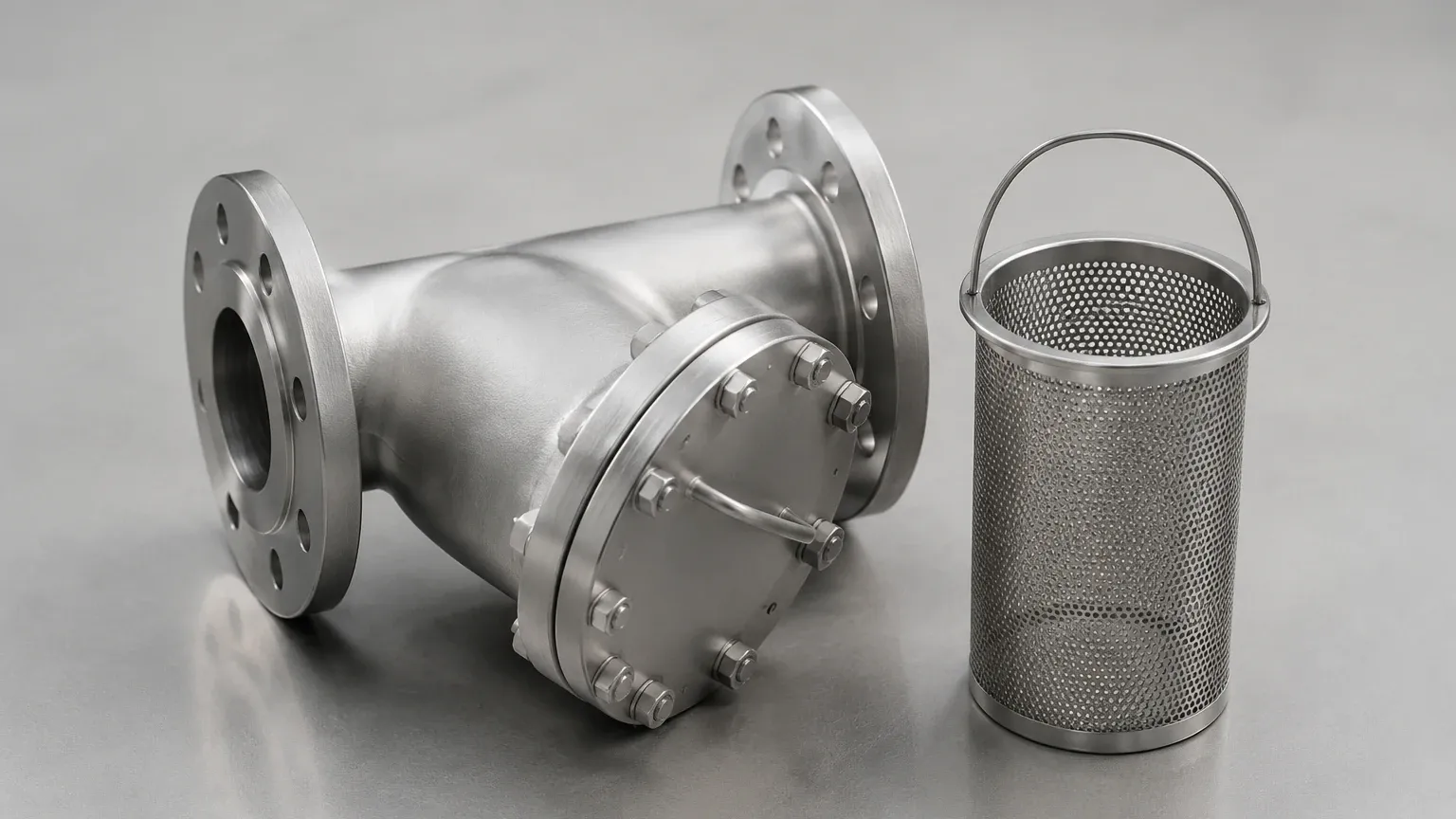
In industrial piping systems, the efficient management of space and fluid dynamics is a primary concern for design engineers. The 90 basket strainer, also commonly referred to as an angle basket strainer, serves a critical dual role in these environments. By integrating a filtration component directly into a 90-degree turn in the pipeline, these units eliminate the need for an additional elbow fitting while providing essential protection for downstream equipment such as pumps, valves, and flow meters.
As a specialized manufacturer of stainless steel filtration solutions, Kaifil provides high-performance Strainers & Baskets designed to meet the rigorous demands of chemical processing, food and beverage production, and hydraulic systems. Understanding the technical nuances of the 90-degree configuration is essential for selecting the right component for long-term operational reliability.
Engineering Design and the 90-Degree Configuration
The fundamental advantage of a 90 basket strainer is its geometry. In traditional straight-line (simplex) strainers, the fluid enters and exits along the same horizontal or vertical axis. However, many industrial layouts require piping to change direction to navigate around structural obstacles or to enter specific machinery.
Space-Saving Integration
By utilizing a 90-degree flow path, engineers can reduce the overall footprint of the filtration assembly. This is particularly beneficial in modular skid designs or compact mechanical rooms where every inch of piping counts. The strainer body effectively replaces a standard long-radius elbow, reducing the number of welded or flanged joints in the system, which in turn minimizes potential leak points.
Flow Dynamics and Pressure Drop
While the 90-degree turn is convenient for layout, it introduces specific hydraulic considerations. Fluid entering the strainer must undergo a change in direction while passing through the internal basket. To compensate for the natural turbulence and potential pressure drop associated with a right-angle turn, high-quality 90 basket strainers are engineered with a larger internal volume. This ensures that the "Open Area Ratio" (the ratio of the total area of the basket holes to the cross-sectional area of the inlet pipe) remains high—typically 6:1 or greater—to maintain efficient flow rates even as the basket begins to collect debris.
Material Selection for Industrial Durability
The longevity of a 90 basket strainer is largely determined by its material composition. Given that these components are often installed in demanding environments involving high pressures, extreme temperatures, or corrosive fluids, material selection is a non-negotiable technical step.
Stainless Steel Grades
Kaifil focuses on stainless steel construction due to its superior mechanical properties and corrosion resistance.
* SS304/304L: Suitable for general industrial applications, water treatment, and less corrosive chemical environments. It provides excellent structural integrity and cost-effectiveness.
* SS316/316L: The standard for pharmaceutical, food and beverage, and marine applications. The addition of molybdenum enhances resistance to pitting and crevice corrosion, particularly in chloride-rich environments.
* Specialty Alloys: For highly aggressive chemical processing, materials such as Duplex stainless steel or Hastelloy may be required to prevent premature failure of the strainer body or the internal mesh.
Compatibility with Process Fluids
Engineers must confirm that the housing, the basket, and the sealing elements (O-rings or gaskets) are all compatible with the process fluid. For instance, in food-grade applications, the stainless steel must be polished to specific Ra values to prevent bacterial growth, and the seals must meet FDA compliance standards.
Filtration Performance and Mesh Specifications
The heart of the 90 basket strainer is the removable basket itself. The performance of the filtration system is defined by the particle size it is designed to capture, which is determined by the mesh or perforation size of the basket.
Micron Ratings and Mesh Count
Baskets are typically constructed from perforated metal sheet, which provides structural strength, lined with a finer wire mesh to achieve the desired filtration accuracy.
* Coarse Filtration: Perforated baskets with hole sizes ranging from 1/32" to 1/4" are used to remove large debris like scale, welding slag, or stones.
* Fine Filtration: Wire mesh linings can achieve filtration levels down to 5 microns. When selecting a mesh, engineers must balance the need for fine filtration with the frequency of cleaning; a finer mesh will clog faster and cause a more rapid increase in differential pressure.
Basket Structural Integrity
In a 90-degree configuration, the basket is subjected to non-uniform flow forces. The fluid often hits one side of the basket with higher velocity. Therefore, the basket must be reinforced with a heavy-duty support cage or a thicker perforated plate to prevent collapsing or bypassing under high-pressure surges.
Key Evaluation Criteria for Engineers and Purchasing Teams
When specifying a 90 basket strainer for a project, several technical parameters must be confirmed to ensure the unit is fit for purpose.
1. Pressure and Temperature Ratings: The strainer housing must be rated according to ASME or DIN standards to handle the maximum operating pressure and temperature of the system. This includes the flange ratings (e.g., Class 150, 300, or 600).
2. Closure Type: For applications requiring frequent cleaning, a quick-opening cover (such as a swing-bolt or clamped lid) is preferable to a bolted-on cover. This reduces downtime during maintenance cycles.
3. Seal Integrity: The choice between a flat gasket and an O-ring depends on the pressure and the frequency of opening. O-rings generally provide a more reliable seal in high-pressure or vacuum applications.
4. Nozzle Configuration: While the standard is a 90-degree inlet and outlet, custom nozzle orientations (such as offset inlets) can be manufactured to meet specific piping geometries.
Installation and Maintenance Best Practices
Proper installation and a proactive maintenance schedule are essential to maximize the service life of Strainers & Baskets.
Correct Orientation
A 90 basket strainer must be installed in the correct orientation to ensure that gravity assists in settling the debris into the basket and that the basket can be easily removed. Most designs are intended for horizontal-to-vertical or vertical-to-horizontal flow. Installing a strainer in the wrong orientation can lead to debris bypassing the basket or falling back into the inlet pipe during cleaning.
Monitoring Differential Pressure
The most effective way to manage a 90 basket strainer is by monitoring the differential pressure (DP) across the unit. Installing DP gauges at the inlet and outlet nozzles allows operators to see exactly when the basket is becoming clogged. A common industry standard is to clean the basket when the differential pressure reaches 5-10 psi above the clean-start pressure. Allowing the DP to rise too high can result in basket deformation or "breakthrough," where particles are forced through the mesh.
Cleaning Procedures
Before opening the strainer, the system must be depressurized and drained. The use of a blow-down valve at the bottom of the strainer body can help clear loose sediment before the cover is removed. Once the basket is removed, it should be cleaned with a high-pressure water jet or ultrasonic cleaner, depending on the nature of the contaminants.
Customization and OEM Solutions from Kaifil
Every industrial process has unique requirements that off-the-shelf components may not fully address. Kaifil specializes in providing customized 90 basket strainer solutions that align with specific engineering drawings and performance criteria.
Tailored Mesh and Perforation
Whether the application requires a multi-layered sintered mesh for high-strength fine filtration or a specific perforation pattern to handle high-viscosity fluids, Kaifil can customize the internal basket to optimize the flow-to-filtration ratio.
Advanced Manufacturing Capabilities
Utilizing precision welding and high-grade stainless steel, Kaifil ensures that every strainer body meets strict quality control standards. For OEM partners, this means receiving components that are ready for immediate integration into larger systems, with full traceability of materials and guaranteed dimensional accuracy.
Conclusion
The 90 basket strainer is a versatile and essential component for modern industrial piping. By combining the function of a 90-degree elbow with high-performance filtration, it offers a space-saving solution without compromising on the protection of sensitive downstream equipment. For engineers and purchasing teams, the key to success lies in the careful evaluation of material compatibility, filtration surface area, and ease of maintenance.
By partnering with an experienced manufacturer like Kaifil, organizations can access the technical expertise required to design and implement Strainers & Baskets that deliver reliable, long-term performance in even the most demanding industrial environments. Confirming the specific pressure, temperature, and micron requirements during the design phase ensures that the filtration system remains an asset rather than a bottleneck in the production process.
