


A Basket Strainer
In industrial fluid handling, the integrity of downstream equipment—such as pumps, valves, flow meters, and heat exchangers—is paramount to operational uptime and safety. The primary line of defense against particulate contamination is a basket strainer. This specialized closed-vessel component is designed to remove solids from flowing liquids or gases, ensuring that debris like scale, rust, or welding slag does not damage sensitive mechanical parts.
As a critical element within Strainers & Baskets configurations, the basket strainer is characterized by its large internal volume, which allows for a high dirt-holding capacity and a relatively low pressure drop compared to other filtration methods. For engineers and procurement teams, selecting the right strainer requires a deep understanding of flow dynamics, material compatibility, and the specific filtration requirements of the application.
The Role of a Basket Strainer in Industrial Piping
While various types of strainers exist, such as Y-strainers or T-strainers, the basket design is preferred in applications where high flow rates and high debris loads are expected. The geometry of a basket strainer allows for a larger screen area than a Y-strainer of the same pipe size. This increased surface area results in a lower initial pressure drop (clean ΔP) and extends the time between cleaning cycles.
In a typical installation, the fluid enters the strainer housing and is directed into the basket. The solids are trapped inside the basket while the clean fluid passes through the mesh or perforated metal and exits through the outlet. Because the debris is collected within the basket, removal and cleaning are straightforward; the operator simply opens the top cover, lifts the basket out, cleans it, and replaces it. This "top-loading" design is a significant advantage in horizontal piping systems where space and ease of maintenance are priorities.
Design Variations: Simplex vs. Duplex Systems
When specifying a basket strainer, one of the first engineering decisions is whether the process can tolerate a temporary shutdown for maintenance. This leads to the choice between simplex and duplex designs.
Simplex Basket Strainers
A simplex strainer consists of a single housing and one basket. It is the most cost-effective solution for batch processes or systems where the flow can be diverted or stopped without causing operational hazards. When the pressure drop across the strainer reaches a predetermined limit, the system is shut down, the housing is depressurized, and the basket is cleaned.
Duplex Basket Strainers
For continuous-flow applications—such as chemical processing, power generation, or cooling water systems—a duplex strainer is required. This configuration involves two separate strainer housings connected by a diversion valve (often a plug or ball valve). When one basket becomes clogged, the operator can switch the flow to the clean chamber without interrupting the process. This ensures 24/7 operation and protects the system from the risks associated with sudden pressure spikes or flow cessation.
Material Engineering: Why Stainless Steel is Standard
Material selection is a critical factor in the longevity and performance of a basket strainer. Industrial environments often involve corrosive fluids, high temperatures, or strict hygienic requirements. Kaifil specializes in stainless steel filtration solutions because of the material's inherent durability and resistance to chemical attack.
1. 304 Stainless Steel: This is the most common grade for general industrial use. It offers excellent corrosion resistance for water treatment, food and beverage, and mild chemical applications. It is cost-effective and maintains structural integrity across a wide temperature range.
2. 316/316L Stainless Steel: For more aggressive environments, such as those involving chlorides or acidic solutions (common in the pharmaceutical and chemical sectors), 316 stainless steel is preferred. The addition of molybdenum enhances its resistance to pitting and crevice corrosion. The "L" (low carbon) version is used when welding is required to prevent carbide precipitation.
3. Specialty Alloys: In extreme cases involving highly corrosive media or high-pressure steam, engineers may specify Monel, Hastelloy, or Duplex stainless steels to ensure the strainer housing and the basket itself do not fail prematurely.
Calculating Filtration Efficiency and Pressure Drop
The performance of a basket strainer is defined by its filtration accuracy and its impact on system pressure. Engineers must balance the need for fine filtration with the necessity of maintaining adequate flow.
Mesh and Perforation Selection
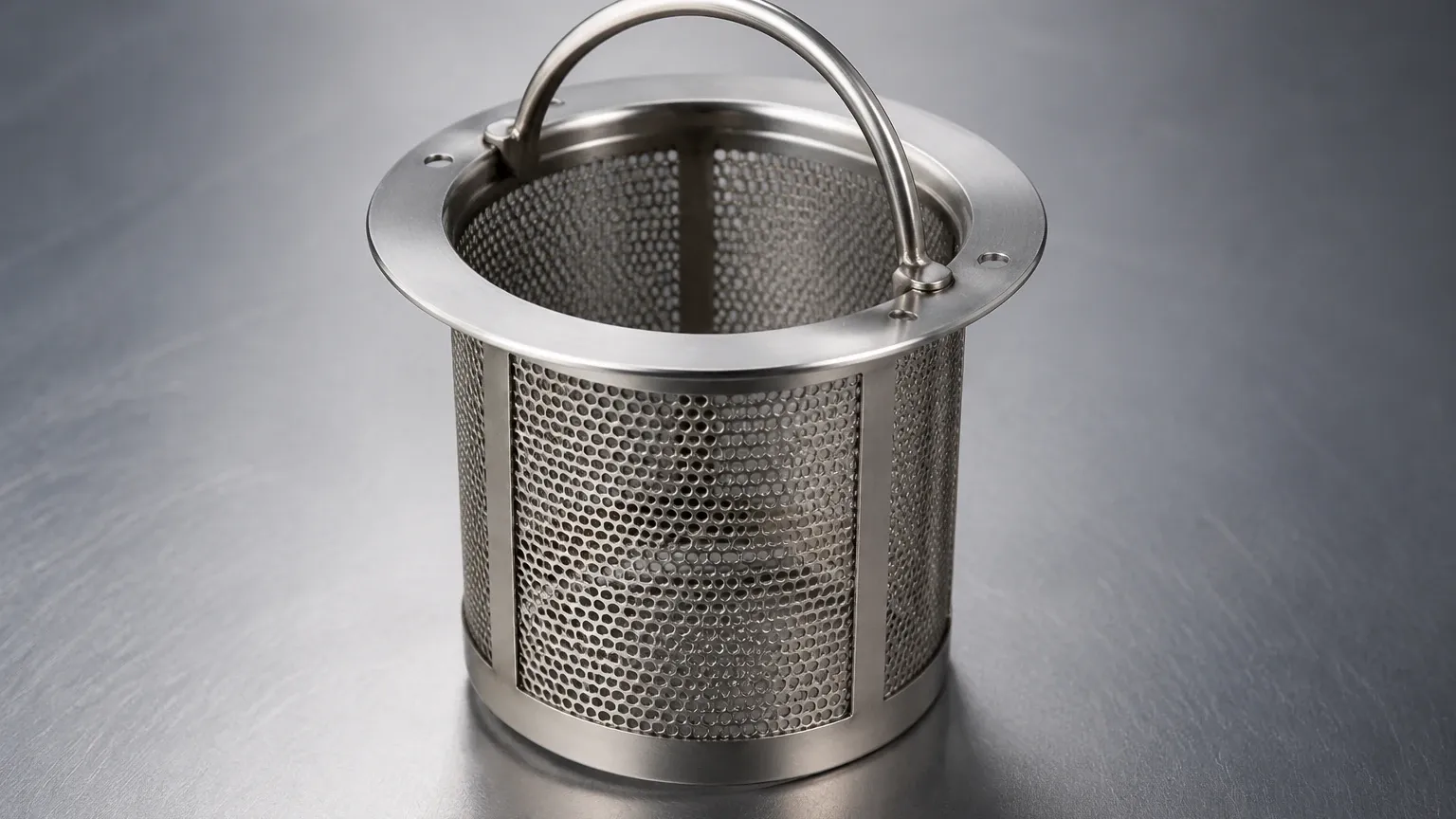
The basket is typically constructed from a perforated metal sheet which provides structural strength, often lined with a finer wire mesh to achieve the desired filtration level.
* Perforation: Measured by hole diameter (e.g., 1/8", 1/16"). Perforated baskets are suitable for removing large debris.
* Mesh: Measured by the number of openings per linear inch. A 100-mesh screen, for instance, has 100 openings per inch and can capture particles down to approximately 150 microns.
The Open Area Ratio (OAR)
A key metric in strainer sizing is the Open Area Ratio. This is the ratio of the total open area of the basket's holes to the internal cross-sectional area of the inlet pipe. A common industrial standard is an OAR of 6:1 or 8:1. A higher ratio means the strainer can accumulate more debris before the pressure drop becomes excessive, thereby reducing maintenance frequency.
Pressure Drop (ΔP)
Every strainer introduces a restriction to the flow. The total pressure drop is the sum of the drop across the housing and the drop across the clean basket. As the basket fills with debris, the ΔP increases exponentially. It is vital to size the strainer so that the clean ΔP does not exceed 2 PSI (0.14 bar) for most liquid applications to ensure the pump operates within its efficient range.
Customization for Demanding Applications
Standard off-the-shelf strainers often fail to meet the unique constraints of specialized industrial processes. Customization is where engineering expertise becomes invaluable. When designing a bespoke basket strainer, several factors are considered:
* Reinforced Baskets: In high-pressure applications or systems with high-viscosity fluids, the basket may be subject to significant mechanical stress. Reinforcing the basket with internal supports or heavier-gauge perforated metal prevents collapse.
* Magnetic Inserts: For systems where fine iron or steel particles (fines) are a concern, magnetic rods can be suspended inside the basket. These capture sub-micron metallic particles that might otherwise pass through the mesh.
* Custom Handle Designs: To facilitate rapid maintenance, baskets can be equipped with heavy-duty handles, slanted tops for ergonomic removal, or locking mechanisms to ensure the basket remains seated correctly under turbulent flow.
* Coatings and Finishes: For the food and pharmaceutical industries, baskets may require electropolishing to achieve a specific surface roughness (Ra) value, preventing bacterial growth and facilitating easier cleaning.
Maintenance Protocols and Total Cost of Ownership
The total cost of ownership (TCO) for a basket strainer is not merely the purchase price but includes the costs of downtime, labor for cleaning, and potential damage to downstream equipment if the strainer fails.
Monitoring Differential Pressure
Installing differential pressure gauges across the inlet and outlet of the strainer is the most effective way to monitor performance. Operators should establish a "clean" baseline and a "dirty" limit. Typically, a strainer should be cleaned when the ΔP reaches 5-10 PSI above the clean reading. Waiting too long can cause the basket to rupture or the pump to cavitate.
Cleaning Procedures
When cleaning a basket strainer, it is essential to inspect the basket for signs of fatigue, broken wires, or corrosion. Even small bypasses can lead to catastrophic failure of downstream high-speed turbines or precision valves. Having spare baskets on hand is a best practice to ensure that the system can be returned to service immediately while the dirty basket is cleaned offline.
Conclusion: Selecting the Right Partner
Choosing a basket strainer is a technical decision that impacts the reliability of an entire industrial facility. By focusing on material quality, precise filtration ratings, and robust mechanical design, engineers can protect their infrastructure and optimize process efficiency.
As a professional manufacturer, Kaifil provides the technical expertise required to navigate these variables. From material selection and filtration accuracy to customized OEM designs, Kaifil delivers dependable filtration components for the most demanding industrial environments. Whether you are dealing with chemical processing, water treatment, or hydraulic systems, ensuring your Strainers & Baskets are engineered for the specific task is the most effective way to ensure long-term operational success.
