


Basket Strainer and Disposal Flange
In industrial and commercial fluid management systems, the efficient separation of solids from liquid streams is critical for protecting downstream equipment, ensuring process hygiene, and maintaining operational uptime. Two components often discussed in the context of drainage and filtration interfaces are the basket strainer and disposal flange. While these terms are frequently encountered in commercial kitchen or laboratory settings, their engineering principles apply broadly across various industrial sectors where precision filtration is required at the point of discharge or intake.
For engineers and procurement professionals, selecting the right Strainers & Baskets involves more than just matching dimensions. It requires a deep understanding of material compatibility, filtration accuracy, and the mechanical integrity of the mounting hardware. This guide explores the technical considerations of the basket strainer and disposal flange assembly, focusing on industrial-grade stainless steel solutions designed for demanding environments.
The Functional Relationship Between Basket Strainers and Disposal Flanges
To understand the system as a whole, one must distinguish between the structural mount and the functional filter.
The Disposal Flange
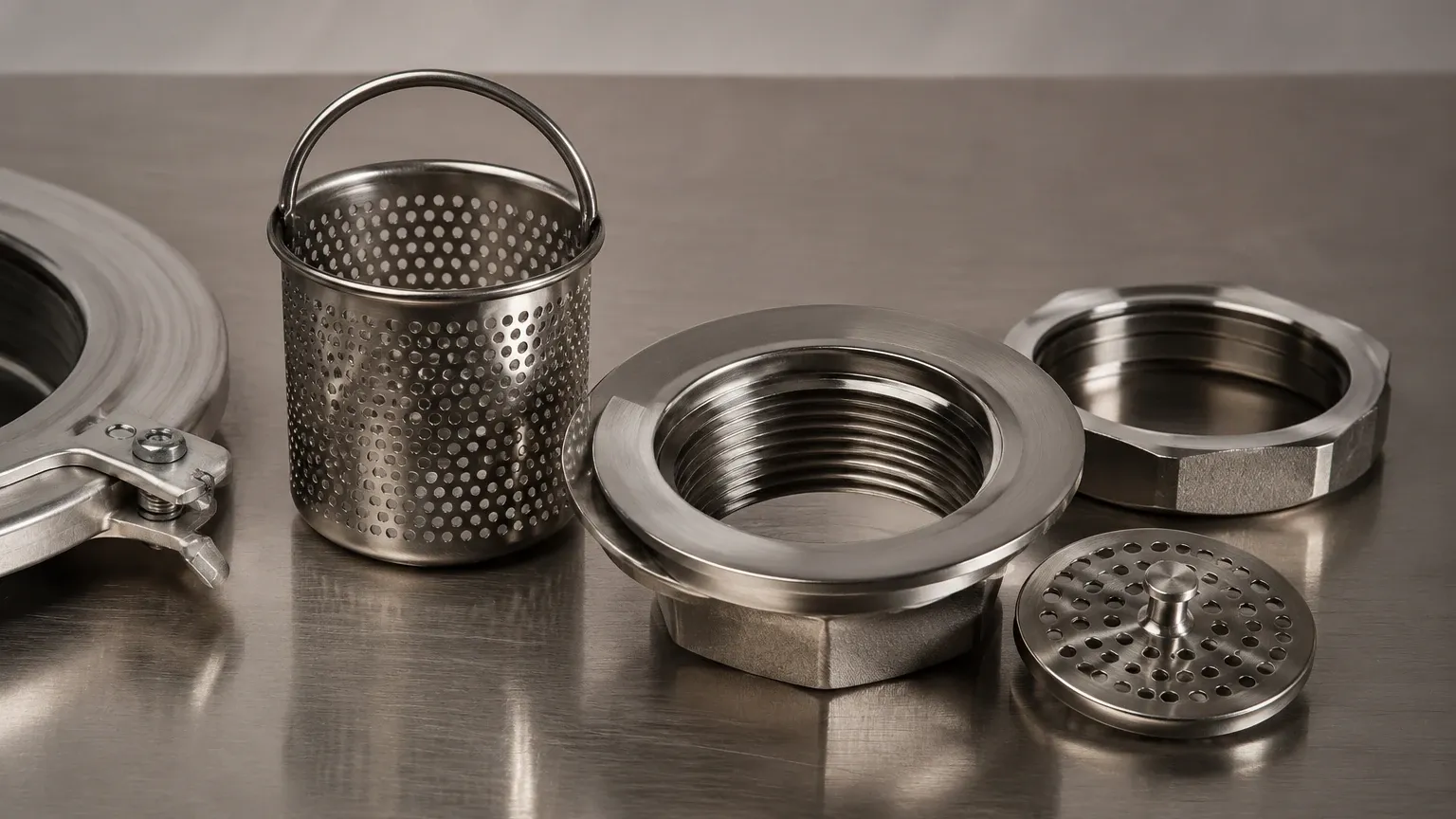
The disposal flange serves as the primary mounting interface between the sink, tank, or vessel and the drainage system. In an industrial context, this component must provide a hermetic seal to prevent leaks and withstand the mechanical stresses of high-volume flow or the vibration of connected machinery. Unlike residential versions, industrial disposal flanges are typically machined from high-grade stainless steel to resist chemical corrosion and physical wear.
The Basket Strainer
The basket strainer is the removable filtration element that sits within the flange or the housing. Its primary role is to capture debris while allowing the liquid phase to pass through with minimal resistance. The design of the basket—specifically its mesh density, perforation pattern, and structural reinforcement—determines the efficiency of the entire filtration stage. When integrated with a basket strainer and disposal flange, the system provides a dual-purpose solution: a secure connection to the plumbing and a high-performance debris trap.
Engineering Considerations: Material Selection
Material choice is the most significant factor in determining the service life and performance of filtration components. In industrial applications, Kaifil emphasizes the use of stainless steel due to its superior mechanical properties.
1. 304 Stainless Steel: This is the standard for most commercial and light industrial applications. it offers excellent corrosion resistance to most oxidizing acids and is highly durable. It is commonly used in food processing environments where frequent cleaning is required.
2. 316 Stainless Steel: For more aggressive environments, such as chemical processing plants or coastal facilities, 316 stainless steel is preferred. The addition of molybdenum provides enhanced resistance to chlorides and pitting, making it suitable for saline solutions and harsh chemicals.
3. 316L Stainless Steel: The low-carbon version of 316 is utilized when components require extensive welding. It prevents carbide precipitation during the welding process, ensuring that the joints remain as corrosion-resistant as the base metal.
Beyond the alloy, the finish of the basket strainer and disposal flange is also critical. Electropolished surfaces are often required in pharmaceutical and food-grade applications to eliminate microscopic pits where bacteria could proliferate, ensuring a higher standard of hygiene.
Technical Specifications and Filtration Performance
When specifying a basket strainer for an industrial system, engineers must evaluate several performance metrics to ensure the component meets the application's requirements.
Micron Rating and Mesh Type
The filtration accuracy of a basket strainer is defined by its micron rating. This is determined by the size of the openings in the wire mesh or the diameter of the perforations in the metal sheet.
* Perforated Metal: Ideal for coarse filtration and high-strength applications where large debris (e.g., metal shavings, large food particles) must be captured.
* Wire Mesh: Used for finer filtration. Options include plain weave for standard applications or twilled weave for higher density and finer particle capture.
Open Area Ratio
The open area ratio is the percentage of the total basket surface area that consists of openings. A higher open area ratio results in a lower pressure drop across the strainer, which is vital for maintaining flow rates and reducing the load on pumps. However, the ratio must be balanced against the structural integrity of the basket; an overly porous basket may deform under the weight of captured solids or high-pressure flow.
Flow Capacity and Pressure Drop
In any fluid system, the introduction of a strainer creates a restriction. Engineers must calculate the "clean pressure drop"—the loss of pressure when the basket is empty—and account for how that drop increases as the basket fills with debris. Selecting a basket strainer and disposal flange with an appropriately sized collection volume ensures that the system can operate for longer intervals between maintenance cycles.
Sealing and Installation Requirements
A basket strainer and disposal flange assembly is only as reliable as its seal. In industrial settings, the choice of gasket material is paramount. Common options include:
* EPDM: Excellent for water and steam applications, offering good resistance to heat and weathering.
* PTFE (Teflon): The gold standard for chemical resistance, though it requires higher torque to achieve a proper seal due to its rigidity.
* Viton: Preferred for applications involving oils, fuels, and high temperatures.
The installation process must ensure that the flange is perfectly centered and that the mounting nuts are torqued according to manufacturer specifications. Improper installation can lead to "creep" in the gasket, eventually resulting in leaks that can damage surrounding equipment or contaminate the workspace.
Applications Across Industrial Sectors
The utility of a robust basket strainer and disposal flange extends across numerous specialized fields:
Food and Beverage Processing
In large-scale kitchens and food production lines, these components prevent organic solids from entering the wastewater system. This not only complies with environmental regulations but also protects grease traps and downstream treatment facilities. Stainless steel construction ensures that the components can withstand the caustic chemicals used in Clean-in-Place (CIP) cycles.
Pharmaceutical and Laboratory Environments
Precision is non-negotiable in lab settings. A basket strainer and disposal flange used here must be easy to sterilize and resistant to a wide array of solvents and reagents. The ability to quickly remove and clean the basket without specialized tools is a key operational advantage.
Chemical and Petrochemical Industries
In these sectors, strainers are often used to protect sensitive instrumentation and pumps from particulate matter. The disposal flange must provide a secure, vibration-resistant connection to heavy-duty piping systems, often requiring custom-engineered dimensions to fit non-standard vessel outlets.
Maintenance and Total Cost of Ownership (TCO)
While the initial purchase price of a high-quality stainless steel basket strainer and disposal flange may be higher than plastic or lower-grade metal alternatives, the Total Cost of Ownership is significantly lower.
Durability and Replacement Cycles
Industrial-grade stainless steel components are designed to last for years, even under continuous use. Cheaply made strainers often suffer from mesh detachment or flange warping, leading to frequent replacements and costly downtime. By investing in precision-manufactured components, facilities reduce their long-term maintenance spend.
Cleaning and Operational Efficiency
The design of the basket plays a major role in maintenance efficiency. Baskets with smooth interior surfaces and reinforced handles allow for rapid emptying and cleaning. In high-throughput environments, having spare baskets on hand allows for an immediate swap, keeping the process running while the dirty basket is cleaned offline.
Customization and OEM Capabilities
Every industrial facility has unique requirements. Standard off-the-shelf solutions may not always meet the specific flow rates, filtration levels, or spatial constraints of a specialized machine. This is where OEM (Original Equipment Manufacturer) capabilities become essential.
Customization options for a basket strainer and disposal flange include:
* Bespoke Dimensions: Modifying the flange diameter or basket depth to fit existing infrastructure.
* Reinforced Structures: Adding external ribs or double-layered mesh for high-pressure applications.
* Magnetic Inserts: Incorporating magnetic rods within the basket to capture ferrous particles that might pass through the mesh.
* Specialized Coatings: Applying non-stick or extra-hardened coatings for specific chemical or abrasive resistance.
Conclusion for Technical Procurement
Selecting a basket strainer and disposal flange is a technical decision that impacts the reliability and efficiency of an entire fluid handling system. For engineers, the focus should remain on material integrity, filtration precision, and ease of maintenance. By choosing high-performance Strainers & Baskets, industrial operators can ensure that their processes remain protected from debris while meeting the stringent hygiene and durability standards of their respective industries.
When evaluating suppliers, it is important to confirm their ability to provide material certifications (such as MTRs), their experience with specific industry standards, and their capacity for providing customized designs. A well-engineered filtration component is not just a hardware item; it is a critical safeguard for industrial productivity.
