


Basket Strainer 20
In industrial fluid handling, the protection of downstream equipment—such as pumps, valves, flow meters, and spray nozzles—is critical to maintaining operational uptime and reducing maintenance costs. The basket strainer serves as the primary line of defense in these systems. When professionals discuss a "basket strainer 20," they are typically referring to one of two critical specifications: a strainer utilizing a 20-mesh screen for particle retention, or a large-scale 20-inch pipeline strainer designed for high-volume flow.
As a specialized manufacturer of stainless steel filtration solutions, Kaifil provides the engineering expertise required to navigate these specifications. Understanding the technical nuances of mesh sizing, flow dynamics, and material compatibility is essential for engineers and purchasing teams tasked with selecting the right filtration component for demanding industrial environments.
Technical Specifications of 20-Mesh Filtration
One of the most common applications for the term "basket strainer 20" involves the use of 20-mesh stainless steel wire cloth. In the context of industrial filtration, mesh count refers to the number of openings per linear inch.
Particle Retention and Micron Rating
A 20-mesh screen typically features an opening size of approximately 841 microns (0.0331 inches). This level of filtration is categorized as coarse to medium filtration. It is ideal for removing larger debris, such as scale, metal chips, and organic solids, before they can enter sensitive machinery. For engineers, selecting a 20-mesh basket requires balancing the need for particle capture with the acceptable pressure drop across the system.
Open Area Ratio (OAR)
The performance of a basket strainer is largely dictated by its Open Area Ratio. This is the relationship between the total area of the openings in the basket and the cross-sectional area of the inlet pipe. A high-quality basket strainer 20 should ideally offer an OAR of at least 6:1. This ensures that the strainer can accumulate a significant amount of debris before the differential pressure increases to a level that requires cleaning, thereby extending the service interval.
Engineering Considerations for 20-Inch Basket Strainers
When the "20" refers to the pipe size (20 inches), the engineering challenges shift toward structural integrity and flow management. Large-diameter basket strainers are staples in water treatment plants, power generation cooling systems, and large-scale chemical processing facilities.
Flow Capacity and Pressure Drop
At a 20-inch diameter, the volume of fluid moving through the system is immense. Engineers must calculate the Clean Pressure Drop ($ΔP$) using the specific gravity and viscosity of the fluid. Because these large strainers represent a significant investment, Kaifil emphasizes the importance of precision-engineered internal baskets that minimize turbulence. If the internal basket is not properly seated or if the flow distribution is uneven, the resulting vibration can lead to fatigue failure of the mesh or the housing itself.
Structural Reinforcement
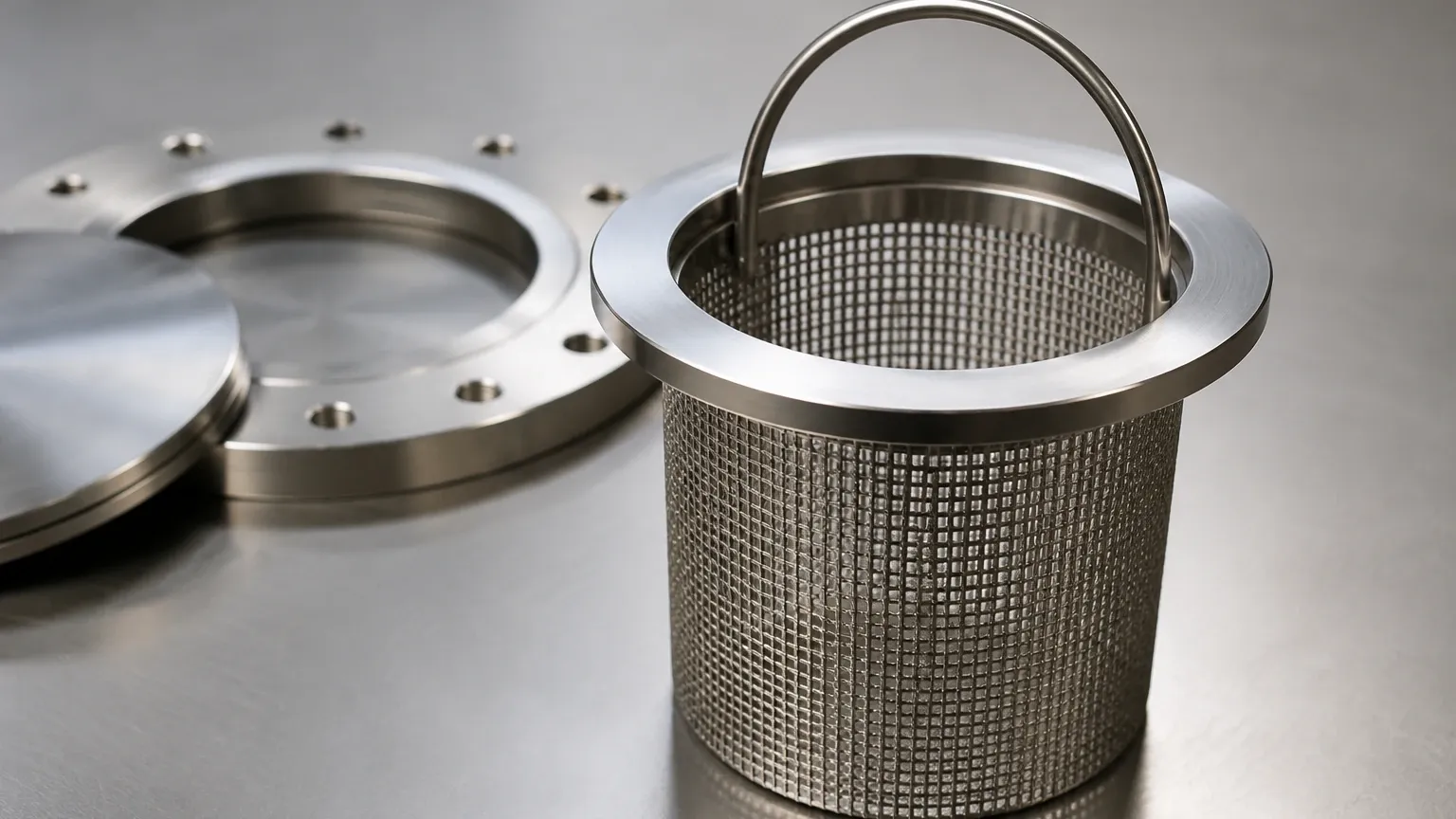
For a 20-inch basket, the surface area of the filtration media is substantial. Under high-pressure conditions, the mesh alone may not have the structural rigidity to withstand the force of the fluid. In these instances, Kaifil utilizes perforated metal backup tubes or heavy-duty stainless steel frames to support the finer 20-mesh lining. This "multi-layer" approach ensures that the basket maintains its shape even under high differential pressure scenarios.
Material Selection for Industrial Durability
The longevity of Strainers & Baskets depends heavily on the materials used in their construction. Industrial environments often involve corrosive fluids, extreme temperatures, and abrasive solids.
304 vs. 316L Stainless Steel
* Type 304 Stainless Steel: This is the standard material for most general-purpose industrial applications. It offers excellent strength and good corrosion resistance for water and mild chemical service.
* Type 316L Stainless Steel: For applications involving chlorides, acids, or high-salinity environments (such as marine or pharmaceutical processing), 316L is the preferred choice. The addition of molybdenum enhances its resistance to pitting and crevice corrosion.
Gasket and Seal Compatibility
A basket strainer is only as reliable as its seals. When specifying a basket strainer 20, it is vital to confirm that the O-ring or gasket material is compatible with the process fluid. Common options include:
* Buna-N (Nitrile): Standard for oil and water.
* EPDM: Excellent for steam and water applications.
* Viton (FKM): High-temperature and chemical resistance.
* PTFE: Near-universal chemical compatibility, though with less elasticity than elastomers.
Maintenance and Operational Efficiency
The total cost of ownership (TCO) for a basket strainer is influenced more by maintenance requirements than by the initial purchase price. A well-designed basket strainer 20 should facilitate rapid cleaning to minimize downtime.
Differential Pressure Monitoring
Installing pressure gauges upstream and downstream of the strainer is an engineering best practice. A common rule of thumb is to clean the basket when the differential pressure reaches 5-10 psi over the clean reading. Allowing the pressure drop to exceed 20 psi can risk basket collapse or "blow-by," where particles are forced through or around the filtration media.
Cover Designs for Ease of Access
For smaller 20-mesh strainers, threaded covers or wing-nut closures allow for tool-free access. For larger 20-inch units, the cover weight becomes a factor. Kaifil provides customized solutions such as davit arms or hinged covers to allow a single operator to safely open the vessel for basket removal. This focus on ergonomic design directly impacts the safety and efficiency of the maintenance team.
Customization and OEM Solutions
Every industrial process has unique variables, and off-the-shelf strainers may not always meet specific performance criteria. Kaifil specializes in customized filtration components that address these specific needs.
Magnetic Inserts
In many hydraulic or machining applications, fine ferrous particles (metal fines) can pass through a standard 20-mesh screen. By integrating high-intensity magnetic assemblies into the center of the basket, the strainer can capture these sub-micron metallic contaminants, providing an extra layer of protection for high-precision pumps.
Specialized Coatings and Linings
For highly abrasive slurries or aggressive chemical environments where even 316L stainless steel may struggle, specialized coatings or exotic alloys (such as Monel or Hastelloy) can be utilized for the basket construction. This level of customization ensures that the filtration system survives the specific rigors of the application.
Comparison: Simplex vs. Duplex Configurations
When selecting a basket strainer 20, engineers must decide between a Simplex or Duplex configuration based on the continuity of the process.
| Feature | Simplex Basket Strainer | Duplex Basket Strainer |
| :— | :— | :— |
| Flow Continuity | Requires system shutdown for cleaning | Allows continuous flow during cleaning |
| Complexity | Simple, single-chamber design | Two chambers with a diverter valve |
| Cost | Lower initial investment | Higher initial investment |
| Best Use Case | Batch processes or non-critical lines | 24/7 operations and critical cooling |
For a 20-inch pipeline, a Duplex configuration is a massive undertaking but often necessary for power plants or municipal water systems where flow cannot be interrupted. Conversely, a 20-mesh Simplex strainer is often sufficient for chemical batching where the system is routinely depressurized between runs.
Conclusion for Engineering and Purchasing Teams
Selecting a basket strainer 20 requires a comprehensive understanding of the application's physical and chemical demands. Whether the requirement is for a specific 20-mesh retention level to protect a spray nozzle or a 20-inch housing for a main process line, the focus must remain on material quality, structural integrity, and ease of maintenance.
Kaifil’s commitment to precision manufacturing and technical support allows us to partner with global customers to develop filtration solutions that perform reliably in the most demanding environments. By considering factors such as the Open Area Ratio, differential pressure limits, and material compatibility, technical professionals can ensure that their filtration systems provide long-term value and equipment protection.
For more information on technical specifications or to request a custom design, visit our dedicated section for Strainers & Baskets and consult with our engineering team to optimize your filtration performance.
