


Basket Strainer 40 Mesh
In industrial fluid handling, the efficiency of a system often depends on the precision of its primary filtration components. Among the most versatile configurations used across the chemical, pharmaceutical, and food processing industries is the basket strainer 40 mesh. This specific mesh size provides a balance between fine particle retention and high flow capacity, making it a standard choice for protecting pumps, valves, and heat exchangers from debris. For engineers and procurement teams, understanding the technical nuances of these Strainers & Baskets is essential for optimizing system uptime and reducing total cost of ownership.
Understanding the Technical Specifications of 40 Mesh
The term "mesh" refers to the number of openings per linear inch of a wire cloth. A basket strainer 40 mesh configuration indicates that there are 40 wires in every inch of the material, both horizontally and vertically. However, the mesh count alone does not fully define the filtration capability; one must also consider the wire diameter and the resulting aperture size.
Aperture and Micron Rating
For a standard 40 mesh stainless steel screen, the aperture (the clear opening between wires) is typically around 0.425 millimeters, which equates to 425 microns. This allows the strainer to capture particles larger than 425 microns while allowing smaller particles and the carrier fluid to pass through.
Open Area Percentage
The "open area" is a critical engineering metric that dictates the flow resistance of the strainer. It is calculated based on the ratio of the total area of the openings to the total area of the mesh surface. A standard 40 mesh screen with a wire diameter of approximately 0.25 mm provides an open area of roughly 36% to 40%. Engineers must ensure that the total open area of the basket is significantly greater (often 4 to 6 times) than the cross-sectional area of the inlet pipe to minimize pressure drop.
The Role of Basket Strainers in Industrial Filtration
Basket strainers are designed for applications where high flow rates and high solids loading are expected. Unlike Y-strainers, which are often used for steam or gases where less debris is present, basket strainers feature a larger internal volume. This allows for a greater accumulation of solids before cleaning is required.
When a basket strainer 40 mesh is integrated into a pipeline, it serves as a mechanical barrier. The fluid enters the top or side of the basket, and as it passes through the mesh, contaminants are trapped inside the "bucket." Because the debris is contained within the basket, it can be easily removed and cleaned without the risk of contaminants falling back into the downstream piping during maintenance.
For many industrial applications, Strainers & Baskets are the first line of defense. They prevent catastrophic failure of expensive equipment like high-pressure pumps or sensitive flow meters by removing welding slag, pipe scale, and large organic particulates.
Material Selection and Durability Factors
Material compatibility is a primary concern when selecting a basket strainer 40 mesh. Since these components are often exposed to corrosive chemicals, high temperatures, or high-pressure cleaning cycles, the choice of metal is paramount.
Stainless Steel 304 vs. 316
Stainless steel is the industry standard for industrial filtration. Type 304 stainless steel offers excellent resistance to atmospheric corrosion and is widely used in general industrial and food-grade applications. However, for environments involving chlorides, acids, or marine conditions, Type 316 (or 316L for welding stability) is preferred due to its molybdenum content, which enhances pitting resistance.
Structural Reinforcement
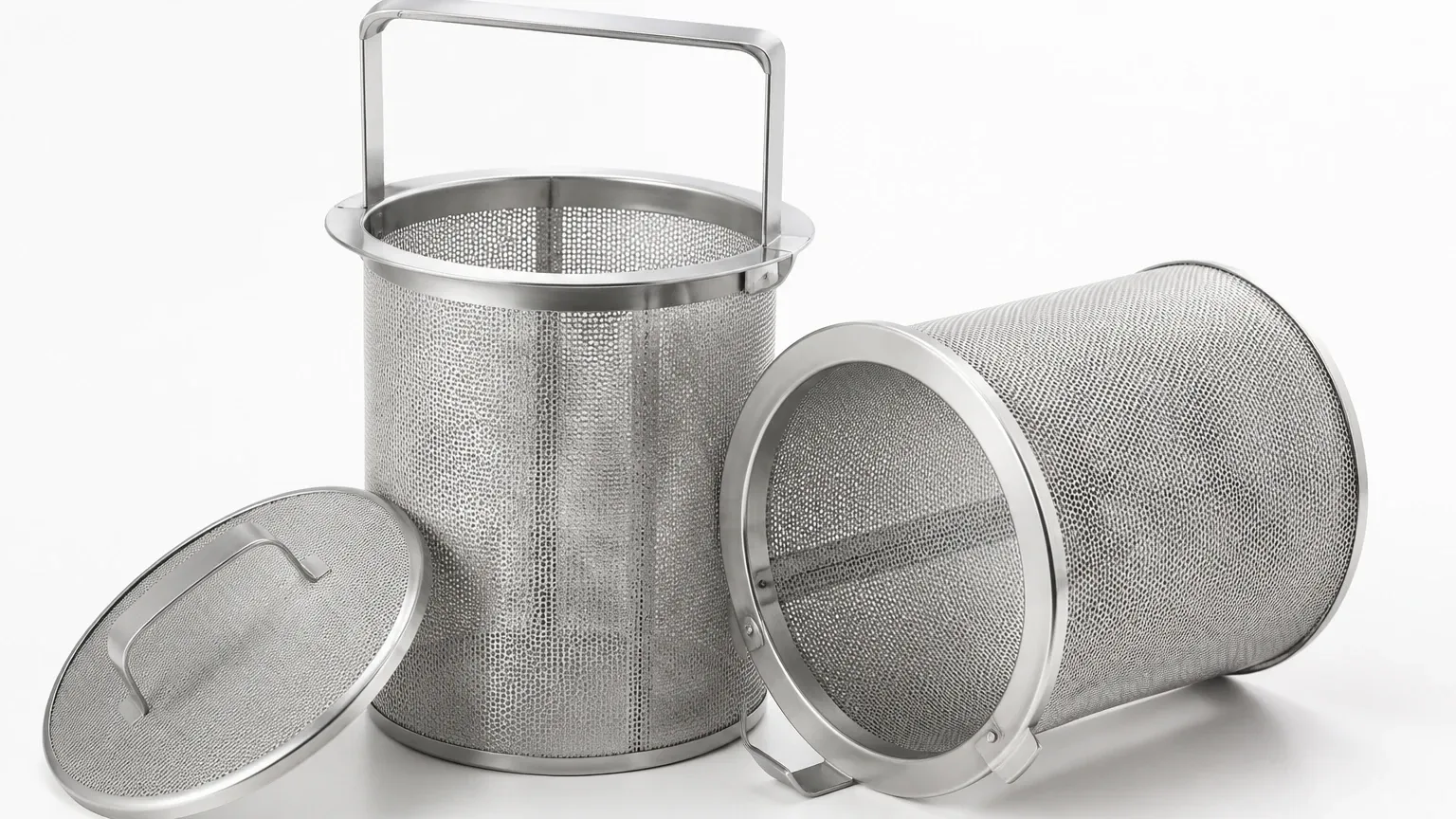
At 40 mesh, the wire cloth is relatively thin and can be susceptible to deformation under high differential pressure. To prevent the mesh from collapsing or "ballooning," manufacturers like Kaifil often use a dual-layer construction. This involves lining a heavy-duty perforated metal basket with the 40-mesh wire cloth. The perforated metal provides the structural integrity required to withstand the force of the fluid flow, while the mesh provides the specific filtration accuracy.
Engineering Considerations for Flow and Pressure
When specifying a basket strainer 40 mesh, engineers must perform a thorough analysis of the fluid dynamics within the system. Two factors are of particular importance: the Clean Pressure Drop (ΔP) and the Terminal Pressure Drop.
Clean Pressure Drop
The clean pressure drop is the initial loss of pressure across the strainer when it is first installed and free of debris. This is influenced by the fluid's viscosity, density, and flow velocity. High-viscosity fluids, such as heavy oils or syrups, will experience a much higher pressure drop through a 40-mesh screen than water. If the initial ΔP is too high, it may starve downstream pumps or require a larger strainer housing to increase the surface area.
Monitoring Differential Pressure
As the basket captures debris, the open area decreases, and the differential pressure increases. It is standard engineering practice to install pressure gauges upstream and downstream of the strainer. A common rule of thumb is to schedule cleaning when the differential pressure reaches 5 to 10 psi above the clean state. Allowing the ΔP to exceed the manufacturer's recommended limit can lead to mesh rupture or bypass, where the fluid forces its way around the basket seals.
Customization Options for Specialized Applications
No two industrial processes are identical, and off-the-shelf solutions may not always meet the specific demands of a facility. Customization is a core strength of professional manufacturers like Kaifil, allowing for the development of filtration components tailored to unique operating environments.
Connection Types and Housing Designs
While standard basket strainers often feature flanged or NPT threaded connections, custom designs can include quick-disconnect fittings, sanitary tri-clamp connections for the pharmaceutical industry, or specialized weld-neck flanges. The housing itself can be modified with vent valves, drain plugs, or even heating jackets for fluids that must remain at a specific temperature to maintain flowability.
Specialized Mesh and Linings
Beyond the standard basket strainer 40 mesh, engineers can request multi-stage filtration baskets. This might involve a coarse outer mesh to catch large debris followed by a 40-mesh inner layer. Furthermore, magnetic inserts can be added to the center of the basket to capture fine ferrous particles that might otherwise pass through the mesh openings.
Maintenance and Operational Best Practices
To ensure the longevity of Strainers & Baskets, a proactive maintenance schedule is required. The primary advantage of the basket design is the ease of cleaning, but this must be done correctly to avoid damaging the precision mesh.
1. System Depressurization: Always ensure the line is depressurized and drained before opening the strainer cover. Many modern designs include a safety vent to bleed off pressure safely.
2. Cleaning Methods: For a 40-mesh screen, cleaning should be performed using a soft brush or a high-pressure water spray from the outside in (backwashing). Avoid using metal scrapers or wire brushes that could distort the mesh openings or create burrs.
3. Gasket Inspection: Every time the strainer is opened, the cover gasket or O-ring should be inspected for wear, compression set, or chemical degradation. A faulty seal can lead to external leaks or internal bypassing.
4. Spare Baskets: To minimize downtime, many facilities keep a spare basket on hand. This allows the operator to quickly swap the dirty basket for a clean one, returning the system to service immediately while the dirty basket is cleaned offline.
Total Cost of Ownership Considerations
When evaluating a basket strainer 40 mesh, the purchase price is only one component of the total cost. Engineers should also consider the durability of the mesh, the ease of cleaning, and the availability of replacement parts. A cheaply manufactured basket may save money upfront but can lead to higher costs through frequent mesh failures, increased labor for cleaning, and potential damage to downstream equipment.
By selecting high-quality stainless steel components and ensuring the mesh is properly supported, industrial facilities can achieve a reliable filtration process that protects their assets and maintains product purity. Whether the application involves cooling water, fuel oil, or liquid chemicals, the 40-mesh basket remains a cornerstone of effective industrial debris management.
For technical assistance in selecting the right configuration or to discuss custom OEM requirements, engineers are encouraged to consult with filtration specialists who understand the balance between flow dynamics and particle retention. Choosing the right partner ensures that your Strainers & Baskets are engineered to meet the specific rigors of your industrial environment.
