


Basket Strainer Design Calculation
In industrial fluid handling, the efficiency and longevity of downstream equipment—such as pumps, valves, and heat exchangers—depend heavily on the effective removal of particulate matter. Basket strainers serve as the primary line of defense in these systems. However, selecting a strainer based solely on pipe size is a common engineering oversight. A precise basket strainer design calculation is essential to ensure that the component provides adequate filtration without inducing excessive pressure drop or requiring frequent, unscheduled maintenance.
For engineers and procurement teams, understanding the mathematical and physical principles behind Strainers & Baskets is the first step toward optimizing system performance. This guide explores the critical variables, formulas, and engineering considerations required to perform an accurate basket strainer design calculation.
Understanding the Role of Strainers & Baskets in Industrial Systems
Before diving into the calculations, it is vital to define the functional requirements of the equipment. Unlike filters, which are often designed to remove microscopic particles, strainers are typically used to remove larger debris from a process stream.
In B2B industrial environments—ranging from chemical processing to food and beverage production—the basket strainer is preferred for its high dirt-holding capacity. The "basket" design allows for a larger surface area compared to Y-strainers, making them ideal for high-flow applications. However, this increased capacity must be balanced against the spatial constraints of the facility and the hydraulic limits of the piping system. A well-executed basket strainer design calculation ensures that the chosen unit matches the specific rheological properties of the fluid and the operational demands of the process.
Fundamental Parameters for Basket Strainer Design Calculation
To begin a design calculation, several data points must be gathered. These parameters form the baseline for all subsequent hydraulic modeling:
1. Flow Rate (Q): Usually measured in gallons per minute (GPM) or cubic meters per hour (m³/h). This is the most critical variable for determining the velocity of the fluid.
2. Viscosity (μ): The resistance of the fluid to flow. High-viscosity fluids (like heavy oils or syrups) significantly increase pressure drop and require larger strainer surface areas.
3. Specific Gravity (SG): The density of the fluid relative to water. This affects the weight of the fluid column and the energy required to move it through the mesh.
4. Operating Pressure and Temperature: These dictate the material selection and the pressure rating of the strainer housing.
5. Allowable Pressure Drop ($ΔP$): The maximum permissible loss of pressure across the strainer when clean. Typically, engineers aim for a clean pressure drop of less than 2 psi (0.14 bar).
6. Filtration Grade: The size of the particles to be removed, usually defined in mesh size or microns.
Pressure Drop Analysis: The Core of Strainer Sizing
The most significant part of any basket strainer design calculation is predicting the pressure drop. Pressure drop occurs because the strainer body and the internal basket act as obstructions to the flow. The total pressure drop ($ΔP_{total}$) is the sum of the drop across the housing and the drop across the clean basket.
The Cv Factor
Most manufacturers provide a Flow Coefficient (Cv), which represents the flow of water in GPM at 60°F that will pass through the strainer with a pressure drop of 1 psi. The basic formula for pressure drop using water is:
$$ΔP = (Q / Cv)^2$$
However, for industrial applications involving fluids other than water, the calculation must be corrected for specific gravity and viscosity.
Correcting for Specific Gravity
If the fluid has a specific gravity different from water (1.0), the formula becomes:
$$ΔP_{corrected} = ΔP_{water} × SG$$
Correcting for Viscosity
Viscosity has a non-linear impact on pressure drop. When the viscosity exceeds 30 centistokes (cSt), the internal friction of the fluid increases the resistance through the mesh pores. Engineers must apply viscosity correction factors (often provided in manufacturer charts) to the clean pressure drop calculation. Failure to account for viscosity is a leading cause of undersized strainers in the oil and gas and food processing sectors.
Determining the Net Open Area and Area Ratio
A critical metric in basket strainer design calculation is the "Open Area Ratio" (OAR). This ratio compares the total open area of the basket's mesh or perforations to the internal cross-sectional area of the inlet pipe.
The Calculation of Open Area
To calculate the open area of the basket, you must first determine the total surface area of the basket cylinder and bottom. Then, multiply this by the percentage of open area provided by the specific mesh or perforation pattern.
* Perforated Plate: The open area percentage is determined by the hole diameter and the pitch (spacing) between holes.
* Wire Mesh: The open area is determined by the wire diameter and the number of wires per inch.
The Importance of the 6:1 Ratio
In many industrial standards, a minimum OAR of 6:1 is recommended. This means the open area of the basket should be six times the area of the inlet pipe. A high OAR provides several benefits:
* Reduced Velocity: Lower velocity through the mesh pores reduces the likelihood of particle "breakthrough" or impingement damage.
* Extended Service Life: A larger surface area allows more debris to accumulate before the pressure drop reaches the critical threshold for cleaning.
* Lower Maintenance Costs: Fewer cleaning cycles translate to reduced labor costs and less downtime.
If the basket strainer design calculation reveals an OAR lower than 4:1, the engineer should consider a larger housing or a pleated basket design to increase the available surface area.
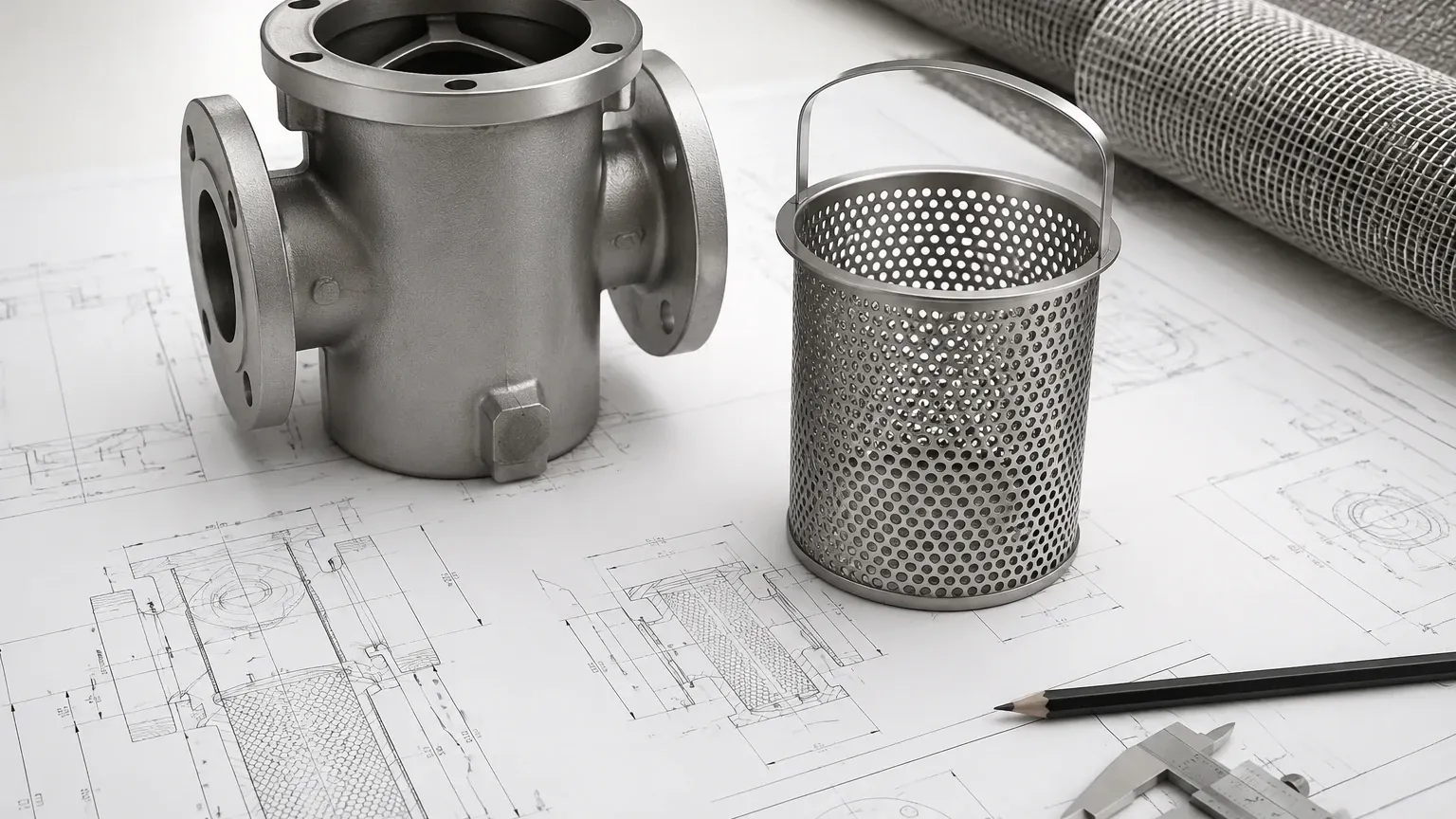
Engineering Considerations for Viscous and High-Solid Fluids
When dealing with heavy industrial fluids, the standard basket strainer design calculation requires additional safety margins. In applications with high solids loading, the "dirty" pressure drop must be modeled.
The 50% Clogged Rule
A common conservative engineering practice is to calculate the pressure drop assuming the basket is 50% clogged. This ensures that the system can continue to operate efficiently even as debris builds up between maintenance intervals. If the pressure drop at 50% clogging exceeds the pump's NPSH (Net Positive Suction Head) requirements, the strainer is undersized.
Impact of Mesh Selection
The finer the mesh, the higher the flow resistance. In a basket strainer design calculation, engineers must strike a balance between protection and flow. If a 100-micron mesh causes too much pressure drop, it may be necessary to use a two-stage straining process or a larger basket size to maintain the required flow rate.
Structural Integrity and Material Selection in Design
Beyond hydraulics, the basket strainer design calculation must account for the physical forces acting on the basket. When a basket becomes clogged, the pressure differential across the mesh increases. If the basket is not designed to withstand this differential pressure ($ΔP_{max}$), it may collapse, sending debris and metal fragments downstream into sensitive equipment.
Burst Pressure Calculations
Engineers must verify the structural limits of the stainless steel mesh and the supporting perforated canister. For high-pressure applications, heavy-duty baskets with internal reinforcement or thicker gauge materials are required. At Kaifil, we focus on the durability of these components, ensuring that the material selection (e.g., 304 or 316L stainless steel) is compatible with both the chemical environment and the mechanical stresses of the application.
Corrosion Allowance
In chemical processing, the design calculation should also include a corrosion allowance. Over time, the thinning of the wire mesh due to chemical erosion can reduce its structural integrity and change the filtration accuracy. Selecting the correct alloy is as important as the hydraulic sizing.
Common Pitfalls in Strainer Design and How to Avoid Them
Even with a robust basket strainer design calculation, certain practical factors can lead to system failure:
1. Ignoring Inlet/Outlet Configuration: Turbulence at the inlet can cause uneven debris distribution within the basket, leading to localized clogging and premature pressure spikes.
2. Over-straining: Specifying a mesh that is far finer than necessary. This leads to excessive pressure drop and frequent cleaning without providing meaningful additional protection.
3. Neglecting Thermal Expansion: In high-temperature applications, the expansion of the basket relative to the housing must be considered to prevent bypassing or mechanical binding.
4. Inaccurate Fluid Data: Using water-based calculations for non-Newtonian fluids or fluids with high viscosity will invariably result in an undersized strainer.
Conclusion: Partnering for Optimized Filtration Performance
Performing an accurate basket strainer design calculation is a multidisciplinary task that combines fluid mechanics, material science, and mechanical engineering. By focusing on the relationship between flow rate, viscosity, and open area ratio, engineers can specify Strainers & Baskets that provide reliable protection with minimal operational impact.
At Kaifil, we understand that every industrial process has unique requirements. As a professional manufacturer of custom stainless steel filtration solutions, we provide the technical expertise necessary to move from theoretical calculations to high-performance hardware. Whether your application involves chemical processing, hydraulic systems, or food production, our team works closely with you to ensure that every filtration component is engineered for durability and precision.
By confirming flow parameters and filtration goals early in the design phase, you can ensure a cost-effective solution that minimizes total cost of ownership and maximizes system uptime.
