


Basket Strainer Diameter
In industrial fluid handling systems, the selection of filtration components is a critical engineering decision that directly impacts system longevity, operational efficiency, and maintenance costs. Among the various parameters involved in specifying Strainers & Baskets, the basket strainer diameter stands out as a fundamental geometric variable. It determines not only the physical fit within a housing but also the available surface area for filtration, the resulting pressure drop, and the overall debris-holding capacity of the system.
For engineers and procurement professionals, understanding the technical nuances of basket diameter is essential for optimizing flow dynamics and ensuring that downstream equipment—such as pumps, valves, and heat exchangers—remains protected from particulate contamination. This guide explores the engineering considerations, performance impacts, and selection criteria associated with basket strainer diameters in industrial applications.
The Relationship Between Pipeline Size and Basket Diameter
A common point of clarification in industrial filtration is the distinction between the nominal pipe size (NPS) of the strainer housing and the actual internal basket strainer diameter. While the housing is sized to match the pipeline (e.g., a 4-inch flange for a 4-inch pipe), the internal basket must be sized to provide sufficient bypass-free filtration while fitting securely within the sump.
In standard simplex or duplex strainer designs, the basket diameter is typically larger than the inlet pipe diameter. This "over-sizing" of the internal element is intentional. By increasing the diameter of the basket relative to the pipe, manufacturers like Kaifil can provide a significantly larger filtration surface area. This design strategy ensures that the fluid velocity slows down as it enters the basket, allowing for more efficient particle capture and reducing the rate of pressure increase as the basket begins to load with debris.
When specifying custom filtration solutions, engineers must confirm the internal clearance of the housing. A basket with an incorrect diameter—even by a few millimeters—can lead to fluid bypass if it is too small, or mechanical interference during installation if it is too large. Precision manufacturing is required to ensure that the basket flange or O-ring seat aligns perfectly with the housing’s internal machined surfaces.
Impact of Diameter on Filtration Surface Area and OAR
The primary function of increasing the basket strainer diameter is to maximize the effective filtration area. The relationship between the diameter (D) and the surface area (A) of a cylindrical basket is linear with respect to the circumference ($A = \pi D L$, where L is length), but the total volume and the potential for pleating or multi-layer mesh construction scale more complexly.
The Open Area Ratio (OAR)
One of the most critical metrics in strainer engineering is the Open Area Ratio (OAR). This is the ratio of the total open area of the basket (the sum of all holes in the mesh or perforations) to the internal cross-sectional area of the inlet pipe.
* Low OAR: A small diameter basket relative to the pipe size results in a low OAR. This leads to high fluid velocity through the mesh, rapid clogging, and a high initial pressure drop.
* High OAR: A larger diameter basket increases the OAR. Most industrial standards require an OAR of at least 6:1 or 8:1 for general service. In high-viscosity applications or systems with high solids loading, an even larger diameter may be required to achieve a higher OAR, ensuring the system can operate for extended periods between cleaning cycles.
By optimizing the basket diameter, engineers can achieve the desired OAR without excessively increasing the length of the strainer housing, which is often constrained by spatial limitations in a plant layout.
Fluid Dynamics: Velocity and Pressure Drop Considerations
The basket strainer diameter plays a pivotal role in the fluid dynamics of a filtration system. According to the continuity equation ($Q = A \times v$), for a constant flow rate (Q), increasing the cross-sectional area (A) through which the fluid passes will decrease the velocity (v).
Reducing Differential Pressure (ΔP)
Pressure drop is the loss of energy as fluid moves through the strainer. A significant portion of this loss occurs as the fluid is forced through the restricted openings of the filter media. By increasing the basket diameter, the fluid is distributed over a wider area, which lowers the flux (flow per unit area). Lower flux results in a lower clean pressure drop.
For technical professionals, maintaining a low differential pressure is vital for:
1. Energy Efficiency: Reducing the load on centrifugal or positive displacement pumps.
2. Filter Integrity: High ΔP can cause structural deformation of the basket or "blow-through," where particles are forced through the mesh media.
3. Process Stability: Minimizing turbulence and cavitation risks downstream of the strainer.
Velocity and Particle Retention
High fluid velocity can also negatively impact filtration efficiency. If the velocity through the mesh is too high, it may shear soft particles or push needle-like contaminants through the openings. A larger basket diameter facilitates a more laminar flow profile at the mesh interface, enhancing the probability of particle impingement and retention.
Customization and Engineering Constraints
In many brownfield industrial projects, engineers are forced to work within the constraints of existing strainer housings. However, when performance requirements change—such as an increase in flow rate or a shift to a finer micron rating—the original basket may no longer be adequate.
Tailored Basket Diameters for OEM Replacements
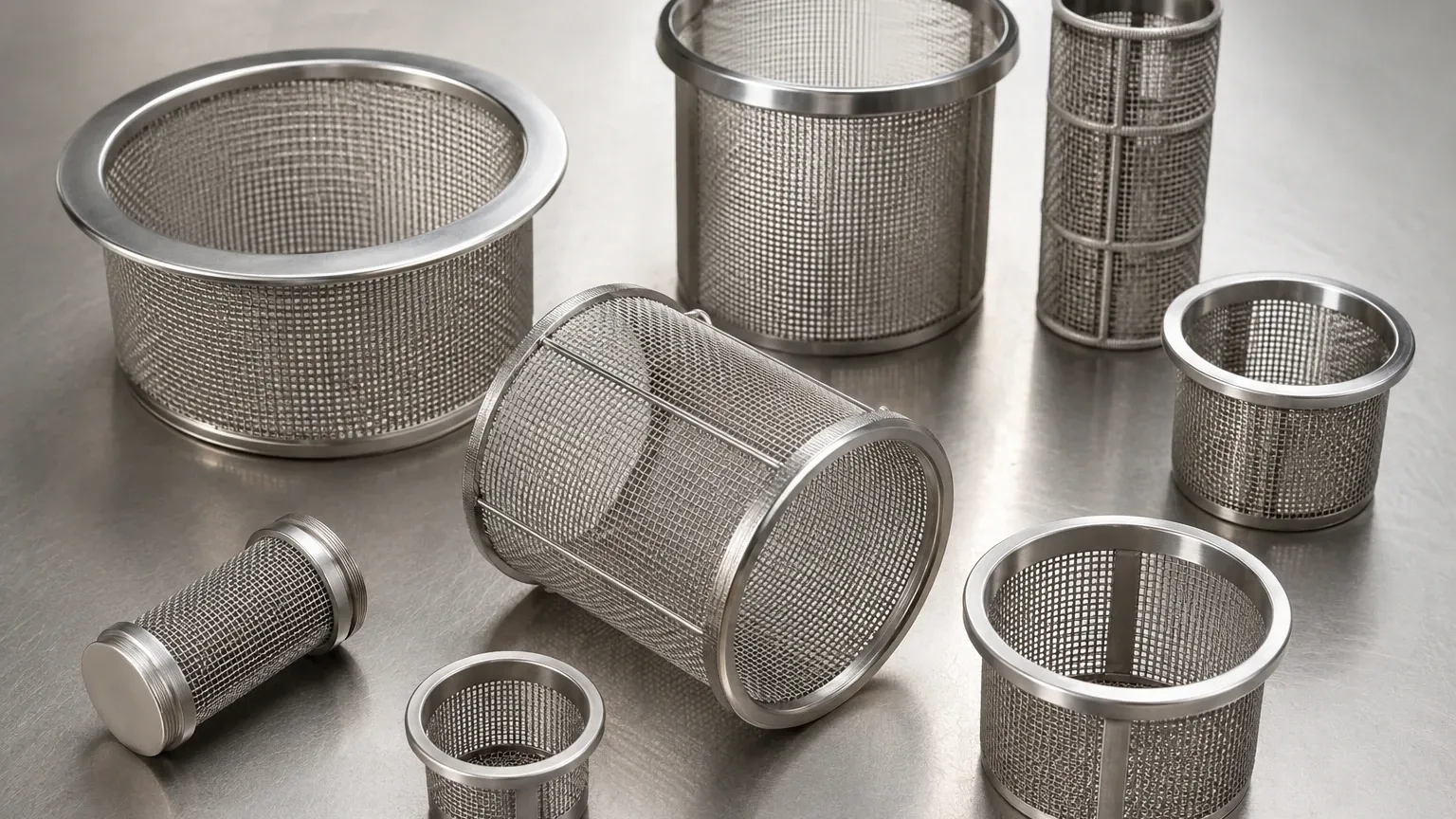
Kaifil specializes in manufacturing custom stainless steel baskets where the diameter is engineered to the exact specifications of the application. This includes:
* Reinforced Structures: For large-diameter baskets, internal or external support cages (perforated metal) are often required to prevent the wire mesh from collapsing under hydraulic pressure.
* Flange Configurations: The top flange diameter must be precisely machined to ensure a metal-to-metal seal or to compress a gasket correctly within the housing's counterbore.
* Tapered Designs: In some specialized housings, baskets may feature a slight taper. Calculating the mean basket strainer diameter in these instances is crucial for volume and flow calculations.
Material Selection and Structural Integrity
As the diameter of a basket increases, the mechanical stresses on the component also increase. A large-diameter basket in a high-pressure hydraulic system or a heavy-duty chemical process must be constructed from high-grade materials like 304 or 316L stainless steel. The thickness of the perforated support plate must be scaled according to the diameter to ensure the basket remains rigid during high-flow conditions or when fully loaded with debris.
Common Risks of Incorrect Diameter Specification
Selecting or manufacturing a basket with an inappropriate diameter leads to several operational risks that can result in costly downtime.
1. Bypass Contamination: If the basket diameter is too small for the housing seat, the fluid will take the path of least resistance—around the outside of the basket rather than through the mesh. This allows unfiltered debris to reach sensitive downstream components.
2. Premature Blinding: A diameter that is too small provides insufficient surface area. In systems with high particulate counts, the basket will "blind" (clog) rapidly, necessitating frequent shutdowns for manual cleaning.
3. Difficulty in Extraction: If the basket diameter is too close to the housing's internal diameter without proper clearance, corrosion products or fine silts can wedge the basket in place, making it extremely difficult to remove for maintenance.
4. Structural Failure: If the diameter is large but the material gauge is insufficient, the basket may lose its circularity under pressure, leading to seal failure at the flange.
Maintenance and Replacement Cycles
The basket strainer diameter directly influences the maintenance schedule of a facility. A well-sized basket with an optimized diameter allows for a larger "dirt-holding capacity." This means the system can accumulate a significant volume of solids before the differential pressure reaches the threshold for cleaning (typically 5-10 psi over the clean drop).
When evaluating replacement baskets, engineers should consider whether a change in diameter or a change in the media type (e.g., switching from a simple perforated plate to a pleated wire mesh) could extend the service life. While the outer diameter must remain compatible with the housing, internal modifications to the basket geometry can often improve performance within the same footprint.
Conclusion: Confirming Technical Specifications
Selecting the correct Strainers & Baskets requires a balance between hydraulic performance and mechanical fit. When discussing requirements with a manufacturer, it is essential to provide accurate measurements of the housing's internal dimensions, the required micron rating, and the expected flow conditions.
Key information to confirm before procurement includes:
* The exact outer diameter (OD) of the basket flange.
* The body diameter of the basket (to ensure clearance).
* The required Open Area Ratio (OAR) for the specific fluid viscosity.
* Material compatibility (e.g., 316L stainless steel for corrosive environments).
By focusing on the technical precision of the basket strainer diameter, industrial operators can ensure their filtration systems provide reliable protection, minimize energy consumption, and reduce the total cost of ownership over the equipment's lifecycle. Kaifil’s expertise in custom stainless steel filtration ensures that every basket is engineered to meet these demanding industrial standards, providing a seamless fit and optimized performance for any application.
