


Strainer Basket Insert
In industrial fluid handling, the strainer basket insert serves as the primary functional component within a strainer housing. Its role is to mechanically remove unwanted solids from a liquid or gas stream, protecting downstream equipment such as pumps, valves, and heat exchangers from damage and clogging. For engineers and procurement teams, selecting the correct insert is not merely a matter of sizing; it involves a complex evaluation of material compatibility, structural integrity under pressure, and filtration precision.
As a critical element in Strainers & Baskets, the insert must be designed to withstand the specific hydraulic forces and chemical environments of the application. Whether utilized in chemical processing, food and beverage production, or hydraulic systems, the performance of the entire filtration system depends on the engineering specifications of the basket insert.
Engineering Fundamentals of Strainer Basket Inserts
The design of a strainer basket insert is governed by the balance between filtration efficiency and flow resistance. Most industrial inserts are constructed using a combination of perforated metal for structural support and fine wire mesh for specific filtration requirements.
Perforation vs. Mesh
For coarse filtration (typically above 500 microns), a perforated metal basket may suffice on its own. The hole size and the "open area" percentage are the primary metrics here. A higher open area reduces the initial pressure drop but may compromise the structural rigidity of the basket.
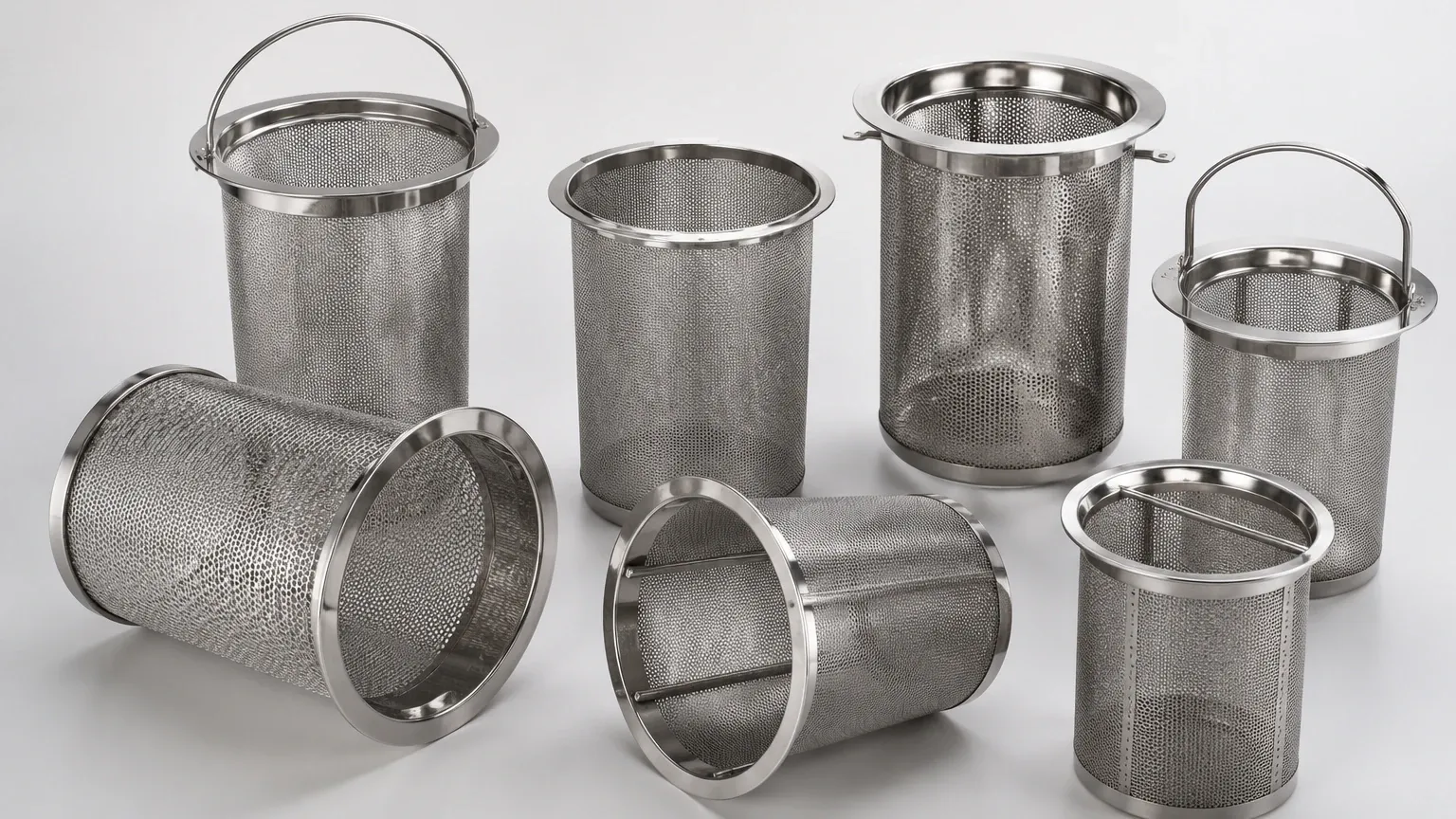
When finer filtration is required, a strainer basket insert is lined with stainless steel wire mesh. In this configuration, the perforated metal acts as a "backup" or cage, providing the mechanical strength necessary to prevent the mesh from collapsing or bursting under the force of the fluid flow. The mesh is typically spot-welded or seam-welded to the support structure to ensure no bypass occurs.
Flow Dynamics and Pressure Drop
Engineers must calculate the "clean pressure drop" (Delta P) across the insert. As the basket collects debris, the effective open area decreases, leading to an increase in pressure. If the insert is not sized correctly—specifically if the ratio of the basket's open area to the pipe's cross-sectional area is too low—the system will experience frequent downtime for cleaning. A common industry standard is to aim for a 6:1 or 8:1 area ratio to ensure longevity between maintenance cycles.
Material Selection and Chemical Compatibility
Material selection is perhaps the most critical factor in ensuring the durability of a strainer basket insert. Since these components are often submerged in corrosive or high-temperature fluids, selecting the appropriate stainless steel grade is essential for preventing premature failure.
1. 304 Stainless Steel: The most common choice for general industrial applications, including water treatment and some food processing. It offers excellent cost-effectiveness and good corrosion resistance.
2. 316L Stainless Steel: Preferred for pharmaceutical, chemical, and marine applications. The addition of molybdenum provides superior resistance to chlorides and pitting, making it essential for environments involving brine or acidic chemicals.
3. Specialty Alloys: For highly aggressive environments, inserts can be manufactured from Monel, Hastelloy, or Titanium. These are typically reserved for applications where standard stainless steels would suffer from rapid stress corrosion cracking or chemical erosion.
Beyond the metal itself, engineers must consider the compatibility of seals and gaskets. If the insert requires a flange seal to prevent bypass, the elastomer (such as Viton, EPDM, or PTFE) must be rated for the process fluid and temperature.
Customization and OEM Considerations
Off-the-shelf inserts often fail to meet the rigorous demands of specialized industrial equipment. Customization allows for the optimization of the insert to the specific geometry of the strainer housing and the unique characteristics of the contaminant.
Structural Reinforcements
In high-viscosity applications or systems with high-pressure surges (water hammer), a standard strainer basket insert might deform. Custom reinforcements, such as longitudinal support bars, heavy-duty top rings, and reinforced bottoms, can be integrated into the design. These additions ensure the basket maintains its shape even when nearly full of debris.
Handle and Lifting Configurations
For large-scale industrial strainers, the weight of a debris-filled basket can be significant. Custom handle designs—such as heavy-duty bale handles, dual handles, or threaded lift-outs—facilitate safer and faster removal during maintenance. In some cases, slanted or offset baskets are required to fit specific housing orientations, such as Y-strainers or T-strainers.
Specialized Coatings and Finishes
In the food and beverage industry, the surface finish of the insert is paramount. Electropolishing can be applied to the stainless steel to remove surface irregularities, reducing the risk of bacterial growth and making the basket easier to clean (CIP – Clean-in-Place). For abrasive applications, specialized coatings can be applied to extend the wear life of the mesh.
Performance Evaluation: Micron Ratings and Efficiency
Understanding the difference between nominal and absolute filtration is vital when specifying a strainer basket insert.
* Nominal Rating: This refers to the ability of the insert to retain a majority of particles of a specific size (e.g., 90% of 100-micron particles). This is usually sufficient for protecting pumps or preventing large debris from entering a system.
* Absolute Rating: This indicates that 99.9% or more of particles of a specific size will be captured. This level of precision is often required in pharmaceutical or fine chemical processes where even trace contamination can ruin a batch.
Engineers should also evaluate the "dirt-holding capacity." A basket with a deeper profile or a pleated mesh design provides more surface area, allowing it to hold more contaminants before the pressure drop reaches the critical change-out point. This directly impacts the operational efficiency of the plant by reducing the frequency of manual interventions.
Maintenance, Cleaning, and Replacement Cycles
A well-engineered strainer basket insert is a reusable asset, but its lifespan is determined by the quality of maintenance.
Cleaning Protocols
Depending on the contaminant, cleaning methods may include:
* Backwashing: Reversing the flow of fluid to dislodge particles from the mesh.
* Ultrasonic Cleaning: Using high-frequency sound waves in a solvent bath to remove fine particles trapped deep within the wire mesh weave.
* Chemical Soaking: Utilizing acids or bases to dissolve organic or mineral buildup, provided the basket material is compatible.
Signs of Fatigue
During routine inspections, maintenance teams should look for "blinded" areas where mesh openings are permanently blocked, as well as signs of wire fatigue or broken welds. If the mesh begins to pull away from the support cage, the risk of bypass increases significantly. A bypass of even a small percentage of fluid can lead to catastrophic failure of high-precision downstream components.
Replacement Planning
While stainless steel inserts are durable, they are not infinite. Establishing a replacement cycle based on the "fatigue life" of the mesh—especially in systems with frequent pressure fluctuations—is a best practice for risk mitigation. Keeping spare inserts on-site is essential to prevent extended downtime during unexpected cleaning or failure events.
Total Cost of Ownership (TCO) and Procurement
When purchasing a strainer basket insert, the initial price is only one component of the total cost. Technical professionals must consider the long-term operational impact of their choice.
* Energy Costs: A poorly designed insert with a high initial pressure drop forces pumps to work harder, increasing energy consumption over the life of the system.
* Labor Costs: Inserts that are difficult to clean or require frequent replacement drive up labor costs and reduce plant uptime.
* Equipment Protection: The cost of a high-quality insert is negligible compared to the cost of repairing a damaged centrifugal pump or replacing a fouled heat exchanger bundle.
By partnering with a manufacturer that understands the nuances of industrial filtration, such as Kaifil, procurement teams can ensure they receive components that are not only dimensionally accurate but also engineered for the specific rigors of their industry. Custom OEM solutions allow for the integration of unique features that simplify maintenance and maximize the service life of the filtration system.
Conclusion for Technical Professionals
The strainer basket insert is the frontline of defense in industrial fluid systems. Its selection requires a deep understanding of the process conditions, including flow rate, pressure, temperature, and chemical composition. By focusing on structural integrity, precise micron ratings, and high-quality stainless steel construction, engineers can optimize their systems for reliability and efficiency. When evaluating suppliers, prioritize those who offer technical transparency and the ability to customize designs to meet the exact needs of your application.
