


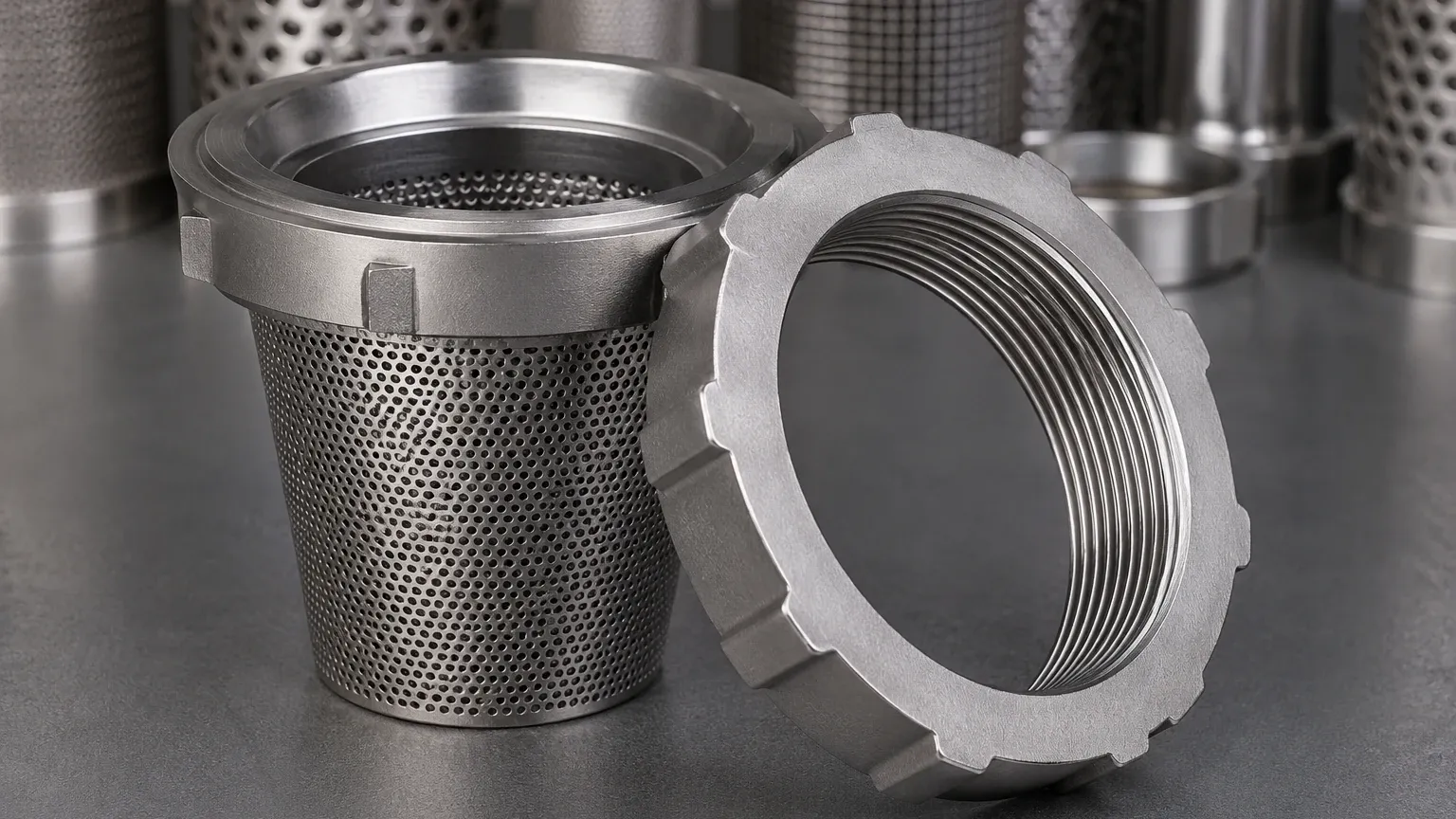
Basket Strainer Joint Nut
In industrial fluid handling and filtration systems, the integrity of the assembly depends not only on the primary filter element but also on the precision hardware that secures the system. The basket strainer joint nut is a critical mechanical component designed to provide the necessary clamping force and sealing pressure for industrial strainers. Whether used in simplex or duplex configurations, this fastener ensures that the strainer basket remains seated correctly and that the housing lid or flange connection maintains a leak-proof seal under varying pressure and temperature conditions.
For engineers and procurement teams, understanding the technical specifications of a basket strainer joint nut is essential for maintaining system uptime and preventing bypass or external leakage. This guide examines the engineering considerations, material selection, and maintenance protocols required for these specialized components within the context of high-performance Strainers & Baskets.
The Functional Role of the Joint Nut in Filtration Systems
The primary function of a basket strainer joint nut is to convert rotational torque into axial tension. In the context of industrial filtration, this tension is applied to the bolts or studs that hold the strainer cover or the internal basket assembly in place.
In high-flow applications, such as chemical processing or water treatment, the internal pressure can exert significant force against the strainer cover. The joint nut must be capable of maintaining its preload to resist these forces. If a nut fails or loosens, the resulting loss of compression on the gasket or O-ring can lead to several issues:
1. Fluid Bypass: If the internal basket is not held firmly against its seat, unfiltered fluid may bypass the mesh, leading to downstream contamination.
2. External Leakage: A failure in the cover joint nut can result in hazardous or costly fluid escaping into the environment.
3. Vibration Damage: In systems with high turbulence, loose hardware can lead to mechanical vibration, which accelerates wear on the basket and housing threads.
Material Selection and Corrosion Resistance
Since basket strainers are frequently used in corrosive environments—ranging from saline water to acidic chemical streams—the material of the basket strainer joint nut is a paramount consideration. Kaifil typically utilizes high-grade stainless steel to ensure longevity and mechanical reliability.
304 Stainless Steel
Standard industrial applications often utilize Type 304 stainless steel. It offers excellent strength and good corrosion resistance for general-purpose filtration in food and beverage or HVAC systems. It is cost-effective but may be susceptible to pitting in high-chloride environments.
316/316L Stainless Steel
For pharmaceutical, chemical, and marine applications, Type 316 stainless steel is the preferred choice. The addition of molybdenum enhances resistance to chloride-induced pitting and crevice corrosion. In systems where welding is required near the joint, the low-carbon variant (316L) is used to prevent sensitization and intergranular corrosion.
Specialty Alloys
In extreme environments involving highly aggressive chemicals or high temperatures, joint nuts may be manufactured from duplex stainless steel or nickel-based alloys. These materials provide superior yield strength and resistance to stress corrosion cracking (SCC), which is vital for high-pressure industrial Strainers & Baskets.
Technical Specifications: Threads and Sizing
Precision in thread manufacturing is what separates industrial-grade fasteners from standard hardware. A basket strainer joint nut must adhere to strict dimensional tolerances to ensure a proper fit with the corresponding studs or bolts.
Thread Profiles
Common thread standards include Unified National Coarse (UNC) for general heavy-duty applications and Metric (M) threads for international equipment standards. In some specialized filtration housings, fine threads (UNF) may be used to allow for more precise torque application and better resistance to loosening under vibration.
Manufacturing Tolerances
Precision machining ensures that the load is distributed evenly across all engaged threads. Uneven load distribution can lead to localized stress concentrations, which may cause the nut to strip or the stud to fail prematurely. For critical filtration components, Class 2B or 3B thread fits are often specified to ensure high-quality engagement.
Preventing Mechanical Failure: Galling and Torque Management
One of the most common issues encountered by maintenance teams when dealing with stainless steel fasteners is "galling" or cold welding. This occurs when the protective oxide layer on the stainless steel surface is rubbed off during tightening, causing the metal surfaces to fuse together.
Anti-Galling Strategies
To prevent galling on a basket strainer joint nut, several engineering steps are taken:
* Lubrication: Applying a high-quality anti-seize compound (specifically formulated for stainless steel) is the most effective way to prevent thread fusion.
* Material Pairing: Using different grades of stainless steel for the nut and the bolt (e.g., a 316 nut on a 304 stud) can reduce the likelihood of galling due to differences in material hardness.
* Surface Treatments: Some nuts are treated with specialized coatings or passivated to increase surface hardness and reduce friction.
Torque Requirements
Proper installation requires the use of calibrated torque wrenches. Over-tightening a joint nut can stretch the stud beyond its elastic limit, leading to permanent deformation or catastrophic failure. Conversely, under-tightening results in insufficient gasket compression. Engineers must refer to the manufacturer’s specifications for the correct torque values based on the gasket material and system pressure rating.
Maintenance Protocols for Strainer Hardware
Industrial filtration systems require regular maintenance, which usually involves opening the strainer housing to clean or replace the basket. During these cycles, the basket strainer joint nut should be inspected as part of a standard preventive maintenance program.
Inspection Checklist
1. Visual Wear: Check for signs of thread deformation, rounding of the hex flats, or visible corrosion.
2. Contamination: Ensure threads are free of debris, scale, or dried process fluids that could interfere with proper tightening.
3. Integrity of Washers: Check that any associated lock washers or flat washers are not flattened or cracked.
Replacement Cycles
While a basket strainer joint nut is designed for multiple uses, it is not an infinite-life component. In high-cycle applications where the strainer is opened daily, the hardware should be replaced periodically to ensure that thread fatigue does not compromise the safety of the pressure vessel. If a nut shows any resistance to hand-tightening before torque is applied, it is an indication of thread damage and should be replaced immediately.
Custom Engineering and OEM Solutions
In many industrial settings, standard off-the-shelf fasteners may not meet the specific requirements of a custom filtration system. Factors such as restricted space, extreme pressure, or the need for rapid-opening mechanisms require customized hardware solutions.
Kaifil specializes in the production of precision metal filtration components, including custom-designed Strainers & Baskets. Our engineering team works with clients to determine the optimal configuration for joint nuts and closure hardware, ensuring compatibility with the specific chemical and thermal profiles of the application. By controlling the manufacturing process from material selection to final machining, we provide components that meet the rigorous demands of the chemical, pharmaceutical, and water treatment industries.
Conclusion: The Importance of Precision Hardware
The basket strainer joint nut may appear to be a simple component, but its role in the safety and efficiency of industrial filtration is indispensable. By selecting the correct materials, adhering to precise thread standards, and following rigorous installation and maintenance protocols, facilities can significantly reduce the risk of system failure.
When evaluating filtration solutions, it is vital to consider the quality of the entire assembly. High-performance Strainers & Baskets require equally high-performance hardware to ensure that the filtration process remains consistent and reliable over the long term. For technical professionals and purchasing teams, prioritizing the quality of these small but essential components is a key step in optimizing total cost of ownership and operational safety.
