


Basket Strainer Lowes
When engineers or procurement specialists begin researching filtration components, the search term "basket strainer lowes" often appears. While big-box retailers like Lowe's are excellent resources for residential plumbing and light commercial maintenance, industrial applications require a significantly different level of engineering, material certification, and performance capability. For professionals operating in chemical processing, food and beverage production, or heavy-duty hydraulic systems, understanding the distinction between consumer-grade hardware and industrial Strainers & Baskets is critical for system longevity and operational safety.
In this technical guide, we will examine the engineering requirements of industrial basket strainers, compare them to retail-grade options, and outline the selection criteria necessary for demanding industrial environments.
Understanding the Intent Behind "Basket Strainer Lowes" Searches
The search for "basket strainer lowes" typically stems from two distinct needs. The first is a residential or light commercial requirement, such as a replacement for a kitchen sink or a standard utility drain. These products are designed for low-pressure, ambient temperature, and non-corrosive environments. They are mass-produced with standard dimensions to fit common household plumbing fixtures.
The second intent, often held by maintenance professionals or junior engineers, is to find a quick, off-the-shelf solution for a facility problem. However, in an industrial B2B context, the limitations of retail-grade strainers become apparent almost immediately. Industrial systems involve high flow rates, aggressive chemicals, extreme temperatures, and strict regulatory compliance (such as FDA or ASME standards). A strainer designed for a home kitchen cannot withstand the 150 PSI or 300 PSI pressures common in industrial piping, nor can it provide the precise micron-level filtration required to protect expensive downstream equipment like pumps and flow meters.
Material Integrity: Why Industrial Grades Matter
One of the primary differences between a generic basket strainer and an industrial component is the metallurgy. Retail products found through a search for "basket strainer lowes" are often made from thin-gauge stainless steel (often 304 grade or lower) or chrome-plated brass. While these materials are sufficient for domestic water, they lack the durability required for industrial processing.
304 vs. 316L Stainless Steel
In industrial filtration, 316L stainless steel is the standard for corrosive environments. The addition of molybdenum in 316L provides superior resistance to pitting and crevice corrosion in chloride-rich environments. For chemical processing plants or marine applications, using a lower-grade 304 stainless steel strainer can lead to premature failure and system contamination.
Construction Methods
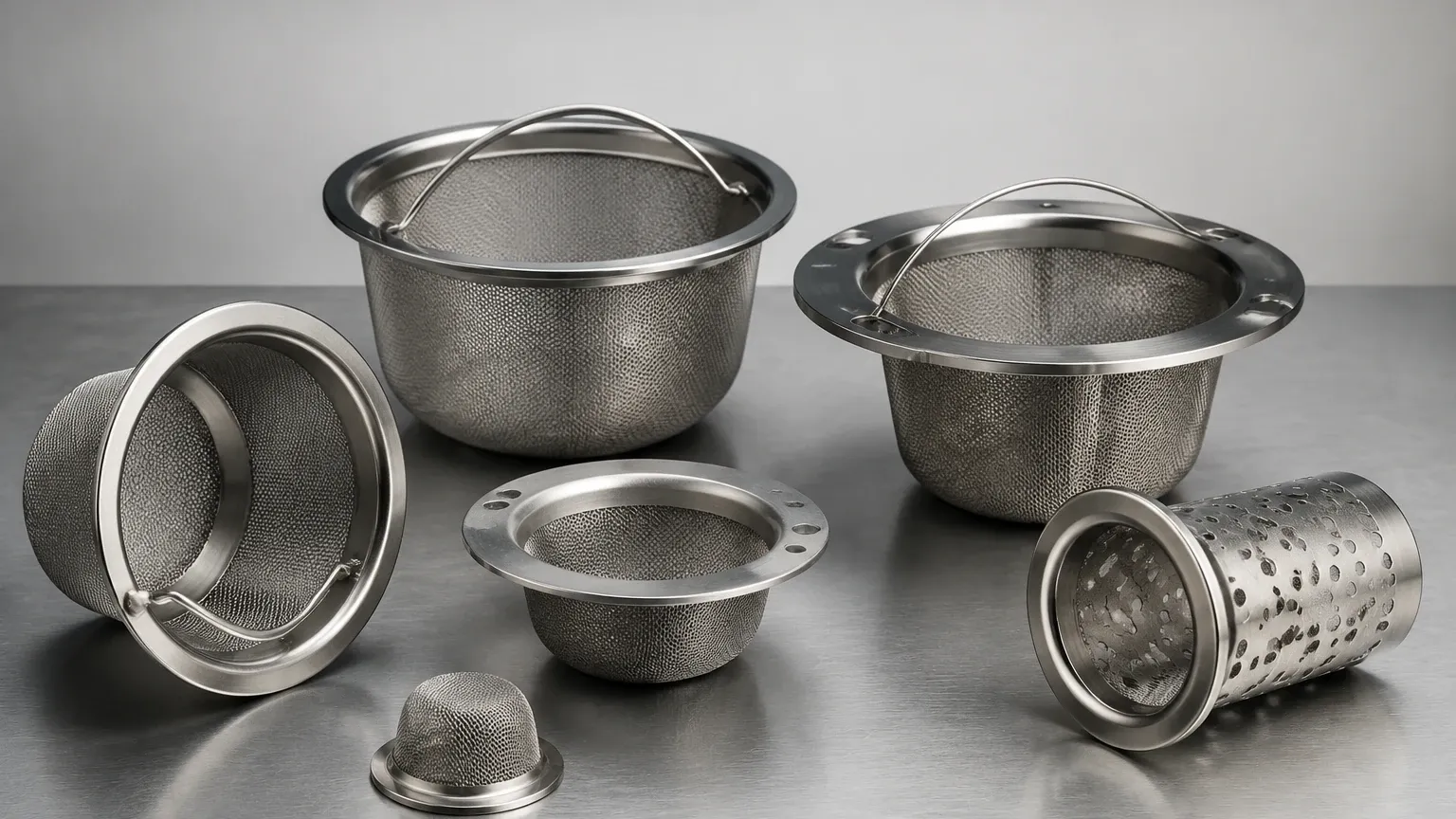
Industrial Strainers & Baskets are typically constructed using heavy-duty perforated plate reinforced with high-precision wire mesh. The seams are often TIG (Tungsten Inert Gas) welded to ensure structural integrity under high differential pressure. In contrast, retail strainers often use mechanical crimping or light spot welding, which can fail when subjected to the hydraulic shock or high-viscosity fluids common in industrial lines.
Performance Criteria for Industrial Filtration
When moving beyond the scope of a "basket strainer lowes" search, engineers must evaluate several technical parameters to ensure the filtration component is fit for purpose.
1. Filtration Accuracy and Micron Ratings
Retail strainers generally offer a single, coarse mesh size designed to catch large debris like food particles or hair. Industrial baskets, however, are engineered for specific micron ratings. Whether the application requires removing 5-micron particles from a hydraulic fluid or 500-micron solids from a cooling water loop, the mesh must be precisely woven and calibrated. Industrial manufacturers provide certified mesh counts and wire diameters to guarantee filtration efficiency.
2. Pressure Drop (Delta P)
Every filter or strainer introduces a restriction to the flow. In industrial systems, calculating the pressure drop is essential to ensure the pump can maintain the required flow rate. Industrial strainers are designed with a high "open area ratio"—often 6:1 or 8:1 relative to the pipe cross-section—to minimize pressure loss and extend the time between cleaning cycles. Retail-grade strainers rarely provide the technical data sheets necessary for these engineering calculations.
3. Flow Capacity and Viscosity
Industrial fluids range from water-like liquids to high-viscosity polymers and oils. The design of the basket—including the handle type, the slant of the basket walls, and the reinforcement ribs—must be optimized for the specific fluid dynamics of the application. High-viscosity fluids require more robust internal support to prevent the mesh from collapsing under pressure.
Customization and Engineering Considerations
A significant limitation of off-the-shelf retail products is the lack of customization. In a professional B2B environment, filtration components must often be tailored to existing infrastructure or unique process requirements. Industrial manufacturers like Kaifil specialize in providing customized solutions that go far beyond standard retail offerings.
Custom Dimensions and Connections
While a "basket strainer lowes" search will return standard 1.5-inch or 2-inch drain sizes, industrial systems may require strainers for 6-inch, 12-inch, or even larger pipelines. Furthermore, the connections must match the system's specifications, whether they are flanged (ANSI, DIN, JIS), threaded (NPT, BSPT), or sanitary tri-clamp fittings.
Specialized Linings and Coatings
For highly aggressive chemical applications, stainless steel baskets may need additional treatments, such as electropolishing to improve surface finish and reduce bacterial growth in food-grade applications, or specialized coatings for extreme chemical resistance. These modifications are not available in mass-market retail products.
Total Cost of Ownership vs. Initial Purchase Price
It is tempting to look at the low price point of a consumer basket strainer and consider it a cost-saving measure. However, for industrial operations, the initial purchase price is only a small fraction of the Total Cost of Ownership (TCO).
Durability and Replacement Cycles
A retail-grade strainer used in an industrial setting may need to be replaced every few months due to corrosion or mechanical fatigue. In contrast, a high-quality industrial basket is designed for years of service. The cost of downtime—the time the production line is halted to replace a failed filter—far outweighs the savings of a cheaper component.
Cleanability and Maintenance
Industrial Strainers & Baskets are engineered for easy maintenance. Features like heavy-duty handles, reinforced bottoms, and smooth interior surfaces allow for rapid cleaning and debris removal. This reduces labor costs and ensures that the system returns to peak efficiency quickly after a maintenance cycle.
Selecting the Right Solution for Demanding Environments
For engineers and purchasing teams, the transition from searching for a "basket strainer lowes" to sourcing a professional industrial component involves a shift in focus from "price and availability" to "specification and reliability." To select the correct filtration component, consider the following checklist:
* Fluid Compatibility: Is the material (304, 316L, or specialty alloy) compatible with the chemical composition of the process fluid?
* Operating Pressure and Temperature: What are the maximum peaks the system will experience, and can the strainer housing and element withstand them?
* Required Filtration Level: What is the smallest particle size that must be removed to protect downstream equipment?
* Flow Rate: What is the maximum GPM (gallons per minute) or m³/h required, and what is the allowable pressure drop?
* Regulatory Compliance: Does the application require FDA, 3A, or ASME certification?
Conclusion
While a search for "basket strainer lowes" might provide a solution for a home repair, it is rarely the appropriate starting point for industrial filtration procurement. The demands of modern manufacturing—ranging from pharmaceutical purity to chemical stability—require precision-engineered components. By focusing on material quality, technical performance data, and customization capabilities, engineers can ensure they implement a filtration solution that protects their equipment and optimizes their process.
For those requiring reliable, high-performance filtration components tailored to specific industrial needs, exploring professional Strainers & Baskets ensures that the selected product meets the rigorous standards of the B2B sector. Investing in industrial-grade filtration is an investment in the safety, efficiency, and longevity of the entire production facility.
