


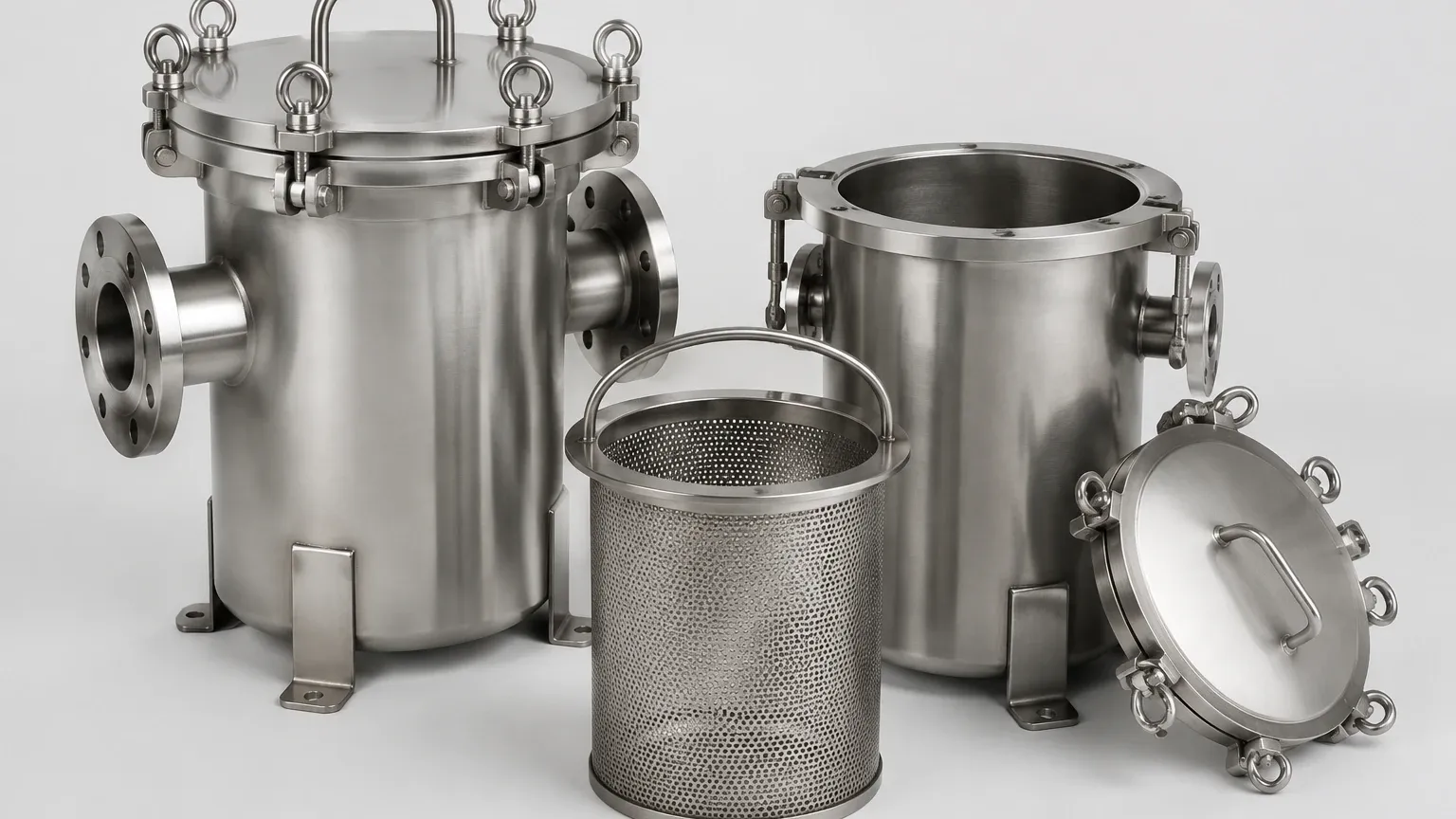
Large Basket Strainer
In industrial fluid handling, the efficiency of a piping system often depends on the reliability of its protection mechanisms. A large basket strainer serves as a primary defense for downstream equipment, such as pumps, valves, and heat exchangers, by removing unwanted solids from the process flow. Unlike smaller, standard-sized components, large-scale strainers are engineered to handle high flow rates and significant debris loads while maintaining a manageable pressure drop. For engineers and procurement teams, selecting the correct Strainers & Baskets involves a deep understanding of fluid dynamics, material compatibility, and mechanical structural integrity.
Understanding the Role of Strainers & Baskets in Industrial Filtration
Industrial filtration systems rely on various components to ensure fluid purity and equipment longevity. Within the broader category of filtration hardware, the distinction between a strainer and a filter is primarily defined by the size of the particles being removed. Strainers are typically used for coarser filtration, often measured in mesh sizes or millimeters, whereas filters handle finer particulate matter in the micron range.
A large basket strainer is specifically designed for high-capacity applications where the volume of fluid and the potential for debris accumulation are substantial. These components are characterized by their "basket" shape, which provides a significantly larger surface area than Y-strainers or T-strainers. This increased surface area is critical because it allows for a higher "dirt-holding capacity," meaning the system can operate for longer periods between cleaning cycles without experiencing a critical drop in flow pressure.
For industries such as chemical processing, water treatment, and power generation, the basket strainer is a standard requirement. In these environments, the cost of equipment failure or unplanned downtime far exceeds the initial investment in a high-quality, precision-engineered strainer. By capturing pipe scale, weld slag, and foreign objects, these baskets ensure that the internal components of expensive machinery remain undamaged.
Sizing and Flow Dynamics for a Large Basket Strainer
The most critical phase in the procurement of a large basket strainer is the engineering sizing. A common mistake is selecting a strainer based solely on the pipe size. While the flange size must match the piping, the internal dimensions and the open area of the basket are what dictate performance.
Open Area Ratio (OAR)
An essential metric for any engineer is the Open Area Ratio. This is the ratio between the total open area of the strainer basket (the sum of the areas of all the holes or mesh openings) and the internal cross-sectional area of the inlet pipe. For a large basket strainer, a minimum OAR of 6:1 is often recommended. A higher OAR ensures that even as the basket begins to fill with debris, the fluid has enough alternative paths to pass through, preventing a rapid increase in differential pressure.
Pressure Drop Calculations
Every component in a pipeline introduces a pressure drop (delta P). In high-flow systems, an excessive pressure drop can lead to cavitation in pumps or reduced system efficiency. Engineers must calculate the clean pressure drop using the fluid's viscosity, specific gravity, and flow rate. Because a large basket strainer is designed for high volumes, the housing design must also be optimized to minimize turbulence as the fluid enters and exits the basket chamber.
Material Selection: Evaluating Stainless Steel Grades
Material selection is the primary factor in determining the service life of a strainer. In most industrial applications, stainless steel is the preferred material due to its mechanical strength and resistance to corrosion. Kaifil specializes in manufacturing these components from various grades of stainless steel to meet specific environmental challenges.
SS304 vs. SS316L
* Stainless Steel 304: This is the standard grade for many industrial applications. It offers excellent durability and good corrosion resistance for water and mildly corrosive chemicals. It is a cost-effective choice for general industrial use where extreme chemical resistance is not required.
* Stainless Steel 316L: For more demanding environments, such as pharmaceutical manufacturing or chemical processing, 316L is the preferred choice. The addition of molybdenum provides superior resistance to chlorides and pitting. The "L" denotes low carbon content, which is essential for components that require welding, as it prevents carbide precipitation and ensures the integrity of the weld joints under stress.
Gasket and Seal Compatibility
Beyond the metal housing and basket, the choice of sealing materials is vital. Depending on the temperature and chemical nature of the fluid, seals may be constructed from EPDM, Viton (FKM), or PTFE. A large basket strainer often features a quick-opening cover design, which requires a reliable O-ring or gasket to maintain a leak-proof seal under high operating pressures.
Structural Design and Filtration Media Options
The mechanical integrity of a large basket strainer is tested by the weight of the debris it captures and the pressure of the fluid pushing against it. For large-diameter baskets, simple wire mesh is rarely sufficient on its own.
Perforated Metal Support
Most industrial baskets utilize a perforated metal plate as the primary structural element. This plate provides the necessary rigidity to withstand differential pressure. The hole size in the perforated plate can range from 1/32" to 1/2" or larger, depending on the application.
Wire Mesh Linings
When finer filtration is required, the perforated basket is lined with a precision-woven wire mesh. This combination allows for fine particulate removal (down to 20 microns or 400 mesh) while maintaining the structural strength of the perforated backing. In high-pressure systems, engineers may specify a "multi-layer" construction where the mesh is sintered or mechanically fastened between two perforated layers to prevent mesh migration or collapse.
Handle and Lifting Mechanisms
Because a large basket strainer can become quite heavy when full of debris and saturated with fluid, the design must include ergonomic features. Heavy-duty handles or lifting lugs are standard on large baskets to facilitate safe removal during maintenance. Some custom designs also include slanted bottoms or specialized drain plugs to assist in the evacuation of sludge before the basket is lifted.
Maintenance, Cleaning, and Total Cost of Ownership
From a purchasing perspective, the total cost of ownership (TCO) of a strainer is not just the purchase price, but the cumulative cost of maintenance, energy loss due to pressure drop, and replacement frequency.
Differential Pressure Monitoring
To optimize the cleaning cycle, it is recommended to install differential pressure gauges across the strainer inlet and outlet. A typical guideline is to clean or replace the basket when the pressure drop reaches 5-10 psi over the clean pressure drop. Waiting too long can result in "basket burst," where the pressure differential exceeds the structural limits of the mesh, allowing contaminants to bypass the strainer and enter the downstream system.
Cleaning Protocols
Stainless steel baskets are designed to be reusable. Cleaning typically involves removing the basket and using a high-pressure water jet or ultrasonic cleaning for fine mesh. In applications involving sticky or viscous fluids, chemical cleaning may be necessary. The durability of stainless steel ensures that these baskets can undergo hundreds of cleaning cycles without losing their filtration accuracy.
Customization and OEM Specification Requirements
Many industrial projects involve unique constraints that standard off-the-shelf strainers cannot meet. This is where custom manufacturing and OEM capabilities become essential. When specifying a custom large basket strainer, engineers should provide the following data points to the manufacturer:
1. Fluid Characteristics: Viscosity, specific gravity, and chemical composition.
2. Operating Parameters: Maximum operating pressure (PSIG) and temperature range.
3. Flow Rate: Normal and maximum flow rates (GPM or m³/h).
4. Filtration Target: The size of the smallest particle that must be removed.
5. Connection Type: Flanged (ANSI, DIN, JIS), threaded, or socket weld.
6. Space Constraints: Height and width limitations for the housing installation.
Customizations can include specialized coatings, non-standard flange orientations, or the integration of magnetic inserts to capture fine ferrous particles that might otherwise pass through the mesh. By working closely with a manufacturer like Kaifil, engineering teams can ensure that the final product is perfectly matched to the specific demands of their process environment.
Conclusion
A large basket strainer is a vital component in the infrastructure of any high-volume fluid system. By prioritizing correct sizing, selecting high-grade materials like SS316L, and ensuring a robust structural design, facilities can significantly reduce their maintenance overhead and protect their most valuable equipment. When evaluating options for Strainers & Baskets, focusing on technical specifications and engineering data rather than just the initial cost will lead to better long-term system performance and reliability.
