


Basket Strainers Stainless Steel
In industrial fluid handling, the protection of downstream equipment—such as pumps, valves, flow meters, and heat exchangers—is a critical operational requirement. Basket strainers serve as the primary line of defense against particulate contamination, scale, and debris. When these components are fabricated from stainless steel, they offer a combination of mechanical strength, chemical resistance, and thermal stability that is essential for demanding B2B environments. Understanding the technical nuances of basket strainers stainless steel is vital for engineers and procurement teams tasked with maintaining system integrity and optimizing total cost of ownership.
The Role of Stainless Steel Basket Strainers in Industrial Systems
A basket strainer is a closed vessel with a removable screen element designed to trap and remove foreign particles from a process stream. Unlike Y-strainers, which are often used for smaller pipelines or where debris loading is minimal, basket strainers are engineered for larger flow volumes and higher dirt-holding capacities. The "basket" design provides a larger surface area for filtration, which directly translates to longer service intervals and lower pressure drops.
Strainers & Baskets are utilized across various sectors, including chemical processing, food and beverage production, pharmaceutical manufacturing, and hydraulic systems. The choice of stainless steel as the base material is rarely optional in these industries; it is a requirement driven by the need to prevent fluid contamination and to withstand corrosive cleaning agents or aggressive process chemicals.
Material Selection: Comparing 304 and 316L Stainless Steel
When specifying basket strainers stainless steel, the selection of the specific alloy grade is the most impactful decision regarding the component's lifespan. While several stainless alloys exist, 304 and 316L are the industry standards.
Grade 304 Stainless Steel
Grade 304 is the most common austenitic stainless steel. It contains approximately 18% chromium and 8% nickel. It provides excellent corrosion resistance for most atmospheric conditions and many organic and inorganic chemicals. In applications involving water treatment, food processing (where chloride levels are low), and general industrial hydraulics, 304 stainless steel offers a cost-effective balance of durability and performance.
Grade 316L Stainless Steel
Grade 316L includes molybdenum (typically 2-3%), which significantly enhances its resistance to pitting and crevice corrosion, particularly in chloride-rich environments. The "L" designation stands for "Low Carbon," which minimizes carbide precipitation during welding, ensuring the structural integrity of the strainer housing and the basket mesh in high-temperature or high-pressure applications. This grade is the preferred choice for marine environments, pharmaceutical processes, and aggressive chemical filtration where 304 might fail due to localized corrosion.
Engineering Parameters: Flow Rate and Pressure Drop
The efficiency of a basket strainer is measured by its ability to remove contaminants without significantly impeding the flow of the process fluid. Engineers must calculate the "Clean Pressure Drop" (initial Delta P) and the "Maximum Allowable Pressure Drop" before the basket requires cleaning.
Open Area Ratio (OAR)
The Open Area Ratio is the relationship between the total area of the strainer openings and the cross-sectional area of the inlet pipe. A standard industrial basket strainer should typically have an OAR of at least 6:1. A higher OAR ensures that even as the basket begins to collect debris, the increase in pressure drop remains gradual. For high-viscosity fluids, such as heavy oils or syrups, an even higher OAR may be required to maintain system efficiency.
Velocity and Viscosity
Flow velocity is another critical factor. High velocities can cause turbulence and increase the rate of erosion on the internal surfaces of the strainer. Furthermore, the viscosity of the fluid affects how easily it passes through the filtration media. As viscosity increases, the pressure drop across the basket increases exponentially, necessitating larger strainer bodies or coarser filtration levels to prevent pump cavitation or system failure.
Filtration Media: Perforated Metal vs. Wire Mesh
The internal element of basket strainers stainless steel can be constructed using various media types, depending on the required filtration accuracy.
1. Perforated Plate: This is the most robust form of filtration media. It consists of a stainless steel sheet with punched holes. It is typically used for coarse filtration (removing particles 1/2" down to 1/32"). Perforated plates serve as excellent support structures for finer mesh linings.
2. Woven Wire Mesh: For finer filtration requirements, stainless steel wire mesh is utilized. Mesh is defined by the number of openings per linear inch. For example, a 100-mesh screen has 100 openings per inch, capable of trapping much smaller particles than a standard perforated plate.
3. Sintered Metal: In high-pressure or high-precision applications, multiple layers of wire mesh may be sintered (diffusion bonded) together. This creates a rigid, high-strength filter element that can withstand significant differential pressure without deforming.
In many custom configurations, a heavy-gauge perforated basket acts as the "skeleton," providing mechanical strength, while a fine wire mesh liner provides the actual filtration. This dual-layer approach ensures that the basket can handle the physical weight of the trapped debris without collapsing.
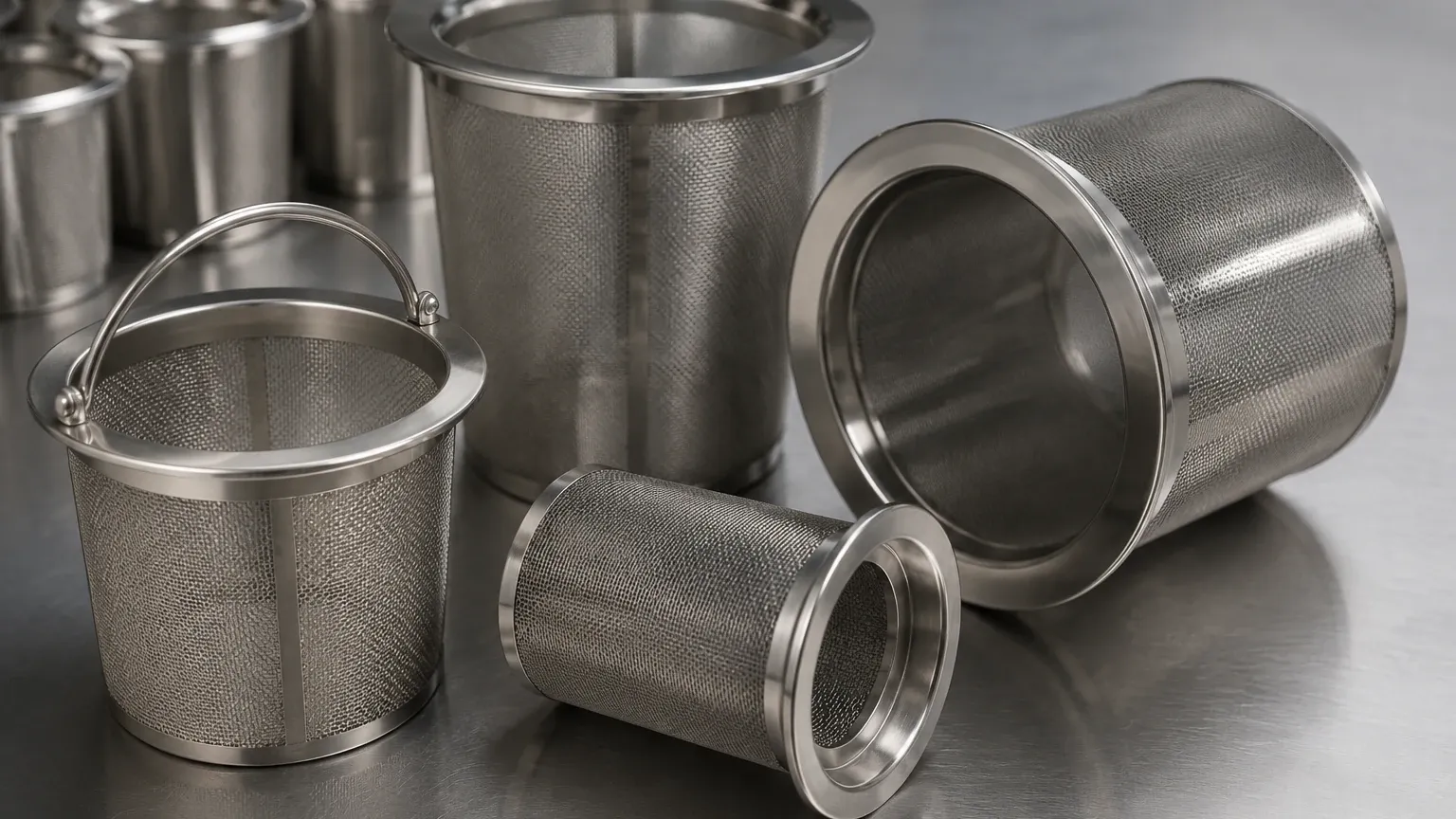
Design Configurations: Simplex, Duplex, and Custom Baskets
The operational requirements of the facility dictate the housing configuration of the strainer.
Simplex Strainers
Simplex strainers are used in batch processes where the system can be shut down periodically to remove and clean the basket. They are simpler in design and more economical, making them suitable for applications where the fluid is relatively clean and cleaning cycles are infrequent.
Duplex (Twin) Strainers
In continuous flow applications—such as power plants, refineries, or cooling water systems—shutdowns for cleaning are not feasible. Duplex strainers consist of two separate strainer chambers connected by a diverter valve. When one basket becomes clogged, the flow is diverted to the second chamber, allowing the first basket to be cleaned without interrupting the process. This ensures 100% uptime and protects critical machinery around the clock.
Custom Basket Geometries
Standard off-the-shelf strainers may not fit specialized equipment footprints. Custom-manufactured basket strainers stainless steel allow for specific inlet/outlet orientations (e.g., offset, right-angle), specialized closure mechanisms (e.g., quick-opening swing bolts for tool-free maintenance), and unique basket depths to accommodate specific debris volumes.
Maintenance and Operational Longevity
The total cost of ownership for a filtration system is heavily influenced by maintenance requirements. Stainless steel's primary advantage is its cleanability. Unlike disposable filters, stainless steel baskets are designed to be washed, ultrasonically cleaned, or chemically de-scaled and returned to service.
Monitoring Differential Pressure
To prevent damage to the strainer element or downstream pumps, systems should be equipped with differential pressure gauges. A sudden spike in Delta P indicates that the basket is reaching its capacity. If left uncleaned, the pressure can cause "blow-by," where the basket deforms or the seal fails, allowing contaminants to bypass the filter and enter the sensitive parts of the system.
Gasket and Seal Compatibility
While the basket and housing are stainless steel, the seals (O-rings or gaskets) must be compatible with the process fluid. Common materials include EPDM, Viton (FKM), and PTFE. Selecting the wrong seal material can lead to leaks, even if the stainless steel components remain in perfect condition.
Selection Checklist for Procurement and Engineering Teams
When sourcing basket strainers stainless steel, confirming the following technical details with the manufacturer will ensure the product meets the specific needs of the application:
* Fluid Characteristics: What is the chemical composition, temperature range, and viscosity of the fluid?
* Particulate Size: What is the smallest particle size that must be removed to protect downstream equipment? (This determines the mesh or perforation size).
* Flow Rate: What are the minimum, normal, and maximum flow rates expected in the system?
* Pressure Rating: What is the maximum operating pressure and the design pressure of the piping system?
* Connection Type: Are flanged, threaded, or socket-weld connections required to match existing piping?
* Compliance Standards: Does the application require FDA-compliant materials for food contact, or 3-A sanitary standards for pharmaceuticals?
By addressing these factors during the design and procurement phase, industrial operators can ensure that their filtration solutions provide reliable, long-term protection. High-quality stainless steel components, engineered to precise specifications, reduce the risk of unplanned downtime and extend the service life of the entire fluid handling system.
