


Cell Strainers 70um
In industrial and laboratory filtration, the precision of particle separation is paramount to the success of downstream processes. The 70-micrometer (70um) threshold represents a critical specification in various biological, chemical, and pharmaceutical applications. While often associated with laboratory-scale cell dissociation, the engineering principles behind cell strainers 70um extend into large-scale industrial filtration systems. For engineers and procurement specialists, understanding the technical nuances of these components is essential for optimizing flow rates, ensuring filtrate purity, and maintaining equipment longevity.
Industrial filtration requires more than just a specific pore size; it demands structural integrity, chemical compatibility, and consistent performance under pressure. When scaling from benchtop experiments to full production lines, the transition from disposable plastic strainers to robust Strainers & Baskets becomes a necessity. This article examines the technical specifications, material considerations, and industrial applications of 70um filtration media.
Understanding the Engineering Behind 70um Filtration
The designation "70um" refers to the aperture size of the filtration mesh. In a cell strainer or industrial filter, this aperture is the clear opening between adjacent parallel wires or fibers. For high-precision applications, the uniformity of these openings is the most critical metric. If the mesh exhibits significant variance in pore size, larger particles may bypass the filter, compromising the integrity of the filtrate.
Mesh Count and Wire Diameter
In stainless steel wire mesh, which is a primary material for durable 70um filtration, the aperture size is a function of the mesh count (the number of wires per linear inch) and the wire diameter. To achieve a 70um opening, manufacturers typically utilize a high mesh count with fine wire diameters. For example, a mesh count of approximately 200 to 230 might be used depending on the wire gauge.
Engineers must balance the wire diameter against the required open area. A thicker wire provides greater mechanical strength and resistance to high-pressure differentials but reduces the total open area, which in turn increases the pressure drop across the filter. Conversely, a thinner wire increases the open area and flow capacity but may require additional support structures, such as perforated metal backings, to prevent deformation under load.
Weave Types
For 70um filtration, the plain weave is the most common configuration. In a plain weave, each warp wire crosses alternately over and under each shute wire. This creates a stable, square opening that is easy to clean and offers predictable flow characteristics. In more demanding applications where higher mechanical strength is required, a twilled weave may be employed, allowing for a heavier wire diameter to be used for the same aperture size.
Material Selection: Stainless Steel vs. Synthetic Polymers
The choice of material for cell strainers 70um depends heavily on the operating environment, including temperature, chemical exposure, and sterilization requirements.
Stainless Steel (304 and 316L)
Stainless steel is the preferred material for industrial-grade filtration components. It offers several advantages over synthetic alternatives:
* Thermal Stability: Stainless steel can withstand extreme temperatures, making it suitable for processes involving hot liquids or steam sterilization (autoclaving).
* Chemical Resistance: Grade 316L stainless steel, containing molybdenum, provides superior resistance to chlorides and organic acids, which is essential in pharmaceutical and chemical processing.
* Durability: Unlike nylon or polyester, stainless steel mesh does not stretch or degrade easily under mechanical stress, ensuring that the 70um aperture remains constant throughout the filter's service life.
* Sustainability: Stainless steel filters are reusable and can be cleaned using ultrasonic baths or back-flushing, reducing the total cost of ownership compared to single-use disposables.
Synthetic Polymers (Nylon and Polyester)
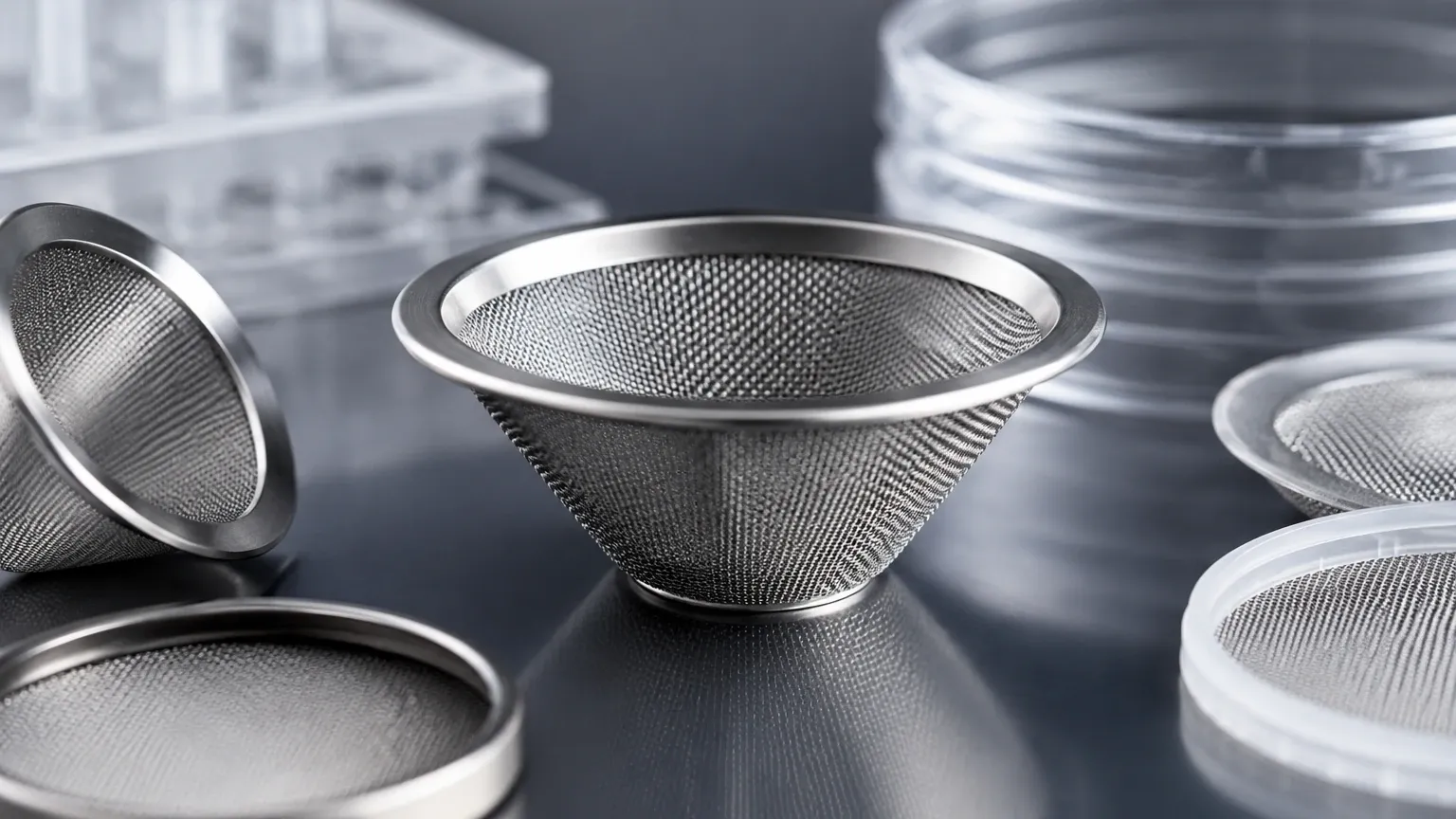
In laboratory settings, cell strainers 70um are frequently made from nylon mesh housed in a plastic frame. While these are cost-effective for small-scale, sterile cell culture work, they have limitations in industrial contexts. Polymers are susceptible to swelling when exposed to certain solvents and may lose structural integrity at elevated temperatures. However, they remain useful in applications where metal contamination must be strictly avoided or where the filtration process is strictly single-use to prevent cross-contamination.
Industrial Applications for Cell Strainers 70um
The application of 70um filtration spans multiple sectors, each with unique requirements for throughput and purity.
Pharmaceutical and Biotechnology
In the production of biologics, 70um strainers are used to remove large cell aggregates, tissue debris, and undissolved powders from media. This is a critical step before finer filtration stages, such as 0.22um sterile filtration. By removing the bulk of larger particles at the 70um stage, the service life of expensive downstream membrane filters is significantly extended.
Food and Beverage Processing
Precision filtration is used to ensure the clarity and consistency of liquid products. In the beverage industry, 70um mesh is often used to strain out pulp, seeds, or spice particulates. In these applications, the material must be food-grade and easy to sanitize to prevent bacterial growth.
Chemical and Petrochemical
In chemical manufacturing, 70um filters protect sensitive equipment, such as spray nozzles and high-pressure pumps, from particulate damage. They are also used in the recovery of catalysts and the purification of fine chemicals where particle size distribution must be tightly controlled.
Key Performance Indicators in Strainer Selection
When specifying 70um filtration components, engineers must evaluate several Key Performance Indicators (KPIs) to ensure the component is fit for purpose.
1. Flow Rate and Pressure Drop: The flow rate is determined by the total open area of the mesh and the viscosity of the fluid. A high pressure drop across the strainer indicates clogging or an undersized filter area, which can lead to pump cavitation or filter failure.
2. Filtration Efficiency: This refers to the percentage of particles larger than 70um that the strainer successfully captures. In high-precision applications, an absolute rating is preferred over a nominal rating, as it guarantees that no particles above the specified size will pass through.
3. Mechanical Strength: The strainer must be able to withstand the maximum operating pressure of the system, including potential pressure spikes. This often involves reinforcing the 70um mesh with a coarser support mesh or a perforated metal cage.
4. Ease of Cleaning: For reusable industrial filters, the ability to restore the mesh to its original flow capacity through cleaning is vital. Smooth surface finishes and high-quality welds prevent particles from becoming permanently trapped in the filter structure.
Integrating 70um Mesh into Industrial Strainers & Baskets
In many industrial systems, the 70um filtration media is integrated into larger Strainers & Baskets assemblies. These assemblies are designed to handle high volumes of fluid while providing a convenient method for removing and cleaning the filter element.
Basket Strainer Configuration
A basket strainer typically consists of a housing with an inlet and outlet, and a removable basket containing the 70um mesh. The basket design provides a large surface area for filtration, which minimizes pressure drop and increases the time between cleaning cycles. For 70um applications, the basket is often constructed with a multi-layer approach: a fine 70um stainless steel inner liner protected by a heavy-duty outer basket made of perforated metal or a coarse mesh.
Y-Strainers and T-Strainers
For inline filtration in piping systems, Y-strainers or T-strainers may be used. These are more compact than basket strainers but have a smaller dirt-holding capacity. When using 70um mesh in these configurations, it is essential to monitor the pressure differential closely, as the smaller surface area can lead to rapid blinding if the particulate load is high.
Maintenance, Sterilization, and Lifecycle Management
To maintain the performance of a 70um cell strainer or industrial filter, a rigorous maintenance schedule is required.
Cleaning Protocols
For stainless steel mesh, ultrasonic cleaning is highly effective at removing particles lodged within the 70um apertures. This process uses high-frequency sound waves to create cavitation bubbles that dislodge contaminants without damaging the fine wires. In chemical applications, solvent cleaning or acid pickling may be used to remove scale or organic deposits, provided the chemical is compatible with the filter material.
Sterilization
In pharmaceutical and food applications, the filter must be sterilized between batches. Stainless steel 70um strainers are ideally suited for Steam-in-Place (SIP) or Clean-in-Place (CIP) procedures. They can withstand the high temperatures and pressures of autoclaving, ensuring that no microbial contamination is carried over between production runs.
Replacement Cycles
Even with regular cleaning, filtration media will eventually show signs of wear, such as mesh deformation, wire thinning, or permanent blinding. Establishing a replacement cycle based on pressure drop trends or visual inspections is critical to preventing catastrophic filter failure, which could result in contaminated product or downstream equipment damage.
Custom OEM Solutions for Precision Filtration
Standard off-the-shelf cell strainers 70um may not always meet the specific requirements of complex industrial systems. Custom OEM solutions allow for the optimization of every aspect of the filter design.
Tailored Dimensions and Fittings
Customization ensures that the strainer fits perfectly within existing housings, preventing bypass and simplifying installation. This includes custom flange types, handle designs for easy removal, and specific basket depths to maximize surface area within a given footprint.
Layered Media for Specific Challenges
In applications with high particulate diversity, a single layer of 70um mesh may clog quickly. Custom-designed filter elements can incorporate graduated filtration layers, where a coarser mesh (e.g., 200um) sits upstream of the 70um layer to remove larger debris, thereby protecting the fine mesh and extending the overall service life of the component.
Quality Assurance and Certification
For regulated industries, custom manufacturers can provide material certifications (such as 3.1b mill certificates), FDA compliance statements for food-contact materials, and documented pressure testing. This level of traceability is essential for maintaining quality standards and meeting regulatory requirements in pharmaceutical and food processing environments.
By focusing on technical precision and material integrity, engineers can successfully implement 70um filtration solutions that enhance process efficiency and product quality. Whether utilized as a standalone cell strainer or integrated into a complex industrial system, the 70um mesh remains a fundamental component in the landscape of modern industrial filtration.
