


Filter Strainer Baskets
In industrial fluid handling systems, the integrity of downstream equipment—such as pumps, valves, flow meters, and heat exchangers—depends heavily on the effective removal of particulate matter. Filter strainer baskets serve as the primary line of defense in these systems. Unlike disposable filter cartridges designed for fine polishing, these baskets are typically engineered for high-capacity solids collection and are designed to be cleaned and reused. For engineers and procurement professionals, selecting the correct basket configuration is a balance of flow dynamics, material compatibility, and structural durability.
As a specialized manufacturer, Kaifil provides a comprehensive range of Strainers & Baskets designed to meet the rigorous demands of chemical processing, food production, and hydraulic applications. Understanding the technical nuances of these components is essential for optimizing system uptime and reducing the total cost of ownership.
The Role of Filter Strainer Baskets in Industrial Filtration
Filter strainer baskets are mechanical components placed within a strainer housing to intercept solid contaminants from a liquid stream. The fluid enters the basket, passes through the filtration media, and exits through the housing outlet, leaving the debris trapped inside the basket.
While the terms "filter" and "strainer" are often used interchangeably, in a B2B engineering context, a strainer is generally defined by its ability to remove larger particles (typically 40 microns and above) with a focus on protecting equipment rather than achieving high-purity sterilization. However, modern filter strainer baskets can be lined with fine stainless steel wire mesh to achieve much higher filtration accuracy, bridging the gap between coarse straining and fine filtration.
Key Functions:
* Equipment Protection: Preventing debris from damaging pump impellers or clogging narrow valve orifices.
* Product Recovery: Capturing valuable solids from a process stream for reprocessing.
* Pre-Filtration: Removing bulk solids to extend the life of more expensive downstream membrane filters or carbon beds.
Engineering Considerations for Material Selection
The environment in which a strainer operates dictates the material requirements. Stainless steel is the industry standard due to its mechanical strength and resistance to corrosion. Kaifil utilizes high-grade alloys to ensure longevity in aggressive environments.
1. Stainless Steel 304
This is the most common material used for industrial baskets. It provides excellent strength and good corrosion resistance for water treatment, hydraulic oils, and general industrial fluids. It is cost-effective for applications where extreme chemical resistance is not required.
2. Stainless Steel 316L
For applications involving salt water, chlorides, or acidic chemicals, 316L stainless steel is preferred. The addition of molybdenum enhances its resistance to pitting and crevice corrosion. This material is also the standard for the pharmaceutical and food and beverage industries because it can withstand rigorous Clean-in-Place (CIP) chemicals and high-temperature sterilization.
3. Specialty Alloys
In extreme cases involving highly corrosive media or cryogenic temperatures, specialty alloys like Monel or Hastelloy may be employed. These are reserved for environments where standard stainless steel would suffer from rapid degradation.
Technical Specifications: Mesh vs. Perforation
One of the most critical decisions in specifying filter strainer baskets is the choice of filtration media. The media determines the "cut point" or the size of the smallest particle the basket will reliably capture.
Perforated Metal Baskets
Perforated metal serves as the structural foundation for most baskets. It consists of a metal sheet with punched holes, usually ranging from 1/32" to 1/2" in diameter.
* Pros: Extremely durable, high structural integrity, easy to clean.
* Cons: Limited to coarse filtration; cannot capture fine silts or sands.
Wire Mesh Lined Baskets
When finer filtration is required, a stainless steel wire mesh is welded to the inside or outside of the perforated metal support. This allows for filtration ratings down to 5 microns.
* Plain Weave: The most common mesh, offering a straight-through flow path.
* Dutch Weave: A denser weave that provides higher strength and finer filtration levels, often used in high-pressure applications.
The Importance of Open Area Ratio
A critical engineering metric is the "Open Area Ratio." This is the ratio of the total area of the holes in the basket to the cross-sectional area of the inlet pipe. A well-designed basket typically offers an open area ratio of at least 6:1. A higher ratio ensures that even as the basket begins to fill with debris, the pressure drop ($ΔP$) remains low, preventing system cavitation and reducing energy consumption by the pump.
Customization and Design Variations
No two industrial processes are identical, which is why customization is a core service at Kaifil. Standard off-the-shelf baskets may not fit specialized housings or handle unique flow characteristics.
Basket Geometry
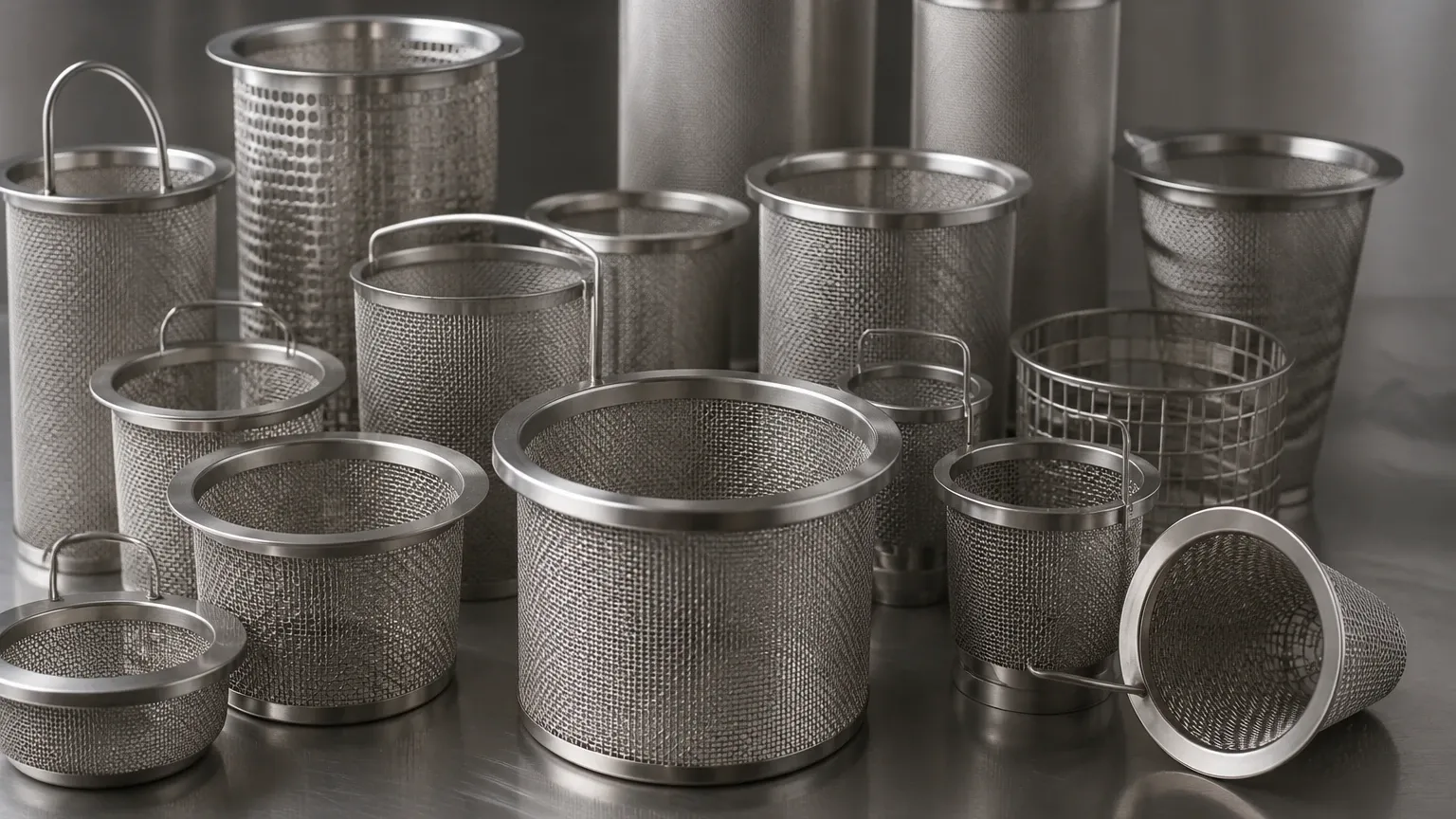
* Slant-Top Baskets: Designed for easy removal in angled strainer housings.
* Flat-Bottom Baskets: The standard for vertical housings, providing maximum volume for solids collection.
* Pleated Baskets: For applications with high solids loading, pleating the mesh increases the surface area significantly, allowing for longer run times between cleaning cycles.
Reinforcement and Structural Support
In high-pressure systems or applications with high-viscosity fluids (such as resins or heavy oils), the basket must withstand significant differential pressure. We incorporate heavy-duty support cages, longitudinal stiffeners, and reinforced bindings to prevent basket collapse or "blow-by," where the media bypasses the seal.
Handle and Seal Options
To facilitate maintenance, baskets can be equipped with various handle types, including fixed bars, folding handles, or even magnetic inserts to capture fine ferrous particles. Sealing is equally important; we offer precision-machined flanges or O-ring grooves (using Viton, EPDM, or PTFE) to ensure a bypass-free fit within the housing.
Industry-Specific Applications
Chemical and Petrochemical
In these sectors, filter strainer baskets must handle aggressive solvents and high temperatures. They are used to protect sensitive instrumentation and ensure that catalysts are not contaminated by pipe scale or weld slag.
Food and Beverage
Hygiene is the priority here. Baskets must feature smooth welds (often electropolished) to eliminate crevices where bacteria could grow. They are used to strain fruit pulps, seeds, and hop residues in breweries.
Water Treatment and Desalination
Large-scale water intake systems use heavy-duty baskets to remove aquatic life, leaves, and debris before the water reaches membrane filtration units. Corrosion resistance to brackish water is a key requirement.
Pharmaceutical and Biotech
Precision is paramount. These baskets often require 316L stainless steel with full traceability and high-polish finishes to meet FDA and cGMP standards.
Maintenance, Cleaning, and Replacement Cycles
The longevity of a stainless steel filter basket is one of its primary advantages over disposable media, but it requires a disciplined maintenance approach.
Monitoring Pressure Drop
Systems should be equipped with differential pressure gauges. A common rule of thumb is to clean the basket when the pressure drop reaches 5-10 psi over the clean-start pressure. Allowing the $ΔP$ to climb too high risks deforming the basket or forcing contaminants through the mesh.
Cleaning Procedures
* Manual Cleaning: Removing the basket and using a high-pressure water jet or steam. It is vital to clean from the "clean side" to the "dirty side" (backwashing) to dislodge particles trapped in the mesh.
* Ultrasonic Cleaning: For baskets used with resins or adhesives, ultrasonic baths can remove deeply embedded contaminants that manual washing cannot reach.
* Chemical Soaking: Using compatible solvents to dissolve organic buildup.
When to Replace
While durable, baskets are not permanent. They should be inspected for:
* Mesh Fraying: Small breaks in the wire mesh that allow bypass.
* Structural Distortion: Any bowing or warping of the perforated support.
* Seal Integrity: Damage to the flange or seating surface that prevents a tight seal.
Total Cost of Ownership (TCO) Analysis
When evaluating filter strainer baskets, the initial purchase price is only one component of the TCO. Engineers must also consider:
1. Downtime Costs: How long does it take to swap or clean the basket? Quick-release handles and high-capacity designs reduce this.
2. Energy Consumption: A basket with a low open area ratio increases the load on pumps. Over a year, the extra electricity costs can far exceed the cost of a higher-quality, high-flow basket.
3. Disposal Costs: Unlike disposable filters, stainless steel baskets generate zero waste, making them the more sustainable and cost-effective choice for long-term operations.
Critical Information for Procurement and Specification
Before initiating a custom order for filter strainer baskets, technical teams should confirm the following data points to ensure the final product meets application requirements:
* Fluid Characteristics: Viscosity, temperature, and chemical composition.
* Flow Rate: Minimum, normal, and maximum gallons per minute (GPM).
* Contaminant Profile: What is the nature of the solids? (Hard/abrasive, soft/deformable, or fibrous?)
* Housing Dimensions: Precise measurements of the basket seat, height, and diameter are required for a bypass-free fit.
* Required Micron Rating: The specific size of the smallest particle that must be removed.
By focusing on these technical parameters, engineers can ensure they select a filtration solution that provides reliable protection and optimized performance. Kaifil’s expertise in custom stainless steel manufacturing allows us to deliver high-performance filtration components that stand up to the most demanding industrial environments.
For detailed technical specifications or to discuss a custom design for your specific application, Review product options and application support to find the ideal solution for your filtration needs.
