


Flair Strainers & Filters
In industrial fluid handling and process engineering, the integrity of downstream equipment depends heavily on the efficiency of primary filtration stages. Components such as pumps, flow meters, and control valves are susceptible to damage from suspended solids and debris. To mitigate these risks, engineers rely on robust mechanical separation tools. Among the most critical of these are flair strainers & filters, which provide the necessary interface between raw fluid intake and refined process requirements.
Understanding the technical nuances of these components is essential for maintaining system uptime and ensuring product quality across sectors ranging from chemical processing to food and beverage production. This guide examines the engineering principles, material considerations, and selection criteria for high-performance Strainers & Baskets, focusing on how they integrate into demanding industrial environments.
The Engineering Distinction Between Strainers and Filters
While the terms are often used interchangeably in casual conversation, process engineers distinguish between strainers and filters based on their application and the size of the particles they are designed to remove.
Mechanical Straining
A strainer is typically a coarse filtration device designed to remove larger particles—usually measured in mesh sizes or millimeters—from a liquid or gas stream. Strainers are often installed as permanent components of a piping system. They are designed for low pressure drop and high flow rates, acting as a "safety net" for expensive machinery.
Fine Filtration
Filters, conversely, are engineered to remove much smaller contaminants, often measured in microns. While flair strainers & filters can bridge this gap through multi-layered mesh designs, the primary function of a strainer remains the protection of the system from catastrophic debris. In many industrial setups, a basket strainer acts as a pre-filter, extending the life of more expensive fine-filtration cartridges downstream.
Technical Specifications of Flair Strainers & Filters
When evaluating flair strainers & filters, engineering teams must look beyond basic dimensions. The performance of these units is dictated by several technical variables that influence flow dynamics and structural integrity.
Material Selection and Corrosion Resistance
Stainless steel is the industry standard for high-performance filtration due to its mechanical strength and resistance to oxidation.
* SS304: Suitable for general industrial applications, water treatment, and non-corrosive chemical environments.
* SS316/316L: Preferred for pharmaceutical, food and beverage, and marine applications where resistance to chlorides and acidic environments is required.
* Specialty Alloys: For extreme environments involving high temperatures or highly aggressive chemicals, alloys like Hastelloy or Monel may be utilized in the construction of the basket and housing.
Mesh and Perforation Configurations
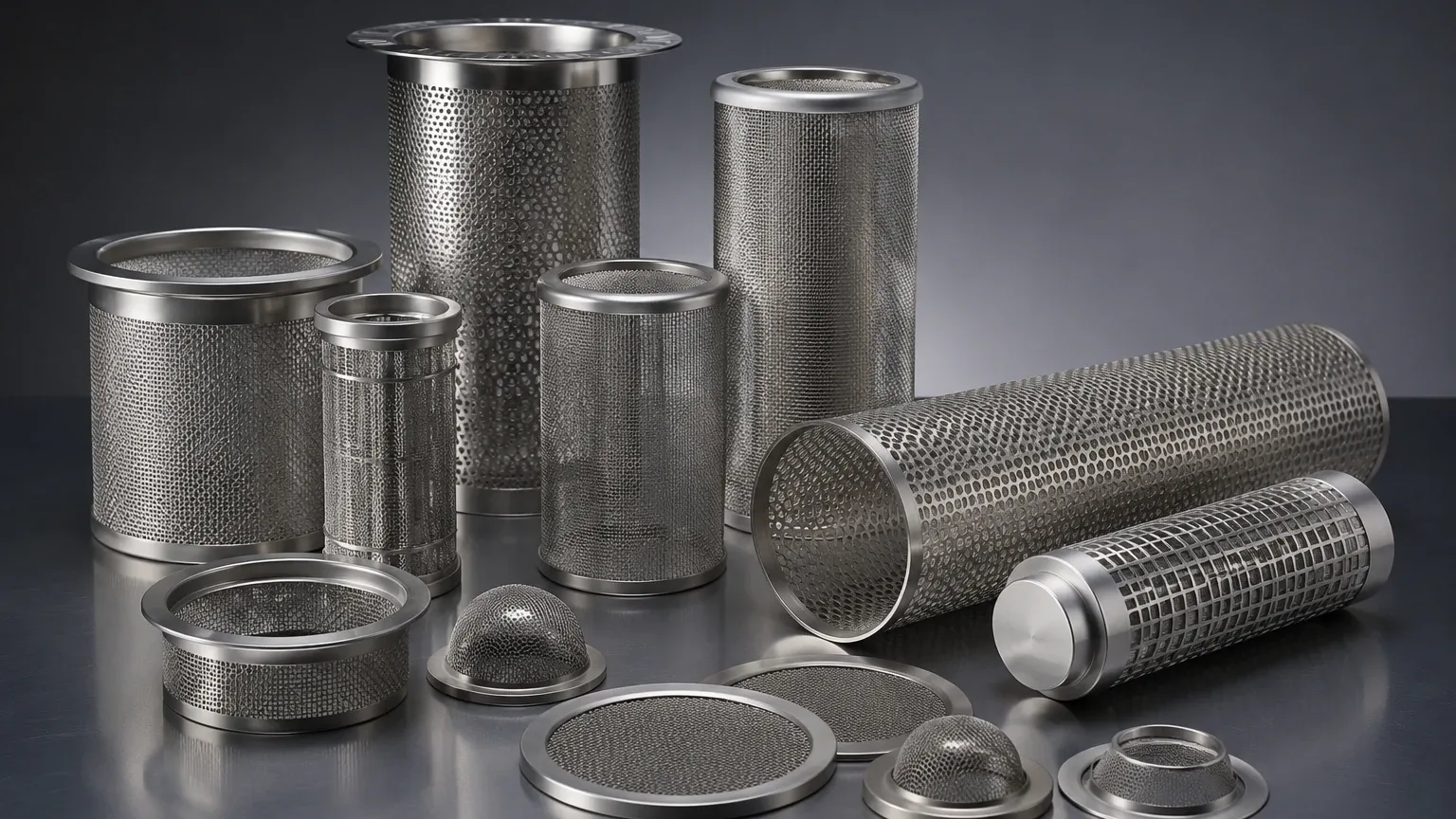
The heart of the strainer is the basket or element. These are typically constructed using either perforated metal or woven wire mesh.
* Perforated Metal: Provides the structural skeleton for the strainer. The hole size and staggered pattern determine the initial screening capability.
* Wire Mesh Liners: For finer filtration requirements, a stainless steel wire mesh is sintered or welded to the interior of the perforated basket. This allows for precise micron ratings while maintaining the mechanical strength needed to withstand high differential pressures.
Key Design Variants in Industrial Strainers
The physical configuration of the strainer housing and the internal basket determines how easily the system can be maintained and how much fluid it can process before requiring cleaning.
Simplex Strainers
Simplex designs are used in batch processes or systems where the flow can be intermittently stopped for cleaning. They consist of a single chamber and basket. While cost-effective, they lack the redundancy required for continuous 24/7 operations.
Duplex Strainers
For applications that cannot afford downtime, such as hydraulic systems or continuous chemical reactors, duplex strainers are the standard. These units feature two separate chambers connected by a diverter valve. When one basket reaches its maximum dirt-holding capacity, the flow is switched to the clean chamber, allowing the operator to service the dirty basket without interrupting the process.
Y-Strainers vs. Basket Strainers
Y-strainers are typically used for steam or high-pressure gas lines where the amount of debris is minimal. However, for liquid applications with higher solids loading, flair strainers & filters in a basket configuration are superior. Basket strainers offer a larger surface area, resulting in lower pressure drops and longer intervals between cleaning cycles.
Performance Evaluation: Pressure Drop and Flow Rate
One of the most critical factors in selecting flair strainers & filters is the "Clean Pressure Drop" (Delta P). Every filtration component introduces resistance to the flow. If the pressure drop is too high, it can lead to cavitation in pumps or insufficient flow to critical process stages.
The 6:1 Ratio Rule
In high-quality basket strainer design, the open area of the strainer basket should ideally be at least six times the cross-sectional area of the inlet pipe. This "6:1 ratio" ensures that even as the basket begins to collect debris, the pressure drop remains within acceptable limits for a longer period.
Viscosity Considerations
The viscosity of the fluid significantly impacts the performance of strainers. Thicker fluids, such as oils or syrups, require larger mesh openings or increased surface areas to maintain the same flow rate as water. Engineers must calculate the corrected pressure drop based on the fluid's specific gravity and centipoise (cP) rating.
Applications Across Critical Industries
Customized filtration solutions are not a luxury but a necessity in regulated industries. The versatility of stainless steel flair strainers & filters makes them indispensable in several sectors:
* Chemical Processing: Protecting reactors and heat exchangers from scale and particulate matter that could catalyze unwanted side reactions or clog narrow passages.
* Food and Beverage: Ensuring product purity by removing oversized particles or accidental contaminants. In these applications, "sanitary" designs with polished surfaces and no dead zones are required to prevent bacterial growth.
* Pharmaceuticals: Utilizing high-grade SS316L components that can withstand rigorous Clean-in-Place (CIP) and Steam-in-Place (SIP) sterilization cycles.
* Water Treatment: Acting as pre-filtration for Reverse Osmosis (RO) membranes, removing sand, grit, and organic debris that would otherwise foul delicate membrane surfaces.
Customization and OEM Capabilities
Off-the-shelf solutions rarely meet the exact requirements of complex industrial systems. This is where the value of a specialized manufacturer like Kaifil becomes apparent. Customization options for flair strainers & filters include:
1. Custom Dimensions: Tailoring the height, diameter, and flange connections to fit into existing piping footprints where space is constrained.
2. Reinforced Baskets: For high-pressure applications, baskets can be reinforced with external rings or heavy-duty mesh to prevent collapsing under high differential pressure.
3. Magnetic Inserts: Adding magnetic rods to the center of the basket to capture fine ferrous particles that might otherwise pass through the mesh.
4. Specialty Coatings: Applying PTFE or other linings for enhanced chemical resistance or to prevent sticky substances from adhering to the mesh.
Maintenance and Total Cost of Ownership (TCO)
When purchasing industrial filtration components, the initial acquisition cost is only one part of the equation. The Total Cost of Ownership (TCO) includes maintenance labor, downtime, and the cost of replacement parts.
Cleaning Cycles
Unlike disposable cartridge filters, stainless steel flair strainers & filters are designed to be cleaned and reused. This significantly reduces long-term operational costs and waste. Maintenance teams should monitor the differential pressure across the strainer. A common rule of thumb is to clean the basket when the pressure drop reaches 5-10 psi above the clean pressure drop.
Durability and Longevity
A well-engineered stainless steel basket can last for years, provided it is not subjected to pressures beyond its design limit or cleaned using abrasive methods that damage the wire mesh. Investing in high-quality construction upfront prevents the frequent replacement of warped or torn baskets, which can lead to downstream equipment failure.
Critical Questions for Engineers Before Purchase
Before finalizing a specification for flair strainers & filters, purchasing and engineering teams should confirm the following:
* What is the maximum allowable pressure drop? Ensure the pump head is sufficient to overcome the resistance of a partially fouled strainer.
* What are the fluid characteristics? Confirm chemical compatibility with the housing and gasket materials (EPDM, Viton, PTFE).
* Is the flow continuous or batch? This determines whether a simplex or duplex configuration is necessary.
* What is the particle size distribution? Selecting a mesh that is too fine will lead to frequent clogging, while a mesh that is too coarse will fail to protect downstream equipment.
Conclusion
Selecting the right flair strainers & filters is a balance of material science, fluid dynamics, and operational practicalities. By focusing on high-quality stainless steel construction and precise engineering specifications, industrial facilities can achieve reliable filtration performance that protects their most valuable assets. Whether for a standard water line or a complex chemical reactor, the right strainer is a fundamental component of a successful process design.
For technical assistance or to explore specialized configurations, reviewing professional Strainers & Baskets options can provide the necessary data to make an informed engineering decision.
